Table of Contents
Overview
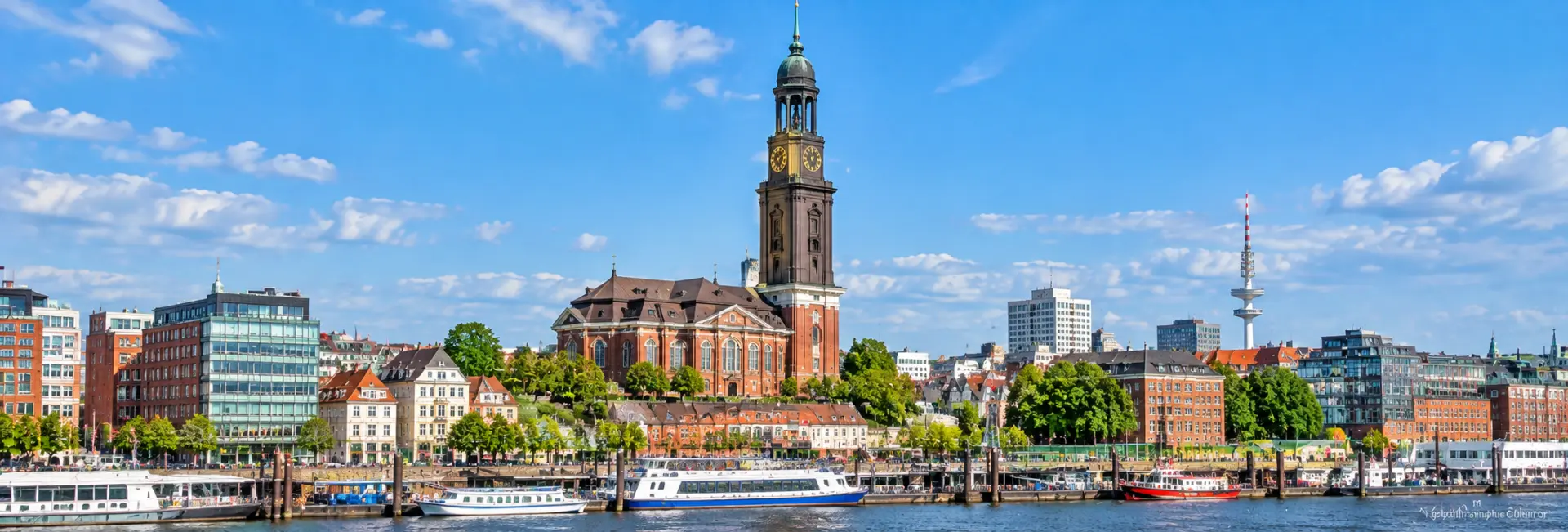
Rising above Hamburg's Neustadt district, St. Michael's Church has watched over the city and its harbour for more than three centuries. Known to everyone in Hamburg simply as "the Michel," it is the largest of the city's five Lutheran main churches and, by wide agreement, its most instantly recognisable building. Sailors once used its copper-clad spire to navigate the final stretch of the Elbe into port, and the tower still dominates the skyline today, visible from the water, the old town, and most of the surrounding districts.
The church is as much a working place of worship as it is a monument. Services, weddings, and organ recitals continue inside a building that has twice been rebuilt from near-total destruction, and its 132-metre tower remains one of the most popular viewpoints in northern Germany. Beyond the view, visitors come for the scale of the baroque interior, the roll call of organs packed into its galleries, and a history that traces Hamburg's own transformation from a fortified merchant town to a modern port city.
History
A Cemetery Chapel Becomes a Parish Church
St. Michael's beginnings were modest. Around 1600, a small chapel was built beside a cemetery just outside Hamburg's fortifications, and within a few years it had been enlarged into a proper church to serve the growing population outside the old walls. When the city expanded and laid out the new district of Neustadt inside a fresh ring of fortifications in 1625, the young parish found itself absorbed into the city proper, and its congregation quickly outgrew the small building.
The First Great Church and Its Destruction
Construction of a much larger church on a new site began in 1647, under the direction of the architects Christoph Corbinus and, after his death, Peter Marquard. The building was consecrated in 1661, though it stood without its tower for several more years. By the 1680s the parish had grown important enough that the church was elevated to the rank of Hauptkirche, joining Hamburg's four older main churches. This first great St. Michael's stood for less than a century: on 10 March 1750, a lightning strike set the building alight, and it burned to the ground.
Rebuilding in the Baroque Style
The loss was significant enough that the congregation worshipped in the smaller neighbouring "Kleiner Michel" chapel while a replacement was designed. Architects Johann Leonhard Prey and Ernst Georg Sonnin drew up plans for a new church in the baroque style, and construction ran from 1751 to 1762. Sonnin then spent more than a decade on the tower itself, a freestanding timber structure sheathed entirely in copper, which was finally completed in 1786. It is this design, largely unchanged in outline, that still defines the Michel today.
Two More Disasters, Two More Rebuildings
The 20th century tested the church again. In 1906, workers using a blowtorch to repair the copper roof accidentally started a fire that destroyed the tower and much of the structure, killing a tower watchman in the process. Hamburg's residents pledged to rebuild it true to the original design, this time using steel and concrete behind the historic brick and sandstone facade, and the reconstructed church reopened in 1912. Barely three decades later, Allied bombing raids in 1943 and 1944 badly damaged the building once more. Repairs continued through the late 1940s, and the restored church was reconsecrated in 1952. Further restoration campaigns addressed the tower structure in the 1980s and 1990s, the crypt in 2007, and the copper roof and interior in 2008 and 2009.
Architecture & Design
St. Michael's is built on a Latin cross plan, roughly 52 metres long, 44 metres wide, and 27 metres to the ceiling of the nave, making it the largest church interior in Hamburg with room for around 2,500 people. The exterior combines red brick with sandstone dressings in the late baroque style typical of Hanseatic Protestant churches of its era, favouring restrained ornament over the elaborate stonework of Catholic baroque architecture further south in Germany.
The tower is the building's defining feature: a freestanding structure rising to 132 metres, clad from base to spire in copper sheeting that has weathered to its familiar green-grey patina. Set into the tower is the largest church clock face in Germany, visible from a considerable distance across the city and harbour. Above the main portal, a large gilded bronze statue depicts the Archangel Michael triumphing over the devil, the scene from which the church takes its name and its emblem.
Inside, the mood shifts from the tower's weight to something lighter: white plaster walls, gilded accents, and tiered galleries create an airy, almost theatrical space quite different from the heavier stone interiors of many older European cathedrals. The marble pulpit, carved in 1910 by the sculptor Otto Lessing, is shaped like a rounded chalice reached by a sweeping staircase, and stands at the centre of the nave rather than to one side, reflecting the Lutheran emphasis on preaching.
The Tower & Panoramic Views
Climbing the tower is the main reason many visitors come to the Michel in the first place. An observation platform sits at roughly 82 metres, well below the tip of the spire but still high enough for a genuinely sweeping 360-degree view across the Elbe, the harbour, the Speicherstadt warehouse district, and the rooftops of the old town. On clear days the view extends well beyond the city centre toward the surrounding countryside.
Visitors can reach the platform either by climbing a staircase of several hundred steps, passing close to the church's large bells along the way, or by taking a lift that covers most of the ascent after a short initial flight of stairs. Both routes are open during normal visiting hours, and the church also periodically opens the tower after dark for an illuminated night view over the city.
- The tower has functioned as a landmark for sailors navigating the Elbe since the 17th century
- A tower trumpeter still plays a chorale toward all four points of the compass each morning and evening, a tradition maintained for more than 300 years
- The tower and its bells are original features of the rebuilt structure, following the same footprint used since the 18th-century design
Cultural & Religious Significance
As one of Hamburg's five historic Hauptkirchen, St. Michael's has been a central institution of the city's Lutheran life since the 17th century, and it remains an active parish church of the Evangelical Lutheran Church in Northern Germany today. Unlike several of Hamburg's other main churches, which began as Catholic foundations before the Reformation, St. Michael's was built as a Protestant church from the outset, giving its design and liturgical layout a distinctly Lutheran character from the start.
The church also carries personal significance for Hamburg's most famous composer: Johannes Brahms was baptised at St. Michael's in 1833 and later confirmed there as a teenager. That connection, along with the church's long musical tradition, has helped make the Michel a natural home for concerts, choral performances, and organ recitals that draw on the building's exceptional acoustics.
Beyond religious life, the church functions as a civic symbol. Its survival through two catastrophic fires and the bombing of Hamburg during the Second World War, followed each time by community-funded rebuilding, has turned the Michel into a recognised emblem of the city's resilience, referenced in local identity well beyond its congregation.
Notable Features
The Organs
St. Michael's houses five organs spread across its nave and galleries, a rare concentration even by the standards of major European churches. The largest, on the west gallery, has thousands of pipes across dozens of registers, while two further instruments sit on the side galleries and additional organs serve the crypt and choir. Regular recitals make use of the building's reverberant acoustics, and concerts combining several of the organs at once are a particular highlight for visiting music lovers.
The Crypt
Beneath the nave, the church's crypt has been reworked into an exhibition space that traces both the building's own history and Hamburg's broader story across roughly a thousand years. It offers a quieter, more contemplative counterpoint to the busy tower and main hall above.
Bells and Clock
The tower carries a set of large bells alongside Germany's largest church clock face, both original to the post-1912 rebuilding and maintained as working instruments rather than static decoration.
Visiting Etiquette & Tips
St. Michael's is a functioning parish church as well as a major tourist attraction, so services and rehearsals occasionally affect access to parts of the building; checking the current schedule before a visit helps avoid disappointment, particularly around major religious holidays. Quiet, respectful behaviour is expected in the nave at all times, and photography without flash is generally welcomed in the main body of the church.
- The tower involves either several hundred steps or a lift with a short initial staircase, so plan accordingly if mobility or stamina is a concern
- Layers are worth bringing even in summer, since the open-air viewing platform can be windy
- Tower and crypt admission typically carries a separate fee from general church entry, which is usually free
- Current opening hours, ticket prices, and any temporary closures are best confirmed on the church's official website shortly before visiting, since these details change over time
Best Time to Visit
Early morning is the quietest time to climb the tower, before tour groups arrive from the nearby harbour and old town, and it also offers the clearest light for photographs across the Elbe. Late afternoon brings warmer, golden-hour views, while the church's periodic night openings give a completely different, illuminated perspective over the city.
Seasonally, spring and autumn tend to offer a comfortable balance of manageable crowds and reasonable weather for the open-air platform, while midsummer afternoons can be busy with cruise passengers and day-trippers visiting the harbour area. Clear days are worth prioritising over convenience of scheduling, since the view is the main draw of a tower visit and is far less rewarding in fog or heavy cloud.
Nearby Attractions
The Michel sits within easy walking distance of several of Hamburg's best-known sights, making it a natural anchor for exploring the old town and harbour on foot.
- Krameramtsstuben, a row of preserved 17th-century merchants' guild houses, stands directly beside the church and now houses small shops and a historic restaurant
- The Landungsbrücken piers and harbour promenade are a short walk toward the Elbe, offering boat tours and views across to the container port
- The Speicherstadt warehouse district and the Elbphilharmonie concert hall lie within a comfortable walking route along the waterfront
- St. Pauli and the Reeperbahn nightlife district border the area to the west, a contrast to the Michel's more solemn atmosphere
- The Fischmarkt, Hamburg's historic riverside fish market, is easily combined with a morning visit to the church
FAQs about visiting St. Michael's Church (the Michel)
What is St. Michael's Church best known for? +
It is best known for its 132-metre copper-clad tower, one of Hamburg's most recognisable landmarks and long used as a navigation point for ships on the Elbe, as well as for its grand baroque interior and collection of five organs.
How many steps are there to the top of the tower? +
Visitors can either walk a staircase of several hundred steps or take a lift for most of the ascent after a short initial flight of stairs, so both fit and less mobile visitors have a practical option.
Is entry to the church free? +
General entry to the main body of the church is typically free, while climbing the tower and visiting the crypt usually require a separate paid ticket; current prices are best checked on the official website.
How long should I plan for a visit? +
A brisk visit covering the interior and tower takes about 45 minutes to an hour, though allowing closer to two hours gives time to also see the crypt exhibition and linger at the viewing platform.
Is the tower suitable for children or visitors with mobility limitations? +
Children generally manage the climb well, and the lift option makes the platform accessible to most visitors with limited mobility, though the final approach to the platform itself involves some stairs.
What is the tower trumpeter tradition? +
A trumpeter plays a chorale toward all four points of the compass from the tower each morning and evening, a custom that has continued at St. Michael's for more than 300 years.
What's the best time of day to visit for views? +
Early morning tends to be quietest with clear light, while late afternoon offers warmer tones; the church's occasional night openings provide an illuminated view unlike anything available during the day.
What else is nearby worth combining with a visit? +
The historic Krameramtsstuben houses sit right beside the church, and the Landungsbrücken harbour piers, Speicherstadt warehouse district, and Elbphilharmonie are all within comfortable walking distance.