Table of Contents
Overview
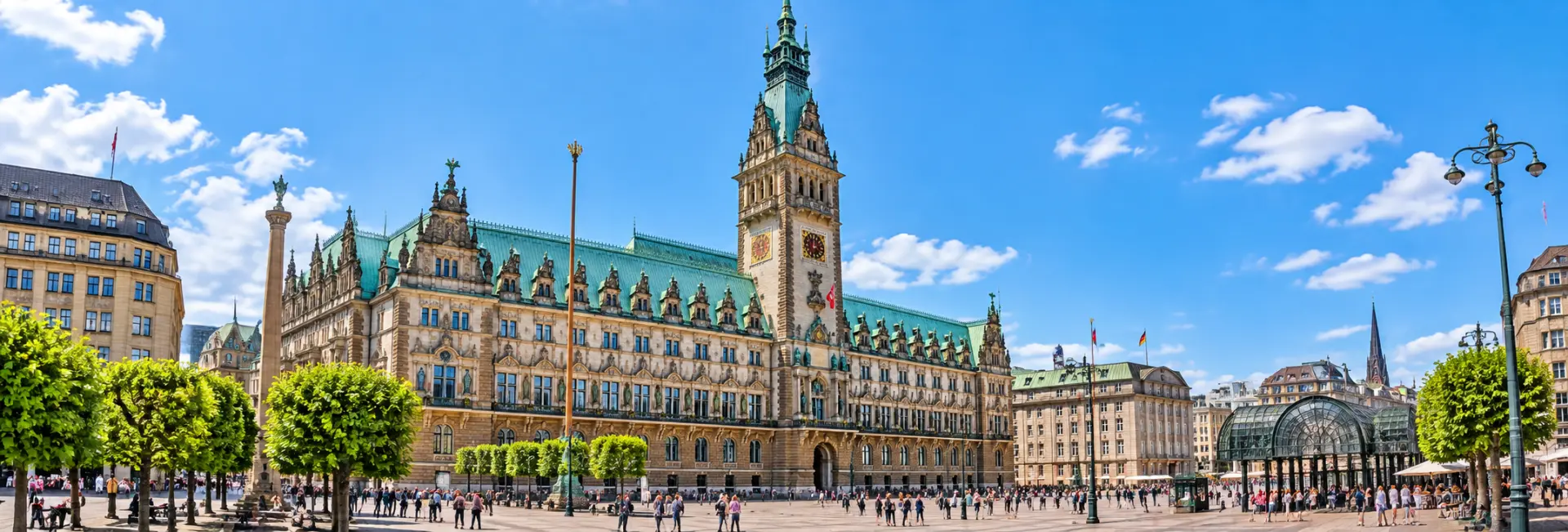
Hamburg Rathaus anchors the city's historic center with a scale that still surprises first-time visitors: a sprawling sandstone building topped by a 112-metre tower, wrapped in statues, mosaics, and carved facades, and built at a moment when Hamburg wanted the world to notice its wealth. It remains the working seat of the city's senate and parliament, so it is a functioning government building as much as a sightseeing stop.
The building faces Rathausmarkt, a wide open square that hosts markets, concerts, and Christmas fairs throughout the year, and it stands just a short walk from the Binnenalster lake and Hamburg's main shopping streets. Much of the interior, including a quiet inner courtyard, is open to the public free of charge, making it one of the easiest grand buildings in the city to actually step inside.
Few visitors expect a city hall to be quite this ornate. Every surface, from the balcony mosaics to the carved sandstone columns in the entrance, was designed to tell a story about Hamburg's history and self-image as an independent, prosperous Hanseatic city, and that density of detail rewards a slow look rather than a quick photo stop.
History
Replacing a Building Lost to Fire
The Rathaus that stands today replaced an older town hall destroyed in the Great Fire of Hamburg in 1842. Rebuilding took decades to agree on, partly because the site itself, low-lying ground near the Alster canals, needed to be stabilized before construction could even begin. The first stone for the new building was laid on 6 May 1886.
A Building Meant to Announce Prosperity
Seven architects working together as the Rathausbaumeisterbund, with Martin Haller taking the lead role, designed the new city hall during a period of rapid growth for Hamburg following German unification. The building was conceived deliberately as a statement of civic wealth and independence, mixing Renaissance, Gothic, and Baroque details across a sandstone facade meant to rival the grandest town halls elsewhere in Europe.
Opening and the Twentieth Century
The Rathaus was inaugurated on 26 October 1897, when First Mayor Johannes Versmann formally received the building's key. It has served continuously as the seat of Hamburg's senate and parliament ever since, surviving the twentieth century's upheavals largely intact and hosting state visits from figures including Emperor Haile Selassie I and, in 1965, Queen Elizabeth II.
That continuity is unusual for a major European city building of its age. While much of Hamburg's historic core suffered heavy damage during the Second World War, the Rathaus escaped the kind of destruction that leveled other parts of the Altstadt, which is part of why it remains one of the most completely preserved examples of its architectural period still standing in the city today.
Architecture & Design
The Rathaus is built in a Neo-Renaissance style outside, with Gothic and Baroque flourishes woven into the interior decoration, and it is considered one of the few completely preserved examples of historicist architecture left standing in Hamburg. The tower rises 112 metres above Rathausmarkt, reachable by 436 steps, and its green copper roof, discolored by more than a century of weathering, has become one of the most recognizable outlines on the city's skyline.
Above the main balcony sits a mosaic of Hammonia, Hamburg's patron goddess, alongside the city's coat of arms and a Latin motto reminding future generations to guard the freedom won by their predecessors. Twenty statues of Holy Roman and German emperors line the facade, and sixteen sandstone columns inside the entrance carry carved portraits of 68 notable citizens from the city's history.
A popular claim holds that the Rathaus has more rooms than London's Buckingham Palace, but the comparison actually runs the other way: the building holds 647 rooms across roughly 17,000 square metres, fewer than the palace's count, even though the misconception persists in a lot of tourist material.
Inside, the historicist exterior gives way to a deliberate mix of period styles rather than a single consistent theme, with Gothic vaulting, Baroque ceiling paintings, and Renaissance-influenced woodwork appearing in different rooms depending on the ceremonial purpose each space was designed for. That variety was intentional, letting the building reference several centuries of European civic architecture at once rather than committing to just one.
Recognition & Notable Moments
Hamburg Rathaus is protected as a heritage-listed building and stands as one of the city's most complete surviving works of nineteenth-century historicist architecture. Beyond its architectural standing, the building has hosted a long list of state visits and civic moments that have made it a recurring backdrop in the city's modern history.
- Heritage-protected as one of Hamburg's most intact historicist buildings
- Hosted state visits from Emperor Haile Selassie I, the Shah of Iran, and Queen Elizabeth II in 1965
- Site of a public memorial service on Rathausmarkt for victims of the 1962 North Sea flood
- A room discovered by accident in the tower in 1971, long after the official 647-room count was fixed, suggesting the true total may be higher
Inside the Rathaus
Public Spaces
The entrance hall, with its sandstone pillars, carved portraits, and Sardinian marble staircase, is open to visitors and regularly used for concerts and exhibitions. From here, a passage leads through to the inner courtyard, centered on the Hygieia fountain, a bronze figure representing the Greek goddess of health, built to commemorate the devastating cholera epidemic that struck Hamburg in 1892.
The Kaisersaal and Parliament Chambers
The Kaisersaal, or Emperor's Hall, is the building's second-largest ceremonial room and is decorated with an elaborate painted ceiling. Elsewhere in the building, the Bürgerschaft debating chamber hosts Hamburg's state parliament in weekly sessions, and the Senate's own meeting rooms and the mayor's office, home to the city's ceremonial Golden Book, remain in active government use.
Because these are working government spaces rather than a museum set piece, the rooms open to visitors can shift depending on the day's parliamentary or ceremonial schedule. Tour groups are generally routed around active meetings, which means the exact sequence of rooms seen on a guided visit can vary slightly from one day to the next.
Ways to Experience It
Much of the Rathaus can be seen without a ticket, since the entrance hall and courtyard are open to anyone during the building's public hours. Seeing the more ornate ceremonial rooms, however, generally requires joining a tour.
- Free, self-guided access to the entrance hall and inner courtyard
- Guided interior tours, typically offered in German and English several times a day
- Public concerts and exhibitions held periodically in the entrance hall
- Viewing the Bürgerschaft debating chamber in session, on the days parliament meets
- A restaurant in the building's lower level, open to visitors independent of the tours
Tour languages and departure times can vary by season, so it's worth checking current availability before planning the rest of a day around a specific slot. Visitors with a looser schedule can simply drop by the entrance hall, since it requires no reservation and gives a genuine sense of the building's scale even without joining a tour.
Best Time to Visit
The Rathaus is a working government building, so tours can be paused or cancelled on short notice for official events, parliamentary sessions, or state visits. Weekday mornings tend to offer the most reliable access to the interior, since afternoons and event days carry a higher chance of closures.
Rathausmarkt itself is worth timing separately from the building tour. The square hosts a Christmas market in the weeks before the holidays and various concerts and public events throughout the year, so visiting during one of these periods adds an extra layer to a walk around the building even if the interior tour isn't running.
Outside of special events, the square tends to be at its calmest early on weekday mornings, before shoppers and office workers fill the surrounding streets. Later afternoons can bring long shadows across the facade that make for striking photographs, particularly on a clear day.
Visitor Tips
A visit to the entrance hall and courtyard alone can take fifteen or twenty minutes, while a full guided tour of the interior runs closer to forty-five minutes to an hour.
- Check the current tour schedule before arriving, since sessions and official use can change availability with little notice
- Bring photo identification if joining a guided tour, as security checks are common for government buildings
- The tower itself is not generally open for public climbing, so treat it as a photo subject from the square rather than a viewpoint to visit
- Rathausmarkt gets busy during lunch hours and market events, so early morning is easiest for photographing the facade without crowds
- Combine a visit with the nearby Alster lake for a walk immediately afterward, since it's only a few minutes on foot
- Keep an eye out for the Hygieia fountain in the courtyard even on a short visit, since it's easy to miss from the main entrance hall alone
Nearby Attractions
The Rathaus sits at the edge of Hamburg's historic Altstadt, within easy walking distance of several of the city's other central landmarks and waterways.
- Binnenalster lake, a short walk north with paths and boat tours along the water
- Speicherstadt warehouse district and the Elbphilharmonie, both reachable on foot to the south
- Hamburg's main shopping streets around Jungfernstieg and Mönckebergstrasse
- St. Nikolai memorial, a former church tower left as a war memorial nearby
- Hamburg Hauptbahnhof (main train station), a few minutes away by foot or public transport
FAQs about visiting Hamburg Rathaus
What is Hamburg Rathaus? +
It's Hamburg's city hall, a grand nineteenth-century sandstone building on Rathausmarkt square that serves as the seat of the city's senate and parliament and is open in part to the public.
Is it free to visit the Rathaus? +
The entrance hall and inner courtyard are free to enter and explore. Guided tours of the more ornate ceremonial rooms may carry a small charge depending on the current schedule.
Does the Rathaus really have more rooms than Buckingham Palace? +
No, that's a popular misconception. The Rathaus has 647 rooms, which is actually fewer than Buckingham Palace's count, even though many guides repeat the claim in reverse.
Can I go up the tower? +
No, the 112-metre tower is not generally open to the public for climbing, so it's best appreciated from Rathausmarkt or nearby streets.
How long should I plan for a visit? +
Fifteen to twenty minutes covers the free public areas, while a full guided interior tour typically runs closer to forty-five minutes to an hour.
Can tours be cancelled without notice? +
Yes, since the Rathaus is a working government building, tours can be paused for parliamentary sessions, state visits, or other official events, so it's worth checking the schedule shortly before arriving.
What's the best time to visit? +
Weekday mornings tend to offer the most reliable access, since afternoons and event days carry a higher chance of the interior being closed to visitors.
What's nearby that I can combine with a visit? +
The Binnenalster lake, Speicherstadt, the Elbphilharmonie, and Hamburg's main shopping streets are all within easy walking distance of Rathausmarkt.