
Table of Contents
Overview
The Banys Àrabs, or Arab Baths, are a small but remarkable survivor from the days when Palma was the Islamic city of Madina Mayurqa. Hidden behind a modest doorway on Carrer de Can Serra, a few minutes on foot from the cathedral, they preserve part of a medieval bathhouse that has outlasted almost everything else built in the city before the Christian conquest of 1229.
Two rooms remain: a square, domed hot room carried on twelve columns, and a narrower vaulted chamber beside it. Together they show how a bathhouse of this period was organised, and how its builders used brick, light and clever heating to turn a few chambers into a place for washing, relaxing and meeting.
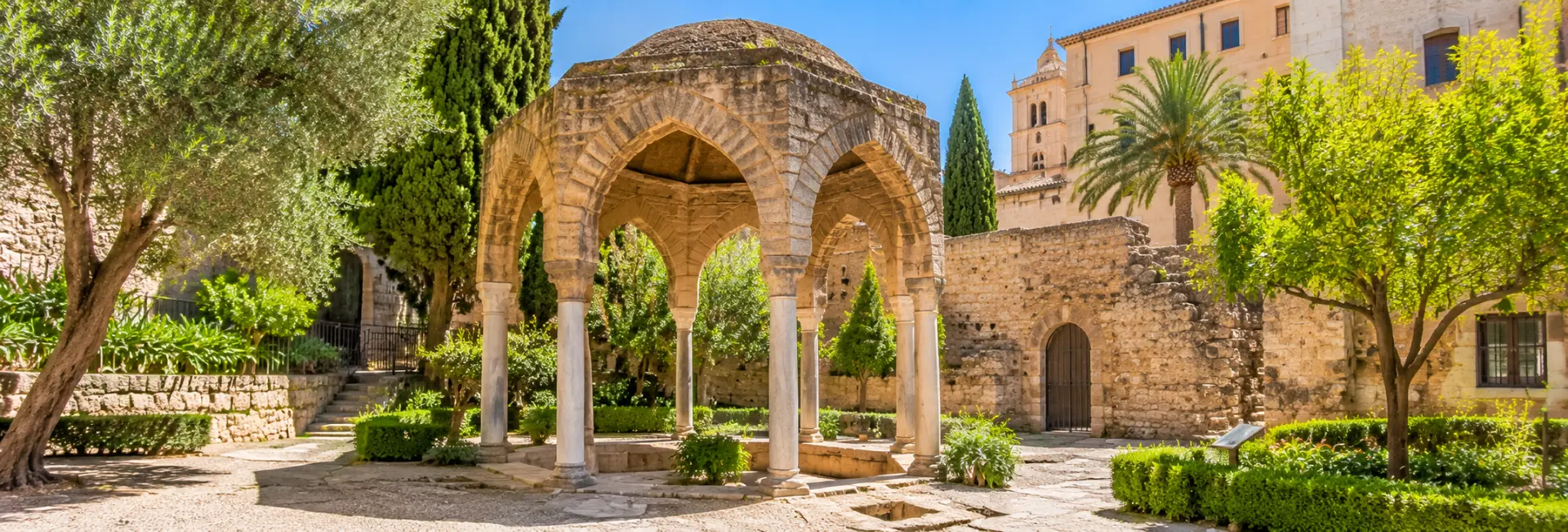
The site is compact, and many visitors are in and out within an hour. What makes it linger in the memory is the contrast between the dim, cool interior and the garden outside, planted with palms and orange trees in what was once the orchard of a manor house. It is one of the quietest and most atmospheric corners of the old town.
History
Madina Mayurqa
Mallorca was under Muslim rule from the early tenth century until the conquest led by James I of Aragon in 1229. During those centuries Palma was known as Madina Mayurqa, a city the Arabs refounded on the remains of an earlier Roman settlement. It grew into a prosperous trading centre with its own mosque, markets, palaces and private houses, and a bathhouse was a normal part of any well-to-do urban property.
A Private Bathhouse
The surviving baths are usually dated somewhere between the tenth and twelfth centuries, with the tenth and eleventh centuries most often cited. Scholars generally believe they belonged to the home of a nobleman or other wealthy resident rather than serving as a large public hammam. That distinction matters, because it explains both the modest scale of the building and the care taken with its design.
The builders also worked with recycled material. The columns and capitals in the main room do not match, which points to stone salvaged from older Roman, Byzantine or earlier Islamic buildings and reused here rather than carved new.
Survival and Rediscovery
After the conquest of 1229 much of Islamic Palma disappeared, was built over, or was absorbed into new construction. The baths survived largely because they lay within the grounds of a private manor house, Can Fontirroig, which kept the remaining rooms standing even after they no longer served their original purpose. The cold room that once completed the bathing sequence has been lost.
The rooms that remain were later recognised as a monument in their own right, and the surrounding orchard was turned into the garden visitors walk through today.
Architecture and the Bathing Rooms
Islamic bathhouses followed a sequence of rooms moving from cold to warm to hot, a pattern inherited from Roman baths. In Palma only the warm and hot elements survive, but they are enough to read the design clearly.
The Hot Room
The central chamber, interpreted as the caldarium, is the highlight of the visit. It is a square room covered by a hemispherical dome of brick, supported by twelve columns joined by horseshoe arches. Small openings pierced through the dome, some of them star-shaped, let in light and allowed steam to escape, so the room glows softly even without windows.
Traces of the original decoration can still be made out on the pendentives, the curved triangles that carry the dome over the square plan. The columns are the other great attraction, since each capital differs from its neighbours.
Heating the Floor
The hot room was heated from below. Hot air and steam circulated in a hollow space beneath a raised floor, warming the stone and filling the chamber with moist heat. The floor itself has worn away in places, which makes it easier for visitors to see how the system worked.
The Warm Room
Next to the hot room is a rectangular chamber with a barrel vault and a side corridor, probably used as the tepidarium or warm room, where bathers could adjust to the heat. Both rooms are reached through a portal with a horseshoe arch, a classic signature of the architecture of al-Andalus.
The Garden of Can Fontirroig
The garden is not an afterthought. It occupies the former orchard of Can Fontirroig, and its planting of palms, orange trees, cacti and ferns gives the whole site a calm, shaded atmosphere that suits its origins. Gardens and water were central to the idea of a refined domestic space in the Islamic world, and the setting here evokes that tradition.
Seating is provided, so the garden works as a place to rest before or after you go inside. It also offers a welcome pause from the busy streets of the old town, especially on hot days.
Recognition and Heritage Status
The Banys Àrabs are protected as a Bien de Interés Cultural, the highest category of heritage protection in Spain, and have held that status since 1931. They are recorded in the national register under the reference RI-51-0000410.
Their importance comes from their rarity. Very little of Mallorca's Islamic-era architecture survives above ground, and the baths are one of the few monuments that let visitors step inside a building from that period. They are also described as one of the best preserved examples of Islamic domestic architecture on the island.
Ways to Experience It
The baths are small enough to be explored independently, and most visitors choose to wander at their own pace. A few approaches make the visit richer.
- Watch the short introductory video shown at the entrance, which is available in several languages and sets the historical scene before you enter the rooms.
- Read the information panels in each room, which are written in English and explain the function of each space.
- Stand beneath the dome and look up, then look down at the floor to understand how the heating system was built.
- Finish in the garden, where the orange trees and palms make a natural place to sit and take in what you have seen.
- Include the baths as one stop on a guided walking tour of the old town, which often pairs them with the cathedral and the Almudaina Palace.
Best Time to Visit
Time of Day
The interior is small, and it can feel crowded when several groups are inside at once. If you arrive when it is busy, begin with the garden and go into the rooms once the numbers thin out. Visiting soon after opening or later in the afternoon often makes for a calmer experience.
Time of Year
The site is a good choice year-round because the interior stays cool and the garden provides shade, which is a real advantage during the hot summer months. Spring and autumn are comfortable for combining the baths with a longer walk around the old town. Opening hours change between seasons and have varied between published sources, so confirm the current schedule before you plan your day.
Visitor Tips
- There is an entrance fee. Cash is often recommended at the ticket desk, so check the current price and accepted payment methods before you go.
- The entrance is a narrow door on a quiet residential street and is easy to walk past. Look for signs reading Banys Àrabs as you follow the lanes from the cathedral.
- Allow up to an hour for the interior and the garden together. A shorter visit is possible if you are only interested in the main hall.
- The site is wheelchair accessible, although the ground is uneven in places.
- Information panels are in English, and the introductory video is offered in multiple languages.
- Expect cool, dim light inside. A camera with good low-light performance helps if you want to photograph the dome.
- Check opening times for the day of your visit, since they differ by season and are subject to change.
Nearby Attractions
The baths sit in the oldest part of Palma, so several major sights are within a short walk.
Palma Cathedral (La Seu)
Roughly five minutes on foot from the baths, the Gothic cathedral stands on the site of the former main mosque of Madina Mayurqa, which makes it a natural companion for a visit focused on the island's Islamic past.
Almudaina Palace
The royal palace occupies the site of the old Moorish fortress, and its position beside the cathedral helps you picture how the two layers of the city fit together.
Museu de Mallorca
The baths lie just behind the Museu de Mallorca, which covers the island's history and archaeology and adds useful context to what you have seen on Carrer de Can Serra.
Parc de la Mar and the Passeig del Born
The lake-side Parc de la Mar, beneath the cathedral, makes a relaxed spot to continue the walk, while the Passeig del Born and La Llotja offer cafés and further historic buildings a little further on.
FAQs about visiting the Arab Baths (Banys Àrabs)
What are the Banys Àrabs in Palma? +
They are the surviving rooms of a medieval Islamic bathhouse in Palma's old town, from the period when the city was known as Madina Mayurqa. A domed hot room and a vaulted warm room remain, set in a garden.
How old are they? +
Sources place construction between the tenth and twelfth centuries, with the tenth or eleventh centuries most often cited. The exact date is still debated.
Was this a public bathhouse? +
Most scholars believe it formed part of a wealthy resident's private home rather than a large public hammam, which explains its compact size.
How long does a visit take? +
Most people need around half an hour to an hour for the rooms and the garden together, since the site is small.
Do I need to pay to enter? +
Yes, there is an entrance fee, and cash is often recommended. Prices and opening hours change, so confirm them on the day of your visit.
Is it accessible for wheelchair users? +
The site is wheelchair accessible, but the ground is uneven in places, so allow a little extra time and take care when moving between rooms.
Can I bathe there? +
No. The baths are preserved as a historic monument rather than operating as a spa, and visitors explore the rooms and garden on foot.
What can I combine with a visit to the baths? +
The cathedral, the Almudaina Palace, the Museu de Mallorca and Parc de la Mar are all a short walk away, making the baths easy to add to a half-day exploring the old town.
