
Table of Contents
Overview
Bellver Castle sits on a wooded hilltop about three kilometres west of Palma's old town, and from almost anywhere in the city its pale, rounded outline is easy to spot. Its name means "lovely view" in Catalan, and the promise is kept: the rooftop terrace opens up a wide panorama over the harbour, the old quarter, the bay and, on clear days, the mountains beyond.
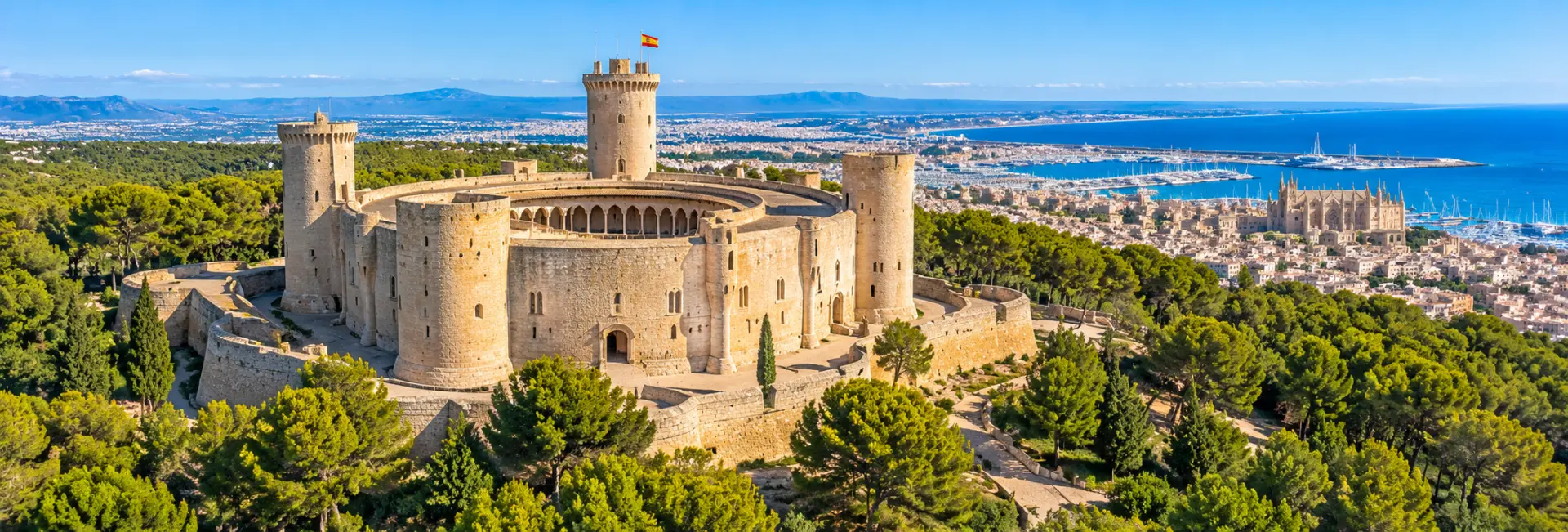
What makes the castle truly unusual is its shape. Where most medieval fortresses were built on square or irregular plans, Bellver is completely circular, a design widely described as unique in Spain and rare anywhere in Europe. Three round towers hug the main body, and a separate keep stands apart across a moat.
Built as a royal retreat and a stronghold in one, the castle later served as a prison and is now a municipal museum. A visit combines architecture, history and scenery in a single outing, and the pine forest around it makes the approach part of the experience.
History
A Royal Retreat for Jaume II
Work began around 1300 on a hill known as Puig de sa Mesquida, commissioned by Jaume II of Mallorca. The king wanted a residence that could also serve as a safe refuge if the island came under attack, and most of the structure was completed within about a decade. In practice, few monarchs stayed for long. Sanç is recorded as living here in 1314, and Joan I of Aragon sheltered in the castle in 1395 to escape plague in Barcelona.
Conquest, Rebellion and Prison
In 1343, when Pere III of Aragon took over the Kingdom of Mallorca, the castle held out before surrendering after a hard fight. It later held captives, including members of the family of the last king of Mallorca, Jaume III. In 1408 the lordship was granted to the charterhouse of Valldemossa, and in 1521, during the Germanies uprising, a mob seized the fortress and killed several people who had taken refuge there.
From Fortress to Museum
The castle became a military prison in 1717 and continued to be used for detention through later conflicts, including the Napoleonic period and the Spanish Civil War. The Enlightenment thinker Gaspar Melchor de Jovellanos was held here in the early nineteenth century and wrote a study of the building during his confinement. In 1931 the state handed the castle and its forest to the city, and it later became the home of Palma's history museum.
Architecture & Notable Rooms
A Fortress Built in the Round
Bellver is a fine example of Mallorcan Gothic military architecture. The castle rises on a circular plan, with concentric walls and three semicircular towers attached to the main body. A moat encircles the complex, and the freestanding keep, known as the Torre de l'Homenatge, stands outside the main ring and connects to it by a bridge.
The Two-Level Courtyard
The central courtyard is the architectural heart of the castle. A double gallery wraps around it: the lower level is lined with round arches under a flat roof, while the upper level has pointed Gothic arches and rib vaulting. Seeing the two styles one above the other makes an instructive comparison, especially from the rooftop looking down.
Highlights Inside
- The rooftop terrace and battlements, which offer the finest views and a close-up look at the courtyard layout.
- The keep, which contains the dungeon known as l'Olla, a grim underground prison cell.
- Prisoners' graffiti scratched into the stonework, a reminder of the castle's darker role.
- The upper-floor rooms, including the old kitchen and a series of largely bare chambers that show how the building was organised.
- The museum galleries on the ground floor, which present the city's story through objects and explanatory panels.
Grounds & Views
The Bellver Forest
The castle is surrounded by the Bosc de Bellver, a pine forest covering roughly 126 hectares and the largest public green space in Palma. Shaded paths wind up the hill, and the air carries the scent of pine. Even without entering the castle, the forest is a pleasant place for a walk, a picnic or a run, and it gives the whole site a calm, rural feeling despite the city so close below.
Panoramic Views
From the battlements, the view sweeps across the harbour, the old town and its cathedral, the curve of the bay and the open Mediterranean. In another direction, the sightline stretches toward the Serra de Tramuntana mountains. Photographers often come at the beginning or end of the day, when softer light brings out the colours of the city and the sea.
On the Sunday after Easter, Palma's residents traditionally head up to the forest and castle for the Diumenge de l'Àngel, a local celebration that keeps the hill at the centre of city life.
Cultural Significance & Historical Ties
A Symbol of Medieval Mallorca
Bellver is often described as the best surviving representation of the island's medieval era. It was designed under the Kingdom of Mallorca, an independent realm that flourished in the early fourteenth century, and it captures the ambition of a short-lived monarchy that wanted a residence that was both elegant and defensible.
The City History Museum
Inside, the Museu d'Història de Palma traces the development of the city from the prehistoric Talayotic culture through Roman and Islamic periods to later centuries. Exhibits include ceramics from several eras and informative panels. The museum is also home to the Despuig collection of classical sculpture, assembled by an eighteenth-century cardinal and counted among the best of its kind in the Balearic Islands.
A Place of Memory
Because the castle served as a prison for so long, it carries a layered legacy. For many visitors the contrast between the airy courtyard, with its elegant arches, and the cells below is one of the most memorable aspects of the visit.
Ways to Experience It
Most visitors explore the castle independently, starting with the courtyard, then moving through the museum rooms and finishing on the roof. If you want a fuller understanding of the building, spend extra time reading the panels and looking for details such as the arches, the doorways and the marks left by former prisoners.
- Walk around the outside first to see the moat and the keep from different angles.
- Compare the lower and upper arcades of the courtyard, then climb to the roof to look down on them.
- Browse the museum galleries for the Despuig sculptures and the archaeological pieces.
- Walk up through the forest from the city instead of driving, if you enjoy a short hill climb.
- Pair the visit with a stroll in the woods or a pause at the small cafe near the castle.
Plan on about one to two hours for the castle itself, longer if you add a forest walk.
History enthusiasts may want to approach the visit as a story in three acts: the castle as a royal retreat, as a prison, and as a public museum. Moving through the courtyard, the upper rooms and the galleries in that order gives the building a clear narrative, and it helps explain why such an elegant structure also carries such a heavy past.
Best Time to Visit
Time of Day
Morning is usually the best time to go, with cooler air for the uphill approach and fewer visitors on the rooftop. Late afternoon is also rewarding, as the sun lowers and the views over the bay turn golden. Midday in summer can be hot, particularly on the exposed terrace, so bring water and a hat.
Time of Year
Spring and autumn offer the most comfortable temperatures for climbing the hill and exploring the grounds, and spring brings fresh green to the pine forest. Winter is quiet and often clear, which can give excellent visibility from the roof. Summer is lively but warm, so plan around the heat.
Visiting Etiquette & Tips
Bellver is run by the city of Palma, and opening days, hours and ticket arrangements change by season. Confirm them on the official castle website shortly before you go, since the castle is typically closed on at least one day each week.
- Wear comfortable shoes. The approach on foot is steep, and the castle has stairs, ramps and uneven stone surfaces.
- Choose your route to the hill. City buses stop near Plaça de Gomila, followed by a walk of around fifteen minutes uphill, while an open-top sightseeing bus and taxis go closer. Parking is available near the castle if you drive.
- Bring water, sun protection and a light layer, since the roof can be exposed and breezy.
- Leave pets at home. Animals are generally not allowed inside.
- Ask about accessibility in advance. Some areas have ramps, but the historic layout means not every space is easy to reach.
- Respect the site. Do not touch or climb on historic walls, and take care near edges on the roof.
Nearby Attractions
The castle sits a short ride from the centre, so it combines well with other sights in Palma.
- Bosc de Bellver: the forest around the castle, ideal for walking and picnics.
- Palma Cathedral (La Seu): the city's great Gothic landmark, visible from the castle terrace.
- Royal Palace of La Almudaina: the royal residence beside the cathedral, built in the same era.
- Es Baluard Museum of Modern and Contemporary Art: a cultural stop set within the old city defences.
- Parc de Sa Feixina: a small, popular park near the seafront on the way back toward town.
- Passeig Marítim: the long seafront promenade, perfect for a relaxed walk after the hill.
FAQs about visiting Bellver Castle
Why is Bellver Castle so famous? +
It is a medieval Gothic castle with a completely circular plan, which is considered unique in Spain and uncommon in Europe. It also offers some of the best panoramic views of Palma and its bay.
How old is Bellver Castle? +
Construction began around 1300 under King Jaume II of Mallorca, and most of the building was finished within about ten years. It has stood for roughly seven centuries.
What can I see inside? +
You can walk around the two-level circular courtyard, climb to the rooftop terrace, see the former prison areas and visit the Museu d'Història de Palma with its archaeological collection and classical sculptures.
How far is the castle from the city centre, and how do I get there? +
It is about three kilometres west of the old town. You can take a taxi, a sightseeing bus or a local bus to Plaça de Gomila and walk uphill for around fifteen minutes, or drive and park nearby.
How long should I allow for a visit? +
Allow one to two hours for the castle and museum. If you want to walk in the forest as well, plan for a half-day.
Is Bellver Castle open every day? +
Not always. Days and hours vary by season and the castle is usually closed on at least one weekday, so check the official website before travelling.
Is it suitable for children and people with limited mobility? +
Children usually enjoy the towers, the moat and the rooftop views. The hill approach and the historic stairs can be demanding, so visitors with mobility needs should check access options in advance.
What is the best time of day for photos? +
Morning and late afternoon give the softest light over the bay and the city. Clear days in spring and autumn tend to offer the best visibility.
