
Table of Contents
Overview
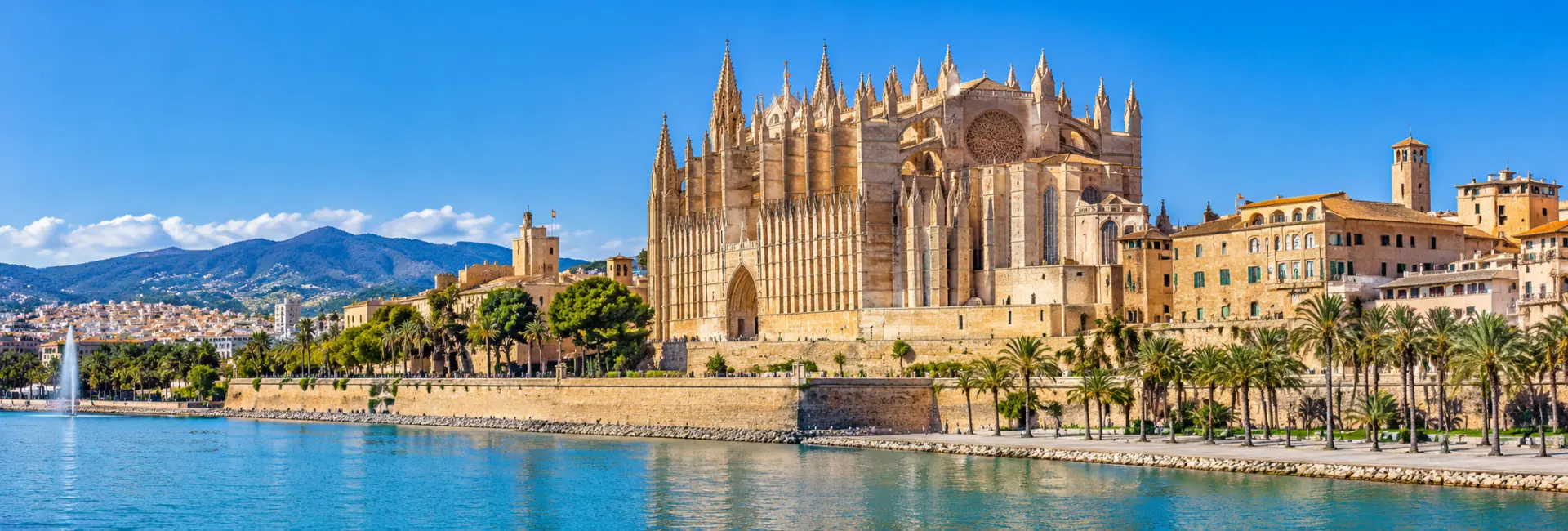
Palma Cathedral, known across Mallorca simply as La Seu, rises from the edge of the old town like a cliff of honey-coloured sandstone, its buttresses and pinnacles mirrored in the waters of the bay. The Catalan word "seu" means "see", the seat of a bishop, and this is the principal church of the Diocese of Mallorca, formally dedicated to Santa Maria.
Scale is part of its appeal. The building runs roughly 121 metres in length, and its central nave climbs to about 44 metres, a height few Gothic churches anywhere can match. Yet it is the light that visitors tend to remember. Dozens of tall windows and several rose windows fill the interior with colour that shifts from morning to afternoon.
Few cathedrals in Europe layer so many chapters of history into a single building. A medieval royal vow, a royal mausoleum, a Modernist makeover by Antoni Gaudí and a contemporary ceramic chapel by Miquel Barceló all sit under one roof. It is one of the most popular sights in Palma and an obvious first stop for anyone arriving on the island.
History
A Vow Made at Sea
The story begins with the Catalan conquest of Mallorca in 1229 under King Jaume I. Tradition says a violent storm threatened his fleet during the crossing, and the king promised to raise a church in honour of the Virgin if he reached land safely. The site chosen for that promise was the city's principal mosque, which was converted for Christian worship soon after the conquest. A first chapel on the spot was consecrated in 1269.
Building a Gothic Giant
Around 1300, during the reign of Jaume II, work started on a far more ambitious Gothic church. The oldest parts are those around the apse, linked to the king's wish to be buried in a chapel there, and the early works were directed by the master builder Jaume Mates. As successive architects took over and tastes changed, construction stretched across roughly three centuries. The cathedral was finally consecrated in 1601.
Restoration and Reinvention
The building never stood still after that. A major restoration began in the mid-nineteenth century, and fifty years into it, in 1901, the architect Antoni Gaudí was invited to take charge. His reforms, followed a century later by Barceló's work, mean La Seu now tells the story of Mallorcan art from the Gothic period through to the present day. The cathedral is protected as a Bien de Interés Cultural, Spain's category for its most important heritage landmarks.
Architecture & Design
A Mediterranean Take on Gothic
La Seu follows the Catalan Gothic tradition, which prefers broad, open interior volumes and clean lines over the dense ornament of northern European cathedrals. Inside, three naves are divided into eight bays by slender octagonal pillars, and the effect is of one vast, airy hall rather than a series of separate compartments. The central nave is lofty enough to rank among the tallest of any Gothic cathedral.
A Commanding Setting
The cathedral stands on the old citadel hill of the Roman city, flanked by the Royal Palace of La Almudaina and the episcopal palace, and looks out over the Parc de la Mar toward the Mediterranean. From the water's edge, its sandstone walls, flying buttresses and tall bell tower create one of the most recognisable skylines in the Balearic Islands.
Portals and Interior Treasures
- The Portal de l'Almoina, dating from 1498, is among the cathedral's best-known doorways.
- The Portal del Mirador faces the sea side of the building and is a favourite subject for photographers.
- The 110 wooden choir stalls are a fine example of Catalan Gothic woodwork.
- The cathedral organ has a long history, with the first mention of an instrument here dating back to 1328.
The Rose Windows & the Cathedral of Light
The Gothic Eye
The great rose window above the high altar is the cathedral's signature feature. It measures close to 14 metres across and is assembled from more than a thousand pieces of coloured glass, making it one of the largest Gothic rose windows ever built. Islanders call it l'ull gòtic, the Gothic eye. Its position at the eastern end of the church is unusual, so the colours greet you the moment you step into the nave.
Why It Is Called the Cathedral of Light
The nickname comes from the sheer amount of glass. La Seu has 87 large windows and seven rose windows, which flood the interior with changing light through the day. A smaller rose window on the western facade faces the great one, so the two eyes look at each other across the length of the church.
The Double Rose Phenomenon
Twice a year, on 2 February (Candlemas) and 11 November (the feast of Saint Martin), the rising sun lines up with the nave. Its light passes through the great rose window and projects a coloured image onto the wall below the western rose, creating the effect of a figure eight, often described as a double rose. Historians debate whether the builders planned it deliberately, but people gather before dawn on both dates to watch it unfold.
Gaudí's Restoration
A Modernist in a Gothic Church
Gaudí took over the restoration in 1904 and worked on the cathedral until 1914, when disagreements with the local authorities brought his involvement to an end. His aim was to revive the spiritual atmosphere of the medieval church, using light, space and craftsmanship rather than bulky decoration.
What He Changed
- He moved and reworked the choir stalls, helping to open up the nave.
- He designed the dramatic wrought-iron baldachin that hangs above the main altar, a canopy of lamps that remained unfinished.
- He collaborated with Josep Maria Jujol on ceramic work in the Royal Chapel.
His interventions were bold and, at the time, controversial. Today they are part of what makes La Seu distinctive, giving a medieval cathedral a surprising layer of early twentieth-century Modernism that rewards a slower look.
Miquel Barceló's Chapel
A Contemporary Seascape
The newest chapter in the cathedral's story was written by the Mallorcan artist Miquel Barceló, who transformed the Chapel of the Holy Sacrament (Capella del Santíssim), in the right-hand apse. He worked on the project between 2001 and 2006, and the chapel was inaugurated in 2007.
Loaves, Fishes and the Sea Floor
Barceló covered the entire apse in ceramic relief, inspired by the Gospel miracle of the loaves and fishes. Fish, fruit and other forms seem to ripple across the walls, as though the chapel had been lowered beneath the sea. He also designed new furnishings and replaced the existing stained glass with grisaille windows that evoke the muted light of the seabed.
The result divides opinion, which is part of its appeal. Some visitors find it startling beside so much medieval stone, while others see it as a natural continuation of a cathedral that has always welcomed the art of its own time. It remains a working chapel, so quiet respect is expected.
Cultural & Religious Significance
A Royal Resting Place
The Trinity Chapel, built in 1329 as a mausoleum, is the burial place of the Kings of Mallorca, Jaume II and Jaume III. Its presence ties the cathedral closely to the neighbouring Almudaina Palace and to the era when Mallorca was the seat of its own kingdom.
The Heart of the Diocese
La Seu is the seat of the Bishop of Mallorca and a living place of worship, with services held regularly and major religious festivals marked here throughout the year. Its tower and rose window appear on postcards, posters and souvenirs across the island, and for many Mallorcans the building is a symbol of local identity as much as a church.
A Gateway to Mallorcan Art
Admission includes the Museum of Sacred Art, which displays religious art and objects connected to the cathedral and the island's Christian heritage. The cathedral also hosts concerts and cultural events from time to time, adding to its role as a civic landmark.
Visiting Etiquette & Tips
Because La Seu is an active place of worship, a few simple rules shape every visit. Opening hours, ticket categories and prices change by season and by day, so check the official cathedral website shortly before you go.
- Dress respectfully. Shoulders should be covered and shorts or skirts should reach below the knee. Beachwear and open-toed shoes are not allowed.
- Plan around closing days. The cathedral is closed to visitors on Sundays, and visiting areas may be restricted during services.
- Enter through the right door. Visitor access is through the Museum of Sacred Art entrance on Plaça de la Seu.
- Leave pets behind. Dogs are not admitted, except guide dogs.
- Consider the terraces. A separate terrace visit takes you onto the roof for close views of the flying buttresses, bell tower and great rose window, plus sweeping views of the bay. Visits run in timed groups of about an hour, and the climb involves narrow stairs.
- Add an audio guide. An optional audio guide explains the main chapels and, on the terrace route, the views over Palma.
- Keep voices low and behave as you would in any church, especially in the Barceló chapel.
Best Time to Visit
Time of Day
Go as early in the day as the opening time allows. Morning light travels through the eastern rose window and across the nave, and the building is quieter before tour groups and cruise passengers arrive. Late afternoon and early evening are best for photographing the exterior, when the sandstone takes on a warmer colour across the Parc de la Mar.
Time of Year
The cathedral works in any season, but spring and autumn offer the most comfortable weather and thinner crowds than the peak summer months. The light show of 2 February and 11 November is a draw for anyone willing to arrive very early. Sunset terrace tours are also offered at certain times of year and make a memorable alternative to a standard visit.
Nearby Attractions
La Seu sits in the middle of Palma's most walkable heritage area, so it pairs easily with other sights on the same day.
- Royal Palace of La Almudaina: next door, this former royal residence dates back to the period after the Christian conquest.
- Parc de la Mar: the seafront park and artificial lake directly below the cathedral, ideal for reflections and a relaxed walk.
- La Llotja: a Gothic maritime exchange that recalls Palma's trading past.
- Basilica of Sant Francesc: another important medieval church, a short walk away in the old town.
- Museu Fundación Juan March: a modern and contemporary art museum in the old town.
- Bellver Castle: a circular hilltop fortress about three kilometres from the centre, with panoramic views over the city.
FAQs about visiting Palma Cathedral (La Seu)
What is Palma Cathedral and why is it so famous? +
It is the Gothic cathedral of Mallorca, known locally as La Seu. It stands out for its enormous rose window, its very tall nave, Gaudí's early twentieth-century reforms and a ceramic chapel by Miquel Barceló.
How long should I allow for a visit? +
Plan on roughly one to two hours for the cathedral and the Museum of Sacred Art. If you add the terrace tour, which lasts about an hour on its own, set aside a half-day.
Is Palma Cathedral open on Sundays? +
No, it is closed to sightseeing visitors on Sundays because it functions as a place of worship, though services are held. Always confirm current opening hours on the official website, as they vary by season.
Is there a dress code? +
Yes. Shoulders must be covered, shorts and skirts should fall below the knee, and beachwear and open-toed shoes are not permitted. A light scarf or shawl in your bag is an easy solution in hot weather.
Did Antoni Gaudí really work on the cathedral? +
Yes. He led a restoration from 1904 until 1914, moving the choir stalls and designing the wrought-iron canopy above the main altar. He also worked with Josep Maria Jujol on ceramics in the Royal Chapel.
When can I see the double rose window effect? +
It happens around 2 February and 11 November, when morning sunlight passes through the great eastern rose window and projects its image below the western one. Arrive early, as both days draw crowds.
Is the terrace tour worth the extra cost? +
Most visitors who enjoy architecture or views say yes. It brings you close to the buttresses, the rose window and the bell tower, with wide views over the bay, but it is a separate ticket and involves narrow stairs.
Where do I enter, and are tickets sold on site? +
Visitors enter through the Museum of Sacred Art entrance on Plaça de la Seu, and tickets can be bought online or at the ticket office. Reduced prices may apply for certain groups, such as residents of the diocese, so check the official site before you go.
