
Table of Contents
Overview
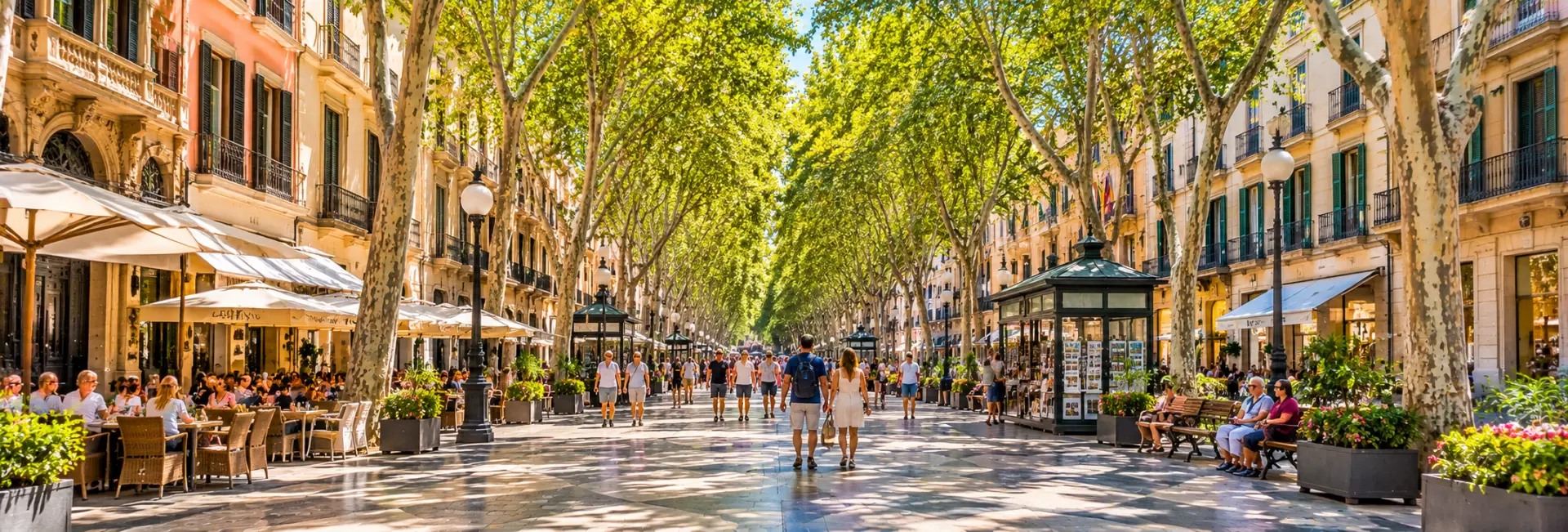
La Rambla is a broad, tree-shaded boulevard in the middle of Palma, the capital of Mallorca. A wide central promenade, kept for walkers, runs between two quiet traffic lanes, and flower kiosks along its length make it one of the most colourful streets in the old city.
What gives the street its unusual width is its past. La Rambla follows the bed of Sa Riera, a seasonal torrent that once cut straight through Palma and flooded it with alarming regularity. When the watercourse was moved outside the city in the early seventeenth century, the empty channel became open ground, and the boulevard grew from there.
Today the street is calmer than its famous namesake in Barcelona and less showy than the nearby Passeig del Born. It rewards visitors who enjoy slow, observant walking: dappled shade, the scent of cut flowers, café terraces and a steady stream of local life, all within a few minutes of Plaça Major and the Teatre Principal.
History
A Torrent Through the City
Sa Riera begins in the Serra de Tramuntana, the mountain range to the west of Palma, and for centuries its path ran through the heart of the medieval city rather than around it. It entered near the top of today's Rambla, ran down the line of the street, turned along what is now Carrer de la Unió past the Plaça del Mercat, and then swung toward the sea along the course of the Passeig del Born.
For most of the year the channel was dry or close to it, but heavy autumn and winter rain could turn it violent. The most serious documented flood struck on 14 October 1403 and devastated the lower part of Palma, with chroniclers and later historians recording very heavy loss of life.
Moving the River, Making a Boulevard
In 1613 the city completed a project to divert Sa Riera outside the walls, sending the water along the line of the old moat and away from the houses. The abandoned bed was filled in and levelled, leaving a long, wide esplanade that would later divide into two celebrated walks: the Passeig del Born and La Rambla.
The diverted torrent still exists. It runs in a canal beside the Passeig de Mallorca on the western edge of the old town before reaching the bay near Es Baluard, although in dry months it carries very little water.
From Convent Fair to Modern Promenade
In its early centuries La Rambla was a wide open space hemmed in by convents rather than a refined promenade. Trees were planted there by 1721, and the ground hosted the Fira del Ram, a long-running fair. A local study of Palma's urban trees sums up the social divide neatly: the Born was the walk of the wealthy, while La Rambla belonged to soldiers and clergy.
The street took on roughly the form visitors see today around 1880, with a landscaped central walk and a lane of traffic on each side.
A Street of Many Names
The word rambla comes from the Arabic ramla, meaning a sandy streambed, which is exactly what this street once was. Palma's boulevard has carried other names too. During the Spanish Civil War it was renamed Via Roma and decorated with statues of Roman eagles, and that name lasted until shortly after the end of the Franco dictatorship. In 1998 it was renamed in honour of the Duchess and Duke of Palma de Mallorca, and in 2013 the city council voted to restore the traditional name, La Rambla. The name Via Roma survives on a later extension of the street.
Layout and Streetscape
La Rambla begins where Carrer dels Oms, Via Roma and Carrer del Baró de Pinopar come together. From there it slopes gently toward the historic centre and finishes beside the Teatre Principal, where a flight of steps leads up to Plaça Major. The whole stretch is short enough to walk in a few minutes, yet it feels like a destination in its own right rather than a mere connection between two points.
The Central Promenade
The pedestrian strip down the middle is the main event. Mature trees shade it for much of the day, benches line the route, and fountains and statues give the walk a few places to pause. Flower kiosks sit along the centre, and cafés and restaurants may set out terraces under rules laid down by the city council.
Those rules shape the feel of the place. A clear central corridor four metres wide must stay open for pedestrians, and terrace tables may only be used between 7:00 and midnight, so the promenade stays easy to walk even when the terraces are busy.
The Traffic Lanes and Façades
On either side of the promenade runs a single lane of traffic, one for each direction, so the walking strip is framed by moving vehicles rather than sealed off from them. The buildings behind the lanes mix shopfronts, cafés and older façades, and it is worth lifting your eyes above street level as you go.
The Flower Kiosks
Roughly ten kiosks, owned by the city council and run by concession holders, sell flowers and plants along the promenade. They are the signature feature of La Rambla and the reason many locals still think of it first as Palma's flower street.
What You Will Find
The kiosks sell bouquets, floral arrangements and potted plants, and their displays spill colour onto the pavement. Even if you are not buying, they make a pleasant excuse to slow down, and they are among the most photographed corners of the street.
The All Saints Connection
The council's rules for the promenade give flower kiosk holders priority over terrace space from 28 October to 2 November, the days around the festival of All Saints. It is a custom across Spain to bring flowers to family graves at this time of year, and the arrangement recognises that La Rambla's flower sellers are at the centre of that tradition.
Streets and Landmarks Around La Rambla
Teatre Principal
The theatre sits at the southern end of the street, at Carrer de la Riera 2. Its origins go back to 1667, when it opened as the Casa de les Comèdies, and today it is the most important theatre and opera production centre in the Balearic Islands. The main hall seats roughly 800 people, and a smaller second space hosts more intimate performances of theatre, music, dance and circus.
Plaça Major
The steps beside the theatre climb to Plaça Major, one of the liveliest squares in the old town. Street artists, market stalls and café terraces gather here, which makes the climb a natural way to extend a short stroll along La Rambla into a longer outing.
Carrer de la Unió and the Old Torrent Route
Carrer de la Unió continues the line of the former watercourse beyond the end of La Rambla and leads down to Plaça del Mercat, where a small cove once received the waters of Sa Riera. From the square the route carries on into the Passeig del Born. Following this sequence on foot is a simple way to trace the river that shaped central Palma.
Toward Carrer de Sant Miquel
The side streets that lead uphill from La Rambla, including Carrer dels Oms, connect with Carrer de Sant Miquel, a pedestrian street lined with local shops and bakeries. It makes a good second leg for anyone who wants to pair a flower-stall stroll with some browsing.
Ways to Experience It
La Rambla works best as a slow, unscripted visit rather than a checklist. There are a few easy ways to shape the time you spend there.
- Walk the promenade from top to bottom, then back up on the opposite side to see the façades and shopfronts from both angles.
- Take a seat on a café terrace and watch the daily rhythm of the street, from flower deliveries to people hurrying to and from the theatre.
- Browse the flower kiosks and pick up a bouquet or a small plant, which is one of the few truly local souvenirs you can buy on the spot.
- Follow the old torrent route: start at the top of La Rambla, continue along Carrer de la Unió to Plaça del Mercat and finish on the Passeig del Born.
- Pair the walk with an evening at the Teatre Principal, checking its programme in advance for opera, concerts, dance or circus.
Best Time to Visit
Time of Day
Mid-morning is a good moment to see the kiosks fully stocked and the pavement at its most animated. If you prefer softer light, the last hour or two before sunset turns the tree canopy golden and makes the terraces especially pleasant. Evenings suit those heading to a performance at the Teatre Principal.
Time of Year
The trees make La Rambla one of the more comfortable places to walk in the centre of Palma during the hot summer months, when shade matters. Spring and autumn offer milder temperatures for a longer wander that continues into nearby streets. Late October and early November bring the flower sellers' busiest period around All Saints, which is the best time to see the kiosks at their most active.
Visitor Tips
- La Rambla is an open public street, so there is no admission fee. The promenade itself takes only a few minutes to walk, but 30 to 60 minutes is a comfortable allowance for browsing and a drink.
- Each flower kiosk sets its own opening times, so plan a daytime visit rather than counting on evening trade.
- The side lanes carry traffic in both directions, so cross them with care when stepping on or off the central promenade.
- The promenade slopes gently, but the steps at the southern end up to Plaça Major are a barrier for wheelchairs and strollers. Visitors who cannot manage stairs should plan an alternative route through the neighbouring streets.
- As in any busy city-centre area, keep an eye on bags and phones while you browse or sit on a terrace.
- Check the Teatre Principal's programme and ticketing directly with the theatre before planning an evening around a show.
- Expect terrace service from around 7:00 until midnight at the latest, and confirm individual venues' hours locally since they vary.
FAQs about visiting La Rambla
Is La Rambla in Palma the same as the famous one in Barcelona? +
No. Palma's La Rambla shares the name and the flower-stall tradition, but it is a much shorter and calmer boulevard in the centre of Palma, built on the former bed of the Sa Riera torrent rather than a long avenue running down to a harbour.
Where does La Rambla start and finish? +
It starts at the junction of Carrer dels Oms, Via Roma and Carrer del Baró de Pinopar, and finishes beside the Teatre Principal, where steps climb to Plaça Major.
Is there an entrance fee, and how long should I allow? +
La Rambla is an open public street, so it is free to walk. The promenade takes only a few minutes, but 30 to 60 minutes is a comfortable allowance for browsing the kiosks and sitting down for a drink, and longer if you continue into Plaça Major or the Born.
Can I buy flowers and plants there? +
Yes. Roughly ten council-owned kiosks sell flowers and plants along the promenade. Individual kiosks set their own opening times, so a daytime visit is the safest bet.
What is the best time of year to go? +
Summer rewards the shade and spring and autumn suit longer walks. The kiosks have priority over terrace space from 28 October to 2 November because of All Saints, when flower sellers traditionally do their busiest trade.
Is La Rambla worth visiting in the evening? +
It can be. Terraces may operate until midnight and the Teatre Principal stages performances at the southern end, although the flower kiosks are mainly a daytime attraction.
Is it suitable for children and visitors with limited mobility? +
The promenade is wide and gently sloping, which suits families and strollers, and traffic is confined to the side lanes. The steps at the southern end up to Plaça Major are the main obstacle, so anyone who cannot manage stairs should plan an alternative route.
What can I combine with a visit? +
Plaça Major, the Teatre Principal, Carrer de la Unió, Plaça del Mercat, the Passeig del Born and the pedestrian shopping street Carrer de Sant Miquel are all within easy walking distance, as is the canalised torrent along the Passeig de Mallorca.
