
Table of Contents
Overview
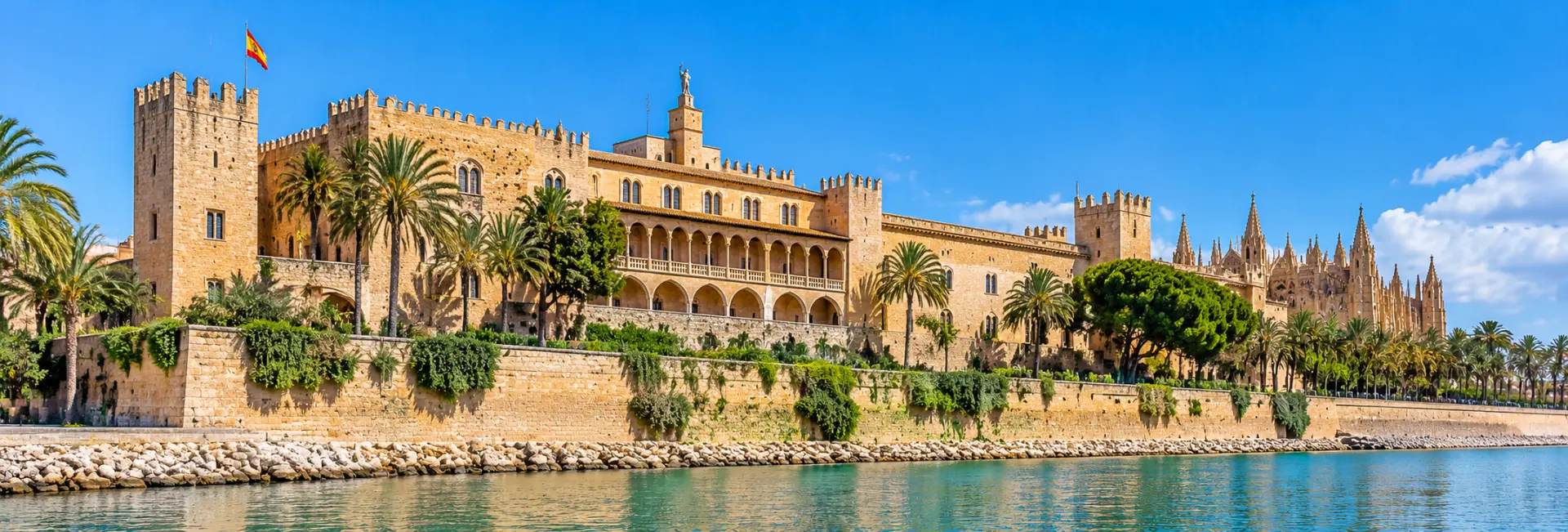
The Royal Palace of La Almudaina stands at the heart of Palma's old town, a stone's throw from the cathedral and directly above the seafront park. With its crenellated walls, square towers and sandy-coloured stone, it looks more like a fortress than a palace, and that impression is accurate: the building began life as a defensive citadel long before it became a royal residence.
Today it is the Spanish monarch's official residence in Mallorca, used for state occasions when the royal family visits the island. Even so, a large part of the complex is open to the public, so you can walk through a working royal property rather than a frozen museum piece.
The name comes from an Arabic word for a fortified citadel, and layers of Roman, Islamic and Gothic history are still visible in its walls. Seen together with the neighbouring cathedral, it explains how Palma was ruled and how political and spiritual power once shared the same hilltop.
History
From Citadel to Alcázar
A fortified settlement occupied this elevated spot above the harbour long before the Middle Ages, and the site's strategic value was obvious to every ruler of the island. Under Muslim control it became the seat of the island's governors, who built a walled alcázar here. Parts of that Islamic phase survive today, most notably the remains of the old baths.
The Palace of the Kings of Mallorca
After the Catalan conquest of 1229, the fortress passed into Christian hands and was gradually reshaped. The most important transformation took place under Jaume II of Mallorca, who rebuilt it in the early fourteenth century as the royal seat of the independent Kingdom of Mallorca. Tradition holds that the layout drew inspiration from the royal palace in Perpignan, the kingdom's mainland capital. This is the period that gave the palace its present Gothic character.
Centuries of Government
When the Kingdom of Mallorca was absorbed by the Crown of Aragon, the palace continued to house royal officials and later the monarchs of Spain. From the sixteenth century it served as the base for the island's viceroy and royal court of justice, and it also became associated with military command in the Balearics. Management today falls to Patrimonio Nacional, the state body that looks after properties linked to the Spanish Crown.
Architecture & Notable Rooms
Where Gothic Meets Islamic
The palace is a study in contrasts. Its dominant style is Levantine Gothic, with broad stone arches, vaulted rooms and austere walls, but traces of its Moorish past are never far away. Seen from the seafront, the Moorish-style arches of the sea-facing wall are especially striking, and at night they glow like a row of lanterns.
The Courtyard and Royal Staircase
Visitors enter through a fortified gateway into the central parade ground, a large open courtyard framed by palm trees and watched over by the cathedral towers. From here, the Royal Staircase leads up to the principal apartments on the upper floor, which are arranged around the King's Palace and the Queen's Palace.
Highlights Inside
- The Gran Saló, also known as the Tinell, is the palace's great Gothic hall. Since the sixteenth century it has been divided into two levels, but its scale still conveys the grandeur of royal banquets.
- The Chapel of Santa Ana, dating from the early fourteenth century, is one of the finest examples of classical Gothic design on the island. Look closely at the sculpted tympanum, the corbels and the vault keystones.
- The Angel Tower carries a bronze-covered wooden figure of the Archangel Gabriel on its summit and is one of the palace's most recognisable features.
- The royal apartments contain tapestries, paintings and furniture from different centuries, including a collection of Flemish tapestries.
- The surviving Arab baths offer a rare glimpse of the building's Islamic phase.
Grounds & Gardens
S'Hort del Rei
Below the palace walls, the S'Hort del Rei gardens form a green, open terrace between the old town and the sea. Fountains, shaded benches and clipped hedges make them a popular place to rest, and the view back up at the palace's stone ramparts is among the best in the city.
Art and Landmarks in the Garden
The gardens were reworked in the 1960s, and their best-known feature is Joan Miró's sculpture known as the Egg, a smooth white form with an opening that visitors are tempted to look through. Nearby is the Arc de la Drassana, an old gateway that once led to the royal docks, along with a sculpture of a Balearic slinger, a reminder of the islanders' ancient reputation as stone-throwing warriors.
Together with the neighbouring Parc de la Mar, these open spaces turn the palace and cathedral into a single, easily explored cultural landscape.
Cultural Significance & Royal Ties
A Palace That Still Works
Few European palaces blend visitor access and real function as openly as La Almudaina. The upper floors are still used for official ceremonies and receptions, and the building remains the formal residence of the monarch while on the island. The Spanish royal family's more private holiday stays are usually spent at the Marivent Palace elsewhere in Palma.
A Symbol of Power
Standing opposite the cathedral, the palace reflects the traditional pairing of crown and church in Mallorcan history. Understanding both buildings together shows how Palma's rulers governed from one hilltop while the bishop held spiritual authority from the other.
Layers of Memory
Few buildings in Palma preserve Roman, Islamic, Gothic and modern layers so clearly in one place. The palace does not hide its history behind a single period style, which makes it especially rewarding for visitors interested in how cultures have overlapped on Mallorca.
Ways to Experience It
Most visitors tour the public rooms at their own pace, following a route through the courtyard, the Gothic hall, the royal chapel and the upper apartments. An optional audio guide adds context for the rooms and the building's history, and is worth considering if you want more than the basic signage.
- Visit the palace and cathedral on the same morning, since they face each other across a short stretch of pavement.
- Walk the outside of the walls and the S'Hort del Rei gardens for a different view of the architecture.
- Pause in the Chapel of Santa Ana to appreciate the carving details.
- Look out from the seafront at dusk, when the lit arches create a memorable skyline together with the cathedral.
Allow roughly one to two hours inside, depending on how closely you read the displays.
If you enjoy architecture, slow down in the rooms where the Gothic and Islamic phases meet. Compare the soft, rounded outlines of the older baths with the tall pointed arches of the royal halls, and notice how the same site absorbed several very different building traditions. Visitors with a particular interest in tapestry and decorative arts will find the royal apartments rewarding, as the furnishings change between rooms and give a sense of how the palace was used across the centuries.
Best Time to Visit
Time of Day
Early in the day is generally the calmest time inside the palace, before tour groups and cruise passengers fill the courtyards. Late afternoon has its own appeal: the low sun lights up the cathedral towers above the main courtyard, and the stone of the palace walls takes on a warm tone. After dark, the illuminated arches along the seafront are a highlight in themselves.
Time of Year
Spring and autumn offer pleasant temperatures for combining the interior visit with a slow walk through the gardens. In summer, the cool stone rooms provide welcome relief from the midday heat, though the exterior areas are best saved for early morning or evening. Winter is the quietest season, with softer light and far fewer visitors.
Visiting Etiquette & Tips
La Almudaina is an official royal residence, so access can change at short notice. Opening hours, closing days and ticket prices vary by season and can be affected by state events, so confirm them on the official Patrimonio Nacional page shortly before you go.
- Expect temporary closures. The palace may restrict or close public access when the royal family or government officials are using it.
- Bring ID and be ready for basic security checks at the entrance.
- Check the photography rules at the ticket desk, as restrictions may apply in some rooms.
- Wear comfortable shoes. The palace has stone floors, uneven surfaces and staircases between levels.
- Look into accessibility in advance. Historic stairs and level changes may limit access to some areas, so ask staff what is feasible.
- Consider a joint visit with the cathedral, planning your route so that you can enjoy each building without rushing.
Nearby Attractions
The palace sits in one of the most compact and rewarding corners of Palma, so several of the city's main sights are only minutes away on foot.
- Palma Cathedral (La Seu): directly opposite, with its famous rose window and Gaudí and Barceló interventions.
- Parc de la Mar: the seafront park and lake below the walls, with excellent views of both buildings.
- La Llotja: a Gothic maritime exchange that recalls the city's trading past.
- Basilica of Sant Francesc: a medieval church with a notable cloister, in the old town.
- Es Baluard Museum of Modern and Contemporary Art: a short walk away, set within the old city defences.
- Passeig del Born: a tree-lined boulevard with cafés and shopping, within easy reach.
FAQs about visiting the Royal Palace of La Almudaina
What is La Almudaina Palace? +
It is the royal palace of Palma de Mallorca, a former Islamic fortress rebuilt in Gothic style in the fourteenth century. It is now the Spanish monarch's official residence on the island and is partly open to visitors.
Is the palace still used by the royal family? +
Yes, for official functions and receptions when the king visits Mallorca. The royal family's private summer stays are typically at the Marivent Palace instead.
How long does a visit take? +
Most people spend around one to two hours inside, depending on how long they linger over the chapel, the Gothic hall and the royal apartments.
Is the palace open every day? +
Not necessarily. Opening hours change by season, and the palace may close on certain days or during state events, so check the official Patrimonio Nacional page before you travel.
Do I need to book tickets in advance? +
Tickets are normally available at the entrance, but booking ahead can save time in busy periods. Reduced rates may apply for some visitors, so confirm the current options on the official site.
What are the must-see areas? +
The central courtyard, the Gran Saló (the great Gothic hall), the Chapel of Santa Ana and the royal apartments are the main highlights. Outside, the S'Hort del Rei gardens and Miró's Egg sculpture are worth a stop.
Can I visit the palace and cathedral on the same day? +
Yes, they are directly opposite one another and make a natural pair. A morning for both is comfortable if you start early and pace yourself.
Is the palace suitable for children and visitors with limited mobility? +
Children usually enjoy the courtyards, towers and gardens, but the historic building has stairs and uneven floors. Visitors with mobility needs should ask staff about accessible routes before buying tickets.
