
Table of Contents
Overview
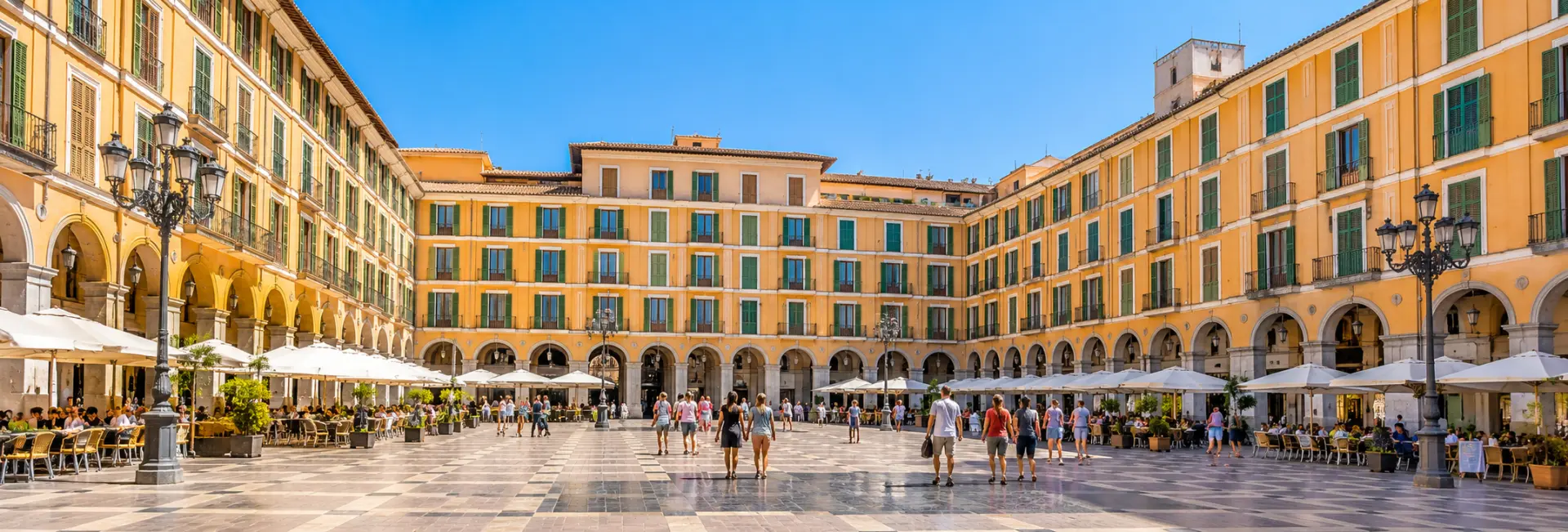
Plaça Major is the largest and most recognisable square in Palma's old town, a wide rectangle that opens suddenly after the tight lanes around it. Lines of uniform buildings in warm yellow with green shutters frame the space, and a continuous arcade runs around the ground floor, giving the whole square a theatrical, almost stage-like quality.
The plaza works as a crossroads more than a destination in itself. Four important streets lead into it, and the pedestrian shopping street Carrer de Sant Miquel pours a steady stream of walkers in from the north. As a result, there is almost always something happening: street performers, craft stalls, people meeting under the arches or lingering over coffee on a terrace.
Despite its classic appearance, Plaça Major is relatively young by Palma's standards. Its history is bound up with a convent, the Spanish Inquisition and a nineteenth-century urban makeover, and that contrast between a heavy past and a relaxed present is a big part of its appeal.
History
A Convent and the Inquisition
Before the square existed, this part of the old town was a dense tangle of narrow streets and small plazas. The site was occupied by the convent of Sant Felip Neri and by the headquarters of the Spanish Inquisition in Mallorca, a large rectangular building with an arcaded courtyard at its centre. For generations, it was one of the most feared addresses on the island.
Clearing the Ground
The Inquisition was abolished in 1813 by the Cortes of Cádiz, and in 1823 its building was demolished to make way for a new open space and a fish market. The neighbouring convent was expropriated in 1836 and torn down in 1854. As these buildings disappeared, the surrounding streets and houses were swept aside as well, and the present square began to take shape. Construction of the arcaded façades continued gradually through the nineteenth century and into the early twentieth.
From Market to Meeting Place
For a time in the early twentieth century, the plaza held the city's food market, which had previously been in Plaça de Santa Eulàlia. When the Mercat de l'Olivar opened in the 1940s, the stalls moved out and the square became a landscaped public space. In the 1960s and 1970s it grew into a gathering point for artists, musicians and bohemians, a role that lingers in its relaxed, creative atmosphere today.
Architecture & Design
A Uniform Frame
The square's appeal lies largely in its consistency. Tall, evenly proportioned buildings surround an open central space, their façades painted in warm yellow tones and fitted with green shutters. Wrought-iron balconies add rhythm to the upper floors, and some of them preserve modernist details that recall the era when Palma embraced art as part of its civic identity.
The Arcades
At street level, arches join to form a covered walkway around the square. Historically these arcades sheltered shoppers and gave merchants space to display their goods. Today, they house cafes, bars, restaurants and shops, and the shade they cast makes them a comfortable place to walk on hot days.
A Square on High Ground
Plaça Major and Carrer de Sant Miquel sit on slightly elevated ground that slopes away to the west toward the shady Passeig de la Rambla. The change in level gives the area a distinctive character, and the square feels open and bright compared with the shadowed alleys around it.
What to See There
- The arcaded façades: take a slow lap under the arches to see the shop fronts, balconies and shutters at close range.
- Street performers: puppeteers, living statues, musicians and other artists often work the square, particularly at busy times of year.
- Craft stalls: seasonal markets bring handmade goods and souvenirs into the open centre of the plaza.
- Terraces: cafes and restaurants set tables along the arcades and out into the square, perfect for people-watching.
- The view down Carrer de Sant Miquel: the lively pedestrian street that connects the square to the northern part of the old town.
- The modernist balconies: look up to spot decorative details that hint at the district's artistic past.
The plaza is not a monument with a ticket office. Its pleasure lies in the atmosphere, the architecture and the movement of everyday life across it.
It also helps to think of the square as a hinge between different parts of the old town. To the north, the busy shopping axis of Carrer de Sant Miquel leads toward the transport hub around Plaça d'Espanya. To the east, Carrer del Sindicat runs toward the edge of the historic centre and the neighbourhood of Sa Gerreria. Standing in the middle, you can sense how many everyday journeys cross this one space.
Events & Festivals
Craft Markets and Seasonal Stalls
Artisan stalls aimed at visitors looking for souvenirs appear in the square on many days, especially in the busiest months and around Easter and Christmas. In winter, the plaza also hosts a Christmas and Three Kings fair, with wooden stalls and festive decorations that give the whole area a warm glow.
The Revetla de Sant Sebastià
One of the biggest nights of the year takes place on 19 January, the eve of the feast of Sant Sebastià, patron saint of Palma. Giant figures dance in the square, bands play across the old town and large barbecues are set up in the streets, creating a lively, communal atmosphere that fills the district with the smell of grilled food.
Cultural Moments
The plaza also serves as an open-air stage for performances, book events and public gatherings. If you are visiting at a particular time of year, check the city's cultural listings to see whether something special is planned.
Ways to Experience It
Plaça Major is best enjoyed at a relaxed pace. Arrive from Carrer de Sant Miquel to experience the full effect of the space opening in front of you, then circle the arcades, stopping wherever something catches your eye.
- Sit on a terrace with a coffee or a drink and watch the square change as the day progresses.
- Browse the craft stalls for handmade gifts when the market is running.
- Photograph the arches, shutters and balconies in soft morning or late-afternoon light.
- Combine the visit with a walk along Carrer de Sant Miquel and its shops.
- Explore the lanes on the eastern side, toward Sa Gerreria, a once-neglected district that has become one of the city's trendier nightlife areas.
Most visitors spend half an hour to an hour here, longer if they stop for a meal. Because the terraces on the square tend to cater heavily to tourists, nearby side streets can be good places for a quieter, more local-feeling bite.
Best Time to Visit
Time of Day
The square is lively during the day, with shoppers, performers and diners filling the arcades. Mornings are calmer and good for photographs, while late afternoon and early evening are perfect for a drink on a terrace. Later at night, the plaza tends to quieten considerably, so it works best as a daytime and early-evening stop.
Time of Year
Spring and autumn offer pleasant temperatures for lingering outdoors. Summer brings the busiest crowds and the largest number of stalls and performers, though the shade of the arcades helps. Winter is a good time for the Christmas market and for the festivities of mid-January.
If you would like to see the square at its most atmospheric, aim for a weekday outside the peak summer weeks. The crowds are thinner, the arcades feel more spacious and it is easier to find a table with a view of the open centre. Visiting during a festival is exciting, but expect noise, queues and a very different, party-like mood.
Visiting Etiquette & Tips
Plaça Major is free to visit and always accessible, but a few tips can help you get the most from it.
- Check market dates and festival schedules in advance if you want to see stalls or celebrations, as they vary by season and year.
- Watch your belongings in busy periods, as you would in any crowded tourist square.
- Compare menus before sitting down. Prices on the square are often higher than in the side streets.
- Wear comfortable shoes, since the paving around the old town can be uneven.
- If you arrive by car, use a public car park nearby. Driving in the old town is not practical, and street parking is scarce.
- Be mindful of residents, particularly in the evening, as many people live in the buildings around the square.
- Expect the plaza to be closed or crowded around major festivals, and plan alternative routes if needed.
Nearby Attractions
Plaça Major sits close to many of Palma's best-known sights, so it is easy to combine with a wider walk.
- Carrer de Sant Miquel: the pedestrian shopping street that links the square with Plaça d'Espanya, and home to the Museu Fundación Juan March.
- Plaça d'Espanya: a large square to the north with a statue of Jaume I on horseback and a popular meeting point for transport connections.
- Mercat de l'Olivar: the city's main market hall, a good stop for food and local produce.
- Plaça de Cort: the town hall square with its ancient olive tree, only a short walk away.
- Basilica of Sant Francesc and Santa Eulàlia: two important Gothic churches in the old town.
- Palma Cathedral (La Seu): the great landmark on the seafront, reachable in a few minutes on foot.
FAQs about visiting Plaça Major
What is Plaça Major known for? +
It is Palma's main old town square, famous for its uniform yellow arcaded buildings, green shutters, cafes, street performers and craft stalls.
What was on the site before the square was built? +
The land held the convent of Sant Felip Neri and the headquarters of the Spanish Inquisition in Mallorca. The Inquisition building was demolished in 1823, and the square was developed over the following decades.
Is there an entrance fee? +
No. The plaza is an open public space and can be visited at any time of day for free.
When are the craft markets held? +
Stalls appear on many days, particularly in the high season and around Easter and Christmas. Schedules change, so check local listings for current dates.
What is the Revetla de Sant Sebastià? +
It is a traditional celebration on the night of 19 January, with giant figures, live bands and street barbecues across the old town, centred partly on Plaça Major.
How long should I spend here? +
Thirty minutes to an hour is enough for a look around, or longer if you stop for a meal or combine it with a walk along Carrer de Sant Miquel.
Is it a good place to eat? +
The terraces are convenient and atmospheric, but they can be pricier and more tourist-oriented. Side streets nearby often offer more local options.
Can I drive or park near the square? +
Driving in the old town is difficult, and parking is limited. Public car parks near the centre are a more practical choice, followed by a short walk.
