
Table of Contents
Overview
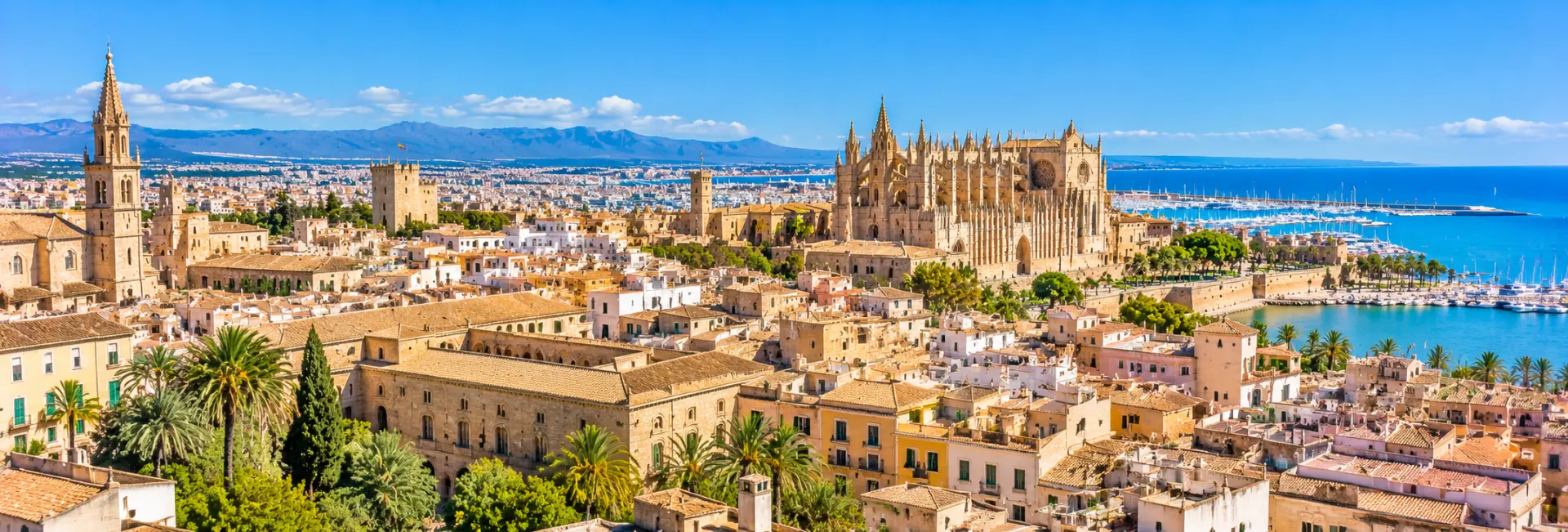
Palma's Old Town is the part of the city where Mallorca's past is easiest to feel. Narrow lanes twist between honey-coloured stone façades, small squares open up without warning, and quiet courtyards hide behind heavy wooden doors. The whole district is compact enough to cross on foot in a few minutes, yet it can fill an entire day of wandering.
It lies between the seafront, with the cathedral and the royal palace standing guard above the bay, and the broader avenues of the newer city. Within that small area you will find a Moorish bathhouse, medieval churches and cloisters, a Gothic maritime exchange, Baroque mansions and a town hall facing a famous olive tree.
The Old Town is also a living neighbourhood rather than a museum piece. Residents shop in its markets, drink coffee in its squares and pass through the same streets that merchants, bishops and kings once used. That mix of everyday life and layered history is what makes it so rewarding to explore.
History
Roman and Islamic Foundations
Palma traces its origins to 123 BC, when the Romans took control of the island under the general Quintus Caecilius Metellus and founded a city on this site. Streets in the oldest part still follow the outline of the original grid. Under Islamic rule the city was known as Madina Mayurqa, and a growing population pushed it beyond the old Roman walls, creating the district that today is recognised as the Old Town.
Capital of a Kingdom
In 1229 the army of Jaume I of Aragon conquered the island, a turning point for Mallorca and the wider Balearic Islands. The city was renamed the City of Mallorca, and for a time it served as the capital of the independent Kingdom of Mallorca, home to nobles, merchants, craftsmen and church institutions. Parish churches, convents and commercial buildings rose across the old quarter during these centuries.
Conflict and Change
The medieval and early modern periods were not always peaceful. The assault on the Jewish quarter in 1391 and the uprisings of the fifteenth and sixteenth centuries, including the Germanies revolt of 1521, left lasting marks on the city. Over time, the name Palma was restored, and the walled core evolved into the historic centre visitors explore today.
Architecture & Streetscape
Stone, Shutters and Narrow Lanes
The Old Town's character comes from its materials as much as its monuments. Warm sandstone, green wooden shutters, wrought-iron balconies and carved doorways line streets that are often only wide enough for pedestrians. Many alleys are shaded for most of the day, which makes strolling comfortable even in warm weather.
Patios Behind the Doors
One of the district's signature features is the traditional Mallorcan patio. Behind large wooden entrances, noble townhouses open onto courtyards with stone arches, stairways and plants, and several eighteenth-century examples are among the finest in the city. Many are private, but some are visible through open doors, and a few are accessible as part of museums, hotels or restaurants.
A Mix of Styles
- Moorish traces, such as the Arab baths and the arch of the Almudaina, which some experts believe may be even older.
- Gothic churches, cloisters and civic buildings from the centuries after the conquest.
- Baroque and Mannerist façades, including the carved wooden eaves of the town hall.
- Modernist and neo-Gothic touches, such as the tower-topped headquarters of the island government, the Consell de Mallorca.
Key Areas
The Cathedral and Seafront Edge
The southern edge of the Old Town is dominated by Palma Cathedral and the Almudaina Palace, which stand side by side above the Parc de la Mar and the bay. This is the district's most photographed corner and a natural place to begin or end a walk.
Plaça de Cort and the Civic Centre
Inland, Plaça de Cort has been a hub of city life since the thirteenth century. It is small, but it works as an orientation point, with routes leading toward the cathedral, Plaça Major and Passeig des Born. The old courts here gave the square its name, and the building they occupied is now the town hall.
Santa Eulàlia and the Jewish Quarter
Around the church of Santa Eulàlia, one of the oldest in Palma, lie the lanes of the former Jewish quarter, divided into the call major and the call menor. The area contains quiet alleys, Gothic interiors, convents and boutiques, and it rewards slow, curious walking.
La Lonja and the Waterfront Streets
Near the harbour, the medieval trading quarter known as La Lonja is now a lively zone of tapas bars, small squares and late-night cafes. It sits close to the Gothic exchange building that gave it its name.
Passeig des Born and the Shopping Streets
The tree-lined Passeig des Born links the old quarter with the more modern centre, and for centuries it followed the course of a watercourse that crossed the city. It is a pleasant promenade lined with shops, and a good place to pause after sightseeing.
Notable Landmarks
- Palma Cathedral (La Seu): the great Gothic church overlooking the bay, famous for its rose window and its interior art.
- Royal Palace of La Almudaina: the former Islamic fortress and royal residence beside the cathedral.
- Plaça de Cort and the Olivera de Cort: the square in front of the town hall, home to an ancient olive tree thought to be more than six hundred years old and replanted here in 1989.
- Palma Town Hall: a mostly seventeenth-century building with a richly decorated Mallorcan Baroque façade and a deep timber overhang.
- Banys Àrabs (Arab Baths): the only surviving bathhouse of the five that once existed in Palma, with a domed steam room, skylights and a quiet garden.
- Santa Eulàlia: one of the city's oldest churches, with a Gothic interior and a prominent place in the story of the Jewish quarter.
- Basilica of Sant Francesc: a major Gothic church with an adjoining cloister, set on its own square.
- La Llotja: the Gothic maritime exchange, designed by Guillem Sagrera, a reminder of Palma's medieval trading power.
- Plaça Major: the arcaded square reached through archways from the surrounding streets.
- Museu Fundación Juan March: an art museum on Carrer de Sant Miquel.
Ways to Experience It
The best way to experience the Old Town is on foot, without a strict plan. Start at the cathedral, drift inland toward Plaça de Cort and Plaça Major, then loop back via Santa Eulàlia and Sant Francesc. A walk like this takes a couple of hours without stops, but most visitors prefer to spread it across a morning or afternoon.
- Follow a self-guided route between the major squares and churches, pausing for coffee along the way.
- Look through open doorways for patios, stairways and sculpted arches.
- Visit the Arab Baths for a quiet interlude in the middle of the walk.
- Sample local pastries and hot chocolate in one of the old-fashioned cafes.
- Browse the markets and neighbouring streets for food and everyday life, including the Mercat de l'Olivar.
- Join a guided walking tour if you want historical context and access to places you might otherwise miss.
Evenings add another layer, as lit façades, busy terraces and the glow of the cathedral over the old walls give the district a different mood.
If you enjoy food, build your route around meals. The Old Town offers everything from simple tapas counters to refined restaurants tucked into discreet lanes, and the neighbouring Santa Catalina district, a former fishermen's quarter, has become one of the city's best-known areas for markets, wine bars and chef-led kitchens. Eating late is normal here, so leave room in the day for a long, unhurried evening.
Best Time to Visit
Time of Day
Early morning is the calmest time to explore, when the lanes are quiet and the light is soft on the stone. Midday can be busy around the cathedral and warm in summer, so it is a good moment to step into a church, museum or shaded courtyard. In the evening, the squares and La Lonja come alive as people gather for tapas and drinks.
Time of Year
Spring and autumn are the most comfortable seasons for walking, with mild temperatures and a pleasant atmosphere. Summer is lively but hot, so plan sightseeing for early or late in the day. Winter is calmer and often sunny, and the Old Town takes on a festive air in the weeks around Christmas, when the town hall and surrounding streets are decorated.
Visiting Etiquette & Tips
The Old Town is easy to navigate, but a few practical points make the experience smoother.
- Wear comfortable shoes. Many streets are paved with stone or uneven surfaces.
- Leave the car behind. Parking in the centre is difficult and expensive, and many lanes are too narrow for traffic.
- Dress respectfully in churches, with shoulders covered, and expect some to restrict visits during services.
- Check opening hours for churches, baths and museums, since they vary by season and by day.
- Be considerate in residential streets, where people live and work. Keep voices down, particularly in the evening.
- Carry water and sun protection in summer, and use shaded streets and courtyards for breaks.
- Keep an eye on belongings in busy squares and around the cathedral, as in any popular tourist district.
- Do not worry about getting lost. The district is small, and the cathedral and seafront make good reference points.
FAQs about visiting Palma Old Town
What is Palma's Old Town known for? +
It is known for its maze of narrow lanes, Gothic churches, shaded patios, historic squares and landmarks such as the cathedral, the Almudaina Palace and the Arab Baths.
How long should I spend in the Old Town? +
A highlights walk takes two to three hours, but a full day lets you add museums, patios, cafes and a long lunch. Many visitors return in the evening as well.
Is the Old Town walkable? +
Yes. It is compact and largely pedestrian-friendly, and most major sights are within a ten-to-fifteen minute walk of each other. Comfortable shoes are the main thing you need.
Where is the best place to start? +
The cathedral and Almudaina Palace make a natural starting point, with Plaça de Cort, Plaça Major and the surrounding squares easily reached on foot from there.
Is it free to visit? +
Wandering the streets and squares costs nothing. Individual attractions, such as the cathedral, the palace, the Arab Baths and some museums, charge admission, so check current prices on their official pages.
Can I see the traditional Mallorcan patios? +
Some are visible through open doorways, and a few can be seen inside museums, hotels or restaurants. Many are private, so be respectful and do not enter unless access is clearly allowed.
What is the tree in Plaça de Cort? +
It is the Olivera de Cort, an ancient olive tree standing before the town hall. It is considered a local symbol and is thought to be more than six hundred years old, though it was replanted in the square in 1989.
Is the Old Town suitable for families and visitors with limited mobility? +
Children usually enjoy the squares, courtyards and sweet treats, and the short distances help. The cobbled streets, steps and narrow pavements can be challenging for wheelchairs and pushchairs, so plan routes in advance.
