
Table of Contents
Overview
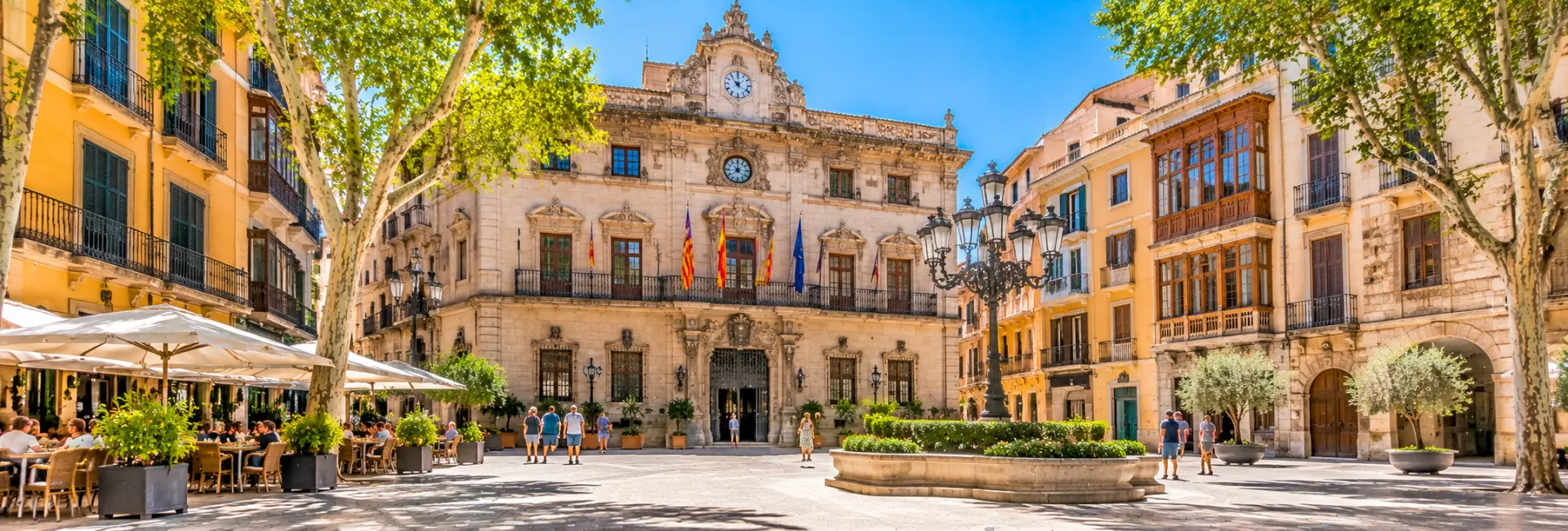
Plaça de Cort is the civic heart of Palma, a compact square in the old town where the city's town hall faces an ancient olive tree. It is small by the standards of Spanish plazas, but it carries a great deal of history, and it is among the most photographed corners of the city.
The square takes its name from the court, or cort, that once sat here. The same word is still used as a nickname for Palma's city council, which is why locals speak of "Cort" when they mean the town hall. Cafés spill onto terraces around the edges, and the space between them works as an open-air meeting point for residents, tour groups and visitors resting their feet.
Two things anchor the visit: the richly detailed façade of the Ajuntament de Palma, and the Olivera de Cort, the gnarled olive tree standing in the middle of the square. Together they make Plaça de Cort one of the best places in Palma to understand how civic life, history and local symbolism fit together.
History
A Square for Justice and Power
Plaça de Cort was never just an empty space between buildings. It grew up around the seat of the court of the Kingdom of Mallorca, and the building that now houses the city council began as a courthouse. Decisions affecting public life in Palma were taken here, which is why the square became the natural stage for official ceremonies and civic gatherings.
The Building Takes Shape
The present town hall dates mainly from the seventeenth century. Construction ran from 1649 to 1680 under the local architects Pere Bauçá, Miquel Oliver and Bartomeu Calafat, and later centuries added further touches, giving the building a blend of Gothic, Baroque and Modernist features. The façade follows the pattern of a traditional Mallorcan noble house, which gives it a familiar, domestic character despite its official role.
A Literary Admirer
The building has long attracted admiring attention. In his 1895 novel Clovis Dardentor, Jules Verne paused to describe it, remarking that visitors to Palma would hardly feel they had seen the city without admiring such a remarkable façade.
Kilometre Zero
Plaça de Cort is also described locally as the kilometre zero of Mallorca's roads, the symbolic point from which distances across the island are measured. It is a fitting role for a square that has been at the centre of the city's administration for centuries.
The Town Hall Façade
The façade is the most important element of the building and rewards slow looking. Its Mannerist and Baroque details are crowned by an enormous carved timber eave that projects about three metres over the street, supported by sculpted figures and giving the front of the building a distinctive, almost theatrical profile.
The Rellotge d'en Figuera
One of the best-known features is the Rellotge d'en Figuera, the historic clock that has watched over the square for generations. Locals treat it as a landmark in its own right, and it makes a useful reference point when you are meeting someone in the plaza.
The Bench of the Idle
At street level a stone bench built into the wall is known as the banc del si no fos, sometimes translated as the lazy man's bench. According to local tradition, people would sit there in the sun instead of going to work, always ready with an excuse that began with the Mallorcan phrase si no fos per, meaning "if it weren't for". The nickname stuck, and the bench is now one of the building's most charming curiosities.
The Dragon and the Snail
Look closely near one of the doorways and you can find a small dragon and a snail carved into the stonework. Spotting them has become a favourite game for children and for visitors who enjoy hunting for details.
Inside the Building
Behind the façade are historic reception rooms, a grand staircase and an entrance hall displaying large ceremonial figures known as giants. The town hall also houses a collection of portraits of illustrious figures from the history of the Kingdom of Mallorca, and the municipal Cort Library occupies part of the building.
The Olivera de Cort
The olive tree in the middle of the square is the best-known resident of Plaça de Cort, and one of the best-known trees in the Balearic Islands. Its trunk is twisted, hollowed and swollen with age, and visitors love hunting for faces and shapes in the bark, including a knot said to resemble an ear that is known as the Orella de Mallorca.
From Pollença to the City Centre
The olive did not begin life in the square. It was transplanted to Palma in 1989 from the estate of Pedruixella Petit, near Pollença, where its shape had already made it a favourite subject for painters and photographers. When the owner learned where it was going, he gave it to the city council. The tree weighed three to four tonnes when it was moved, and it sprouted again the following year, a sign that the operation had succeeded.
How Old Is It?
The official catalogue of protected species estimates the tree at between 500 and 600 years old, and many guides repeat that figure. Some popular accounts claim it is older, but the cautious estimate is the one that appears in the regional record.
Protected Status
The tree is municipal property and has been catalogued by the regional environment authority as a singular tree since 2003. Its trunk measures about seven metres around, the whole tree stands roughly six metres tall, and its canopy spreads more than seven metres across.
The popularity of the olive has had a cost. To protect the roots from visitors who climb or lean on it, the city installed a low steel barrier around the base after a survey of the root system, designed so that it would not damage the tree.
Festivals and Civic Life
Plaça de Cort is still used for collective celebrations, and several traditional events bring the square to life during the year.
Festa de l'Estendard
On 31 December the city celebrates the Festa de l'Estendard, often described as one of the oldest civic festivals in Europe, which commemorates the Christian conquest of Palma. The ceremonies centre on the town hall, and the square is the focus of the day.
Sant Sebastià
The festival of Sant Sebastià, Palma's patron saint, is another major date. In January the old town hosts celebrations around the saint's day, and Plaça de Cort is one of the places where people gather.
Christmas
During the Christmas period the town hall and the square are decorated with festive lighting, which draws extra attention from residents and tourists. It is a good time to see the façade in a different light.
Ways to Experience It
Plaça de Cort rewards a short, attentive visit rather than a long stay. These are the best ways to make the most of it.
- Study the façade slowly, looking for the clock, the lazy man's bench, the carved eave, the dragon and the snail.
- Walk around the olive tree and look for the shapes in its trunk, remembering that the barrier protects its roots.
- Sit on a café terrace around the square for a coffee or an ice cream and people-watch.
- Join a guided tour of the old town, many of which stop here alongside Plaça Major and the cathedral.
- Ask at the town hall about guided visits of the interior. Free tours of the building have been offered on certain Sundays, usually requiring advance booking, and they have covered the entrance hall, main staircase, the original mayor's office and the council chamber.
- Use the square as a navigation point for exploring nearby lanes, as it sits at the centre of the historic quarter.
Best Time to Visit
Time of Day
Early morning offers softer light and fewer crowds, which suits photographs of the olive tree and the façade. The square is busier around midday when tour groups arrive. In the evening the terraces and the lit-up town hall give it a livelier, more social mood.
Time of Year
The square can be visited in any season. Winter brings the Christmas lighting and the Sant Sebastià festivities, while the end of December is the moment for the Festa de l'Estendard. In summer, the terraces around the edges are the best place to rest during the heat of the day.
Visitor Tips
- The square is open public space, so there is no admission fee. A quick visit takes around 15 to 20 minutes, though it is easy to linger longer over a coffee.
- The town hall is a working administrative building. Interior access is not always possible, so check whether guided visits are running before you plan to go inside.
- Photograph the olive tree from outside the barrier, and avoid touching or climbing it so that it stays healthy for future visitors.
- Streets around the square are narrow and the area is best explored on foot, so wear comfortable shoes.
- The square is a good place to rest and get your bearings between the cathedral, Plaça Major and Passeig des Born.
- Expect crowds at peak times in the high season, particularly around midday, so plan an early or late visit if you want a quieter experience.
Nearby Attractions
Església de Santa Eulàlia
The Gothic church of Santa Eulàlia stands only a short walk from the square, a few minutes away through the lanes of the old town. It is a medieval landmark of the old town.
Plaça Major
Palma's main square, with its arcades, street artists and markets, is a short walk away and makes a natural next stop on a stroll through the centre.
Palma Cathedral and the Almudaina Palace
Both landmarks lie within easy walking distance, and many walking tours link them with Plaça de Cort as part of a loop through the oldest part of the city.
Passeig des Born and Arab Baths
The Passeig des Born, with its shops and cafés, is a short walk in one direction, while the Banys Àrabs, one of the few surviving relics of Islamic Palma, are also a short walk away.
FAQs about visiting Plaça de Cort
What is Plaça de Cort known for? +
It is known for the Ajuntament de Palma, the city's baroque town hall, and for the Olivera de Cort, an old olive tree in the centre of the square that has become a symbol of Palma.
How old is the olive tree? +
The regional protected species record estimates it at 500 to 600 years old. It was moved to the square in 1989 from an estate near Pollença.
Why is the square called Cort? +
The name comes from the court of the Kingdom of Mallorca, which sat here. The same word is still used as a nickname for Palma's city council.
Can I go inside the town hall? +
Access is not always available, but free guided visits have been offered on certain Sundays with advance booking. Check current arrangements before you go.
Is there an entrance fee for the square? +
No, Plaça de Cort is an open public square and there is nothing to pay to walk through or sit on a terrace.
How long should I spend there? +
A quick visit takes around 15 to 20 minutes, and an hour is plenty if you also stop for a coffee or join a guided tour.
Can I touch or climb the olive tree? +
No. A low barrier has been installed to protect its roots, so it is best admired and photographed from outside it.
What festivals take place in the square? +
The Festa de l'Estendard on 31 December, the Sant Sebastià celebrations in January and Christmas events all use the square and the town hall.
