
Table of Contents
Overview
The Archaeological Museum in Split is one of the most important places for understanding the long human history of central Dalmatia. Founded in 1820, it is the oldest museum in Croatia and preserves archaeological material connected with Split, ancient Salona, the central Dalmatian islands and other sites across the region. Its collections allow visitors to look beyond the medieval streets and Roman architecture visible around modern Split and explore a much broader story stretching from prehistory into the Middle Ages.
The museum is particularly valuable for travellers who have already visited Diocletian's Palace and want to understand the civilizations that shaped the surrounding region. Stone inscriptions, sculptures, ceramics, coins, glass, jewellery, funerary monuments and everyday objects reveal how people lived, traded, worshipped and commemorated the dead across different periods. The museum's garden, arcaded lapidarium and indoor galleries create a quieter archaeological experience away from the busiest streets of the historic centre.
History of the Museum
Origins in the Early Nineteenth Century
The museum was established on 22 August 1820, following growing scholarly and official interest in the antiquities of Dalmatia. An important stimulus came after Austrian Emperor Francis I visited Split and nearby Solin in 1818. The Roman remains of Diocletian's Palace and ancient Salona demonstrated the exceptional archaeological importance of the region and strengthened the case for an institution dedicated to preserving its discoveries.
From Early Collections to a Permanent Home
The young museum initially lacked a purpose-built home, and its antiquities were kept in temporary or inadequate spaces. A museum building was constructed near the eastern wall of Diocletian's Palace in 1836, but the growing number of objects eventually made more suitable accommodation necessary. The institution changed locations and expanded its storage as archaeological work produced thousands of additional finds.
The Present Museum
Efforts to secure a larger museum became especially important under archaeologist and priest Frane Bulić, a major figure in the study of Salona. Construction of the present museum complex began in 1912 and was completed in 1914. Over time, the institution developed not only as an exhibition venue but also as a centre for archaeological research, documentation, conservation and scholarship focused on Dalmatia's ancient past.
Museum Building and Lapidarium
A Museum Designed Around Archaeology
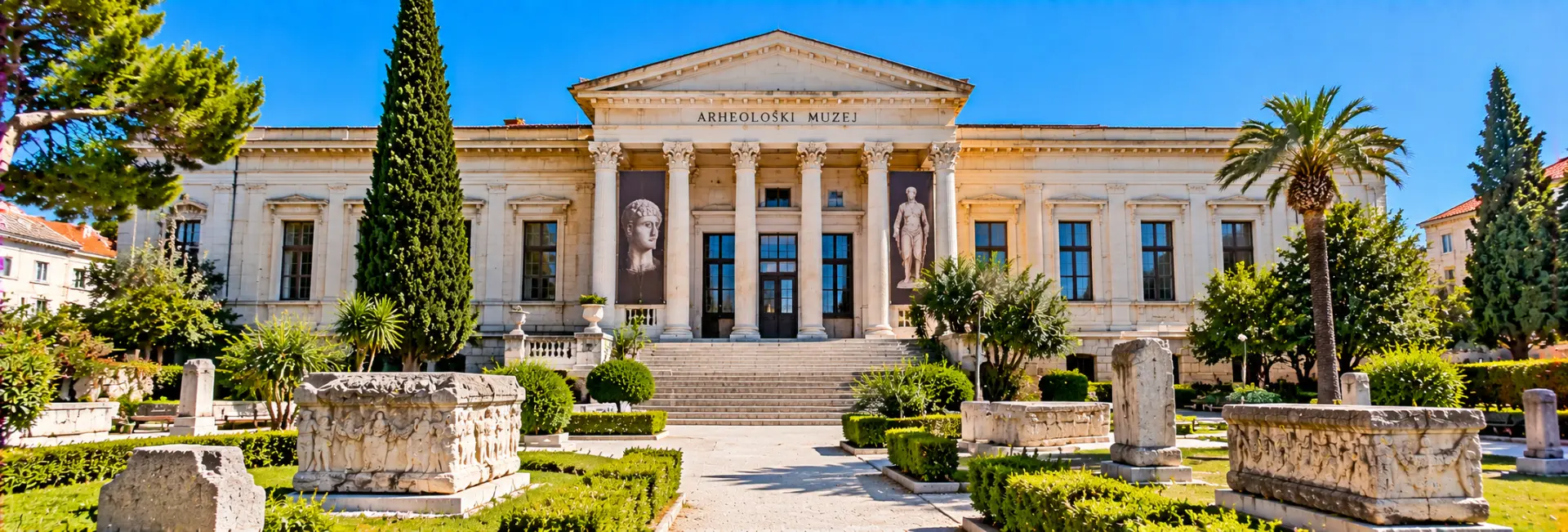
The museum complex offers a different atmosphere from the dense urban fabric of central Split. Exhibition rooms are complemented by an outdoor setting where stone monuments can be viewed with more space around them. This combination is particularly appropriate for archaeological material because many architectural fragments, inscriptions and funerary monuments were originally intended for substantial public or commemorative settings.
The Lapidarium
One of the museum's most distinctive features is its lapidarium. Stone monuments are displayed around the courtyard, portico, atrium and connecting areas, creating an extensive open-air component to the visit. The display includes material from Greek, Roman and medieval periods, together with some later pieces.
Visitors should allow time for this area rather than treating it simply as a passage between galleries. Latin inscriptions, carved reliefs, sarcophagi and architectural fragments preserve names, images and symbols that provide unusually direct contact with people and communities from ancient Dalmatia. Even without specialist knowledge, differences in lettering, decorative motifs and monument types make the lapidarium rewarding to examine slowly.
Archaeological Collections
Prehistoric Dalmatia
The prehistoric holdings provide context for life in the region before Greek colonies and Roman administration transformed the Adriatic world. Archaeological objects help trace settlement, craft traditions, exchange networks and changing communities over long periods. They are useful for understanding that Dalmatia's history did not begin with the monumental Roman remains for which Split is best known.
Greek and Hellenistic Material
The Greek-Hellenistic Collection is particularly significant. The museum holds thousands of registered objects associated with different phases of Greek culture, including material discovered on central Dalmatian islands and along the coast. These finds illustrate the connections that developed across the Adriatic through colonization, navigation, trade and cultural exchange.
Roman and Late Antique Collections
Roman material forms a major part of the museum experience, reflecting the importance of Dalmatia within the Roman world. Sculpture, inscriptions, glass, lamps, ceramics, metal objects and funerary monuments illuminate both public life and private experience. The archaeological record also extends into Late Antiquity and the Early Christian period, when religious practices, burial traditions and urban centres were undergoing profound change.
Coins and Smaller Finds
Small objects can be as revealing as monumental sculpture. Coins, jewellery, gems, household items and personal possessions offer evidence for commerce, status, fashion and daily activity. Viewed together, these collections help visitors move from the grand political history of emperors and cities to the practical lives of individuals who inhabited ancient Dalmatia.
Salona and the Ancient Dalmatian World
Why Salona Matters
Ancient Salona, located in present-day Solin near Split, has been central to the museum's work since its earliest years. The city became the capital of the Roman province of Dalmatia and developed into one of the most important urban centres on the eastern Adriatic. Excavations there have produced a vast archaeological record ranging from monumental architecture to inscriptions, burials and everyday objects.
The relationship between the museum and Salona helps explain why its Roman and Early Christian holdings are so important. Rather than presenting antiquities gathered without a regional connection, the museum preserves material closely tied to the landscapes and archaeological sites of Dalmatia. A museum visit can therefore serve as preparation for exploring Salona itself, where ruins remain visible in their original setting.
Research Beyond Split
The museum's archaeological activity has also extended to islands and other parts of Dalmatia. Its work at sites such as ancient Issa on Vis reflects the wider maritime networks that linked settlements across the Adriatic. Seen in this context, the collections tell a regional story in which coastal cities, islands, inland communities and sea routes continuously influenced one another.
Highlights and What to Look For
Stone Monuments and Inscriptions
The lapidarium is a natural starting point for visitors interested in Roman Dalmatia. Look closely at inscriptions as well as sculptural decoration: even when the Latin text is unfamiliar, names, letter forms and carved symbols demonstrate how stone was used to preserve identity and memory. Funerary monuments are especially valuable for glimpsing individuals who rarely appear in conventional historical narratives.
Greek-Hellenistic Finds
The Greek material provides an important counterpoint to Split's overwhelmingly Roman public image. Objects connected with Greek communities and cultural influence reveal that the central Adriatic had long participated in Mediterranean exchange before Roman rule. Ceramics and smaller artefacts can be particularly useful for recognizing these commercial and cultural connections.
Everyday Archaeology
Do not concentrate only on the largest sculptures and monuments. Lamps, glass vessels, coins, ornaments and utilitarian objects can reveal how ancient people ate, travelled, traded, dressed and organized domestic life. These smaller pieces often make the chronological distance between the visitor and the ancient inhabitants of Dalmatia feel surprisingly narrow.
Temporary Exhibitions
The museum also presents temporary exhibitions, so the exact visitor experience can change. These exhibitions may focus on particular archaeological communities, recent interpretations or selected groups of objects. Visitors interested in a specific exhibition should confirm the current programme directly with the museum before arriving.
Ways to Experience the Museum
Begin with the Regional Timeline
A useful approach is to follow the collections chronologically, beginning with prehistoric material before moving through Greek, Roman, Late Antique and medieval periods. This makes it easier to understand how settlement patterns and cultural influences changed across Dalmatia rather than viewing individual objects in isolation.
Combine Indoor Galleries with the Garden
The museum works best when its indoor and outdoor spaces are treated as a single experience. After examining smaller artefacts inside, spend time among the stone monuments of the lapidarium and garden. The change in scale helps place jewellery, coins and domestic objects alongside the monumental forms of public, religious and funerary archaeology.
Pair the Museum with Salona
Travellers with a strong interest in antiquity can combine the museum with a separate visit to the archaeological site of Salona in Solin. Seeing artefacts in the museum and then exploring the remains of the ancient city creates a more complete picture of Roman Dalmatia. The museum also operates a Salona branch collection and site, strengthening the connection between excavated objects and their archaeological landscape.
Best Time to Visit
The museum is an appealing choice throughout the year because much of the collection is displayed indoors, while the courtyard and lapidarium add an outdoor dimension in pleasant weather. During Split's busy summer season, a museum visit can provide a calmer alternative to the most crowded parts of Diocletian's Palace and the waterfront.
Morning visits are useful for travellers who want to examine the collections at an unhurried pace and then continue to other attractions. In warmer months, visiting the outdoor lapidarium earlier or later in the museum's opening period can also be more comfortable than spending extended time outside during the strongest midday heat.
Opening schedules vary seasonally and the museum closes on Sundays and holidays according to its current published visitor information. Because operating hours, exhibitions and admission arrangements can change, visitors should check the museum's official information shortly before their planned visit.
Visitor Tips and Nearby Attractions
Planning Your Visit
- Allow roughly one to two hours for a comfortable visit, with additional time if you enjoy reading inscriptions or studying archaeological details.
- Do not skip the courtyard and lapidarium; they are integral parts of the museum experience rather than merely decorative outdoor areas.
- Check current opening hours and temporary exhibitions before visiting, particularly outside the main summer season.
- Visitors planning to explore Salona should consider the museum and archaeological site as complementary experiences.
- Photography, accessibility arrangements and any special visitor requirements should be confirmed with the museum if they are important to your trip.
Getting There
The museum is at Zrinsko-Frankopanska 25, north of Split's historic core. It is within walking distance of Diocletian's Palace and can be incorporated into a day of sightseeing without requiring a trip far outside central Split. The museum also identifies nearby bus access via the Emanuel Vidović Park stop on line 8 and the Poljud Stadium stop on line 17.
What to See Nearby
Diocletian's Palace is the most meaningful attraction to pair with the museum because the surviving Roman complex gives architectural context to the objects displayed in the archaeological collections. Visitors can also explore Split's Old Town, the waterfront and other central museums. Those with additional time can travel to Salona in nearby Solin, where archaeological remains connect directly with many themes encountered inside the museum.
FAQs about visiting the Archaeological Museum Split
Why is the Archaeological Museum Split famous? +
It is Croatia's oldest museum, founded in 1820, and is especially important for archaeological material from Dalmatia, including finds associated with ancient Salona.
How much time should I spend at the Archaeological Museum Split? +
Around one to two hours is suitable for most visitors, although archaeology enthusiasts may want longer to study the lapidarium, inscriptions and individual collections.
Where is the Archaeological Museum Split located? +
The museum is at Zrinsko-Frankopanska 25, 21000 Split, north of the historic centre and within walking distance of Diocletian's Palace.
What can I see inside the museum? +
The collections cover prehistory, Greek and Hellenistic culture, the Roman era, Late Antiquity and medieval periods, with ceramics, coins, glass, sculpture, inscriptions and other archaeological finds.
Does the museum have outdoor exhibits? +
Yes. Its courtyard, garden and lapidarium display numerous stone monuments, including inscriptions, architectural pieces and funerary material.
Is the Archaeological Museum connected with Salona? +
Yes. Salona has been central to the museum's archaeological research and collections, and the institution also manages the Salona branch collection and archaeological site in Solin.
Can I visit the museum and Diocletian's Palace on the same day? +
Yes. The museum is about a 15-minute walk from Diocletian's Palace, making the two attractions easy to combine while exploring Split's Roman and archaeological heritage.
Should I check opening hours before visiting? +
Yes. The museum uses seasonal schedules and closes on Sundays and holidays, so current hours and any exhibition changes should be checked before your visit.
