Table of Contents
Overview
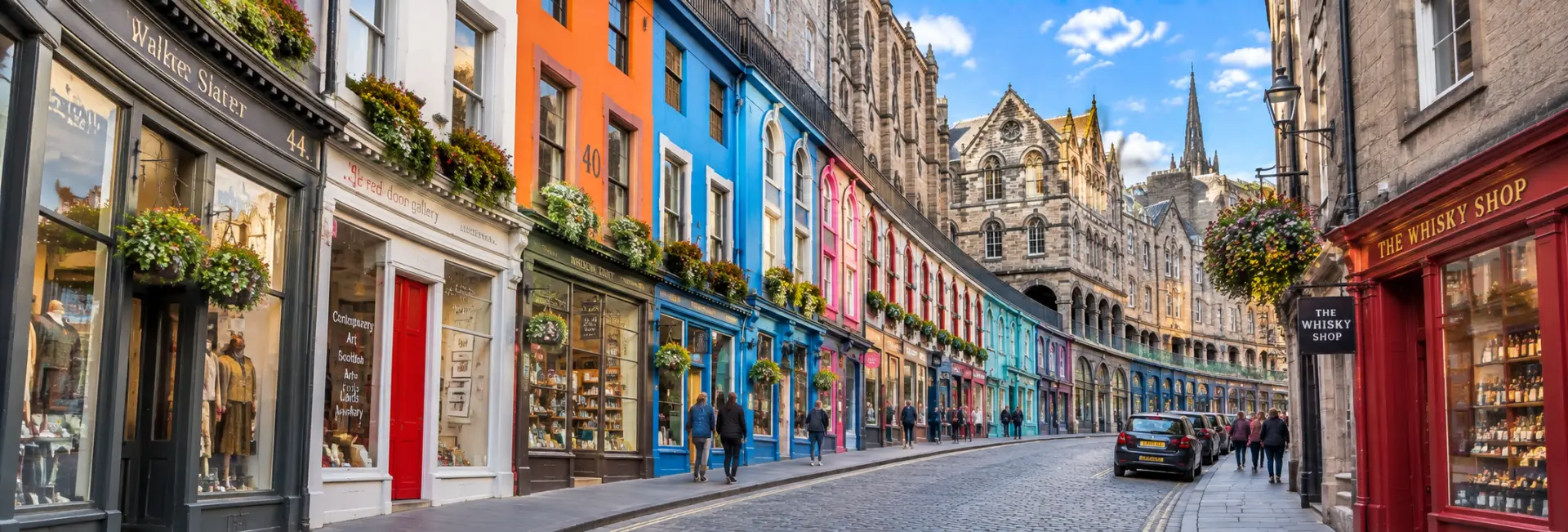
Victoria Street is one of the most photographed corners of Edinburgh's Old Town, a gently curving road lined with brightly painted shopfronts that climbs from the Grassmarket up toward George IV Bridge and the Royal Mile. Its sweeping shape and rainbow of colours make it stand out immediately from the grey stone streets around it, and its shops, from small bookshops to specialist food stores, give it a lively, independent character.
Though only a few hundred metres long, the street packs in centuries of history, tracing the line of one of Edinburgh's oldest routes into the city, and today draws a steady stream of visitors keen to browse its shops, take photographs from the upper terrace, and see the street many associate with the winding, quirky lanes of popular fantasy fiction.
History
The Old West Bow
Before Victoria Street existed, this route was known as West Bow, a steep, narrow, zigzagging lane that formed the main approach into the city from the west and southwest for centuries. Its sharp bends were designed for pedestrians and pack animals rather than wheeled traffic, and the street doubled as a public marketplace and, at times, the site of public executions.
The 19th-Century Improvement Scheme
As Edinburgh grew in the early 19th century, city planners sought a smoother, more practical route to connect the Grassmarket with a newly built bridge leading toward the Old Town's high ground. Much of the old West Bow was cleared to make way for a new, gently curving street, built mainly through the 1830s and 1840s, that could accommodate carriages and carts far more easily than the old lane ever could.
Renaming and Later Character
The new street was originally known simply as Bow Street before being renamed in the late 1830s in honour of the recently crowned queen, giving it the name it carries today. Through the 20th century the street's shops and closes took on a bohemian, independent character, and in more recent decades its striking curve and colourful facades have made it a favourite backdrop for photographers and a popular stop for visitors drawing comparisons to fictional wizarding streets.
Architecture & Streetscape
Victoria Street's most distinctive feature is its pronounced curve, engineered in the 19th century to ease the steep gradient of the older route it replaced. Shopfronts along the lower level are topped by a pedestrian terrace, Victoria Terrace, which runs along the upper storey and offers a raised vantage point over the street below.
The buildings themselves mix stone tenements from the street's Victorian construction with a handful of older structures, some dating back to the 1600s and 1700s, that survived the redevelopment. Shopfronts are painted in a wide range of bold colours, a relatively modern addition that has become closely tied to the street's identity and photographic appeal.
Key Areas
Lower Victoria Street and West Bow
The lower stretch nearest the Grassmarket retains the name West Bow in places and includes some of the oldest surviving buildings on the route, tucked in among newer shopfronts.
Victoria Terrace
Running along the top of the curve, this elevated pedestrian walkway offers sweeping views down over the street's colourful rooftops and is a popular spot for photographs.
Upper Victoria Street
Near the top of the curve, the street levels out close to its junction with George IV Bridge and the Lawnmarket, connecting directly into the wider network of the Royal Mile.
Notable Landmarks
- Victoria Terrace, the raised walkway running above the shops for much of the street's length.
- A cluster of surviving 17th- and 18th-century buildings near the foot of the street in the old West Bow.
- A concentration of independent bookshops, whisky and food specialists, and gift shops with fantasy and fiction themes.
- The street's junction with the Grassmarket, itself a historic marketplace and public square.
Ways to Experience It
Victoria Street is best explored slowly on foot, wandering up from the Grassmarket and browsing the independent shops along the way before doubling back along Victoria Terrace for an elevated view of the street below. Many visitors combine it with a wider walk through the surrounding Old Town, since it sits close to both the Grassmarket and the top of the Royal Mile.
- A simple walk up and back down the street, including the terrace, typically takes 20 to 30 minutes.
- Photographers often shoot from Victoria Terrace to capture the full curve and colour of the street below.
- The street's shops make it a popular stop for browsing gifts, books and Scottish food and drink.
Best Time to Visit
Early mornings tend to offer the clearest photographs and quietest browsing, since the street's narrow width means it can feel crowded once tour groups and shoppers arrive later in the day. Weekday visits, particularly outside the busy summer festival season, generally mean smaller crowds than weekends.
Overcast days can actually suit photography well here, since the street's colourful shopfronts stand out clearly without the harsh shadows that direct sunlight can create on the curved facades.
Visitor Tips
- The street is steep in places, so comfortable footwear is worth wearing, especially on cobbled sections.
- Victoria Terrace, above the shops, offers a quieter route with good photo opportunities if the main street feels crowded.
- Shops here are independently owned, so hours can vary, particularly outside peak tourist season.
- The street can get busy with tour groups in the middle of the day, so visiting earlier or later can mean a calmer experience.
FAQs about visiting Victoria Street
Why is Victoria Street so famous? +
It is known for its distinctive curved shape, colourful shopfronts and historic buildings, and is widely associated by visitors with the winding magical streets of popular fantasy fiction.
What was Victoria Street called before it had its current name? +
The street was originally known as West Bow and, after redevelopment in the 1830s, briefly as Bow Street, before being renamed Victoria Street later that decade.
How long does it take to walk Victoria Street? +
A relaxed walk up the street and back along the upper terrace usually takes around 20 to 30 minutes, longer if stopping to browse shops.
Is Victoria Street free to visit? +
Yes, it is a public street with no entry fee, though individual shops and cafes along the route charge for their own goods and services.
What is Victoria Terrace? +
It is a raised pedestrian walkway running along the upper level of the street, offering elevated views down over the shopfronts and curve below.
Is Victoria Street connected to the Royal Mile? +
Yes, the top of the street joins George IV Bridge close to the Lawnmarket, making it easy to combine with a walk along the Royal Mile.
Is Victoria Street suitable for wheelchair users? +
The main street has a steady incline and cobbled sections in places, which may be challenging for wheelchair users, so an accessible alternative route may be preferable for some visitors.