
Table of Contents
Overview
Banje Beach is the beach most visitors picture when they think of swimming in Dubrovnik. It sits on a small curve of coast just outside the eastern edge of the Old Town, close enough that you can finish a morning on the city walls and be in the water within minutes.
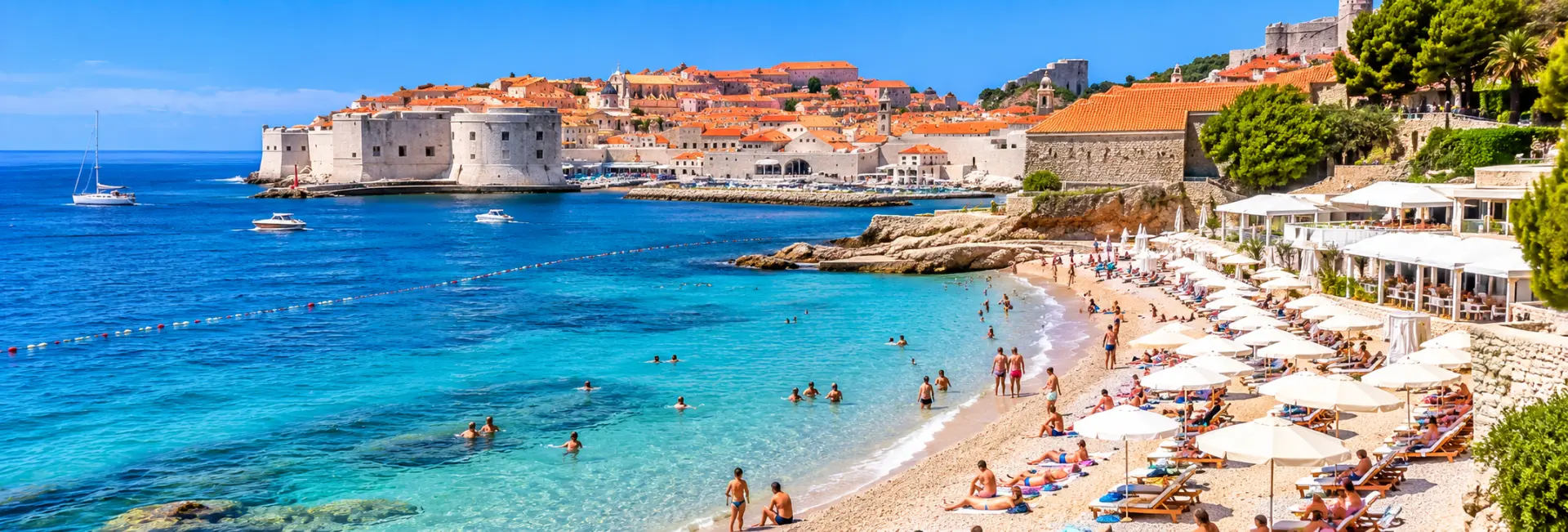
The setting is the real draw. From the shoreline you look across a short stretch of Adriatic water to the green mass of Lokrum Island, while the stone fortifications of the old city stay in view along the coast behind you. Few city beaches in Europe put swimmers this close to a medieval skyline.
The beach is a mix of fine pebbles, gravel and flat rock rather than classic sand. It has a free public section and a paid section run by the Banje Beach restaurant and club, so it suits both travelers on a budget and those who want sunbeds, cocktails and a table with a view.
Because of its position and its reputation, Banje is also one of the busiest places on this stretch of coast in summer. A little planning on timing and gear makes the difference between a crowded stop and a genuinely enjoyable half day by the sea.
Location and Setting
Where it sits
Banje lies on the coast to the east of the walled Old Town, in the Ploče district. The beach is reached by leaving through Ploče Gate, the Old Town's eastern entrance, and following the coastal road a short way before a flight of steps leads down to the shore. Most people need only a few minutes on foot from the gate.
The beach occupies the shoreline between the Hotel Excelsior and the long stone buildings of the Lazareti, which gives it a sheltered, enclosed feel. The street address for the beach club is Frana Supila 10/B, a useful detail for taxis and map searches.
The water and the view
The sea here is clear and generally calm, and the bottom shelves away fairly quickly, so the water gets deep sooner than on some of the gentler sandy beaches elsewhere in Dubrovnik. Lokrum Island lies roughly 600 meters offshore and dominates the horizon.
Looking back from the water, you take in the old city's walls and rooftops along the coast, which is what makes this spot so popular with photographers at the start and end of the day.
History of the Area
A city built on sea trade
The land around Banje belonged to the territory of the Republic of Ragusa, the maritime city-state that Dubrovnik grew into during the Middle Ages. Its wealth depended on ships, merchants and caravans, and its leaders took the risks that came with that traffic seriously.
The birthplace of quarantine
Dubrovnik introduced a mandatory isolation period for arrivals from plague-affected regions in 1377, and the practice later settled at forty days, from the Italian word quaranta. That is the origin of the word quarantine as we use it today.
Early quarantines took place on nearby islets, including Lokrum, but as trade by land and sea grew, the authorities wanted a permanent facility beside the harbor and the eastern gate. The Senate decided in 1590 to build one at Ploče, and construction ran from 1627 to 1647.
The Lazareti next door
The result was the Lazareti, a complex of ten linked halls arranged around five courtyards, still standing a few steps from the beach. Merchants and travelers waited out their isolation there, and goods were stored under the same roofs. The buildings stayed in use as a quarantine and health facility into the 19th century.
Today the Lazareti are one of the best-preserved quarantine complexes in this part of the Mediterranean, and they now host cultural events and nightlife. Swimming at Banje, you are literally at the edge of one of the great public health monuments of Europe.
From walls to waterfront
The Old Town itself is a UNESCO World Heritage Site, inscribed in 1979, and it was rebuilt in its characteristic stone form after the devastating earthquake of 1667. Banje is the modern chapter of this story, a place where the working harbor edge of the old republic became a leisure waterfront.
The Beach: Public and Private Sections
The free public area
Entry to the beach is free, and a part of the shore is left open to anyone who wants to spread out a towel. This public section is mostly gravel, pebbles and flat rock, and it tends to fill up early on summer days. There are showers and toilets nearby, which makes it easy to rinse off and change.
The Banje Beach restaurant and club
The remaining part of the beach is managed by the Banje Beach restaurant and club, where you pay to rent sunbeds and umbrellas. The surface here is softer underfoot than the public area, and the setup includes waiter service, a bar and a private pier used by guests arriving by boat.
The venue works as a seafood-focused Mediterranean restaurant by day and shifts into a beachside party spot after dark. It is typically open daily from 10:00 until 23:00 during the season, which generally runs from spring to autumn, though dates and prices can change, so check with the venue before you go.
Which section to choose
- Choose the public area if you want a quick swim, a low-cost visit or a short stop between sights.
- Choose the paid section if you plan to stay for hours, want shade and comfort, or want to combine the beach with lunch or sunset drinks.
- Locals sometimes joke that the beach has a part for the rich and a part for the poor, but the water and the view are the same on both sides.
Views and Highlights
The most striking feature is the combination of old stone and open sea. Lokrum Island sits directly across the water, covered in dense pine and Mediterranean vegetation, and the city fortifications continue along the coast behind you. On clear days the water takes on a deep blue-green tone that photographs well from almost any angle.
A few small highlights are worth noticing while you are there:
- The view of Lokrum from the shoreline, especially in the late afternoon when the light turns warm.
- The stone arches and red-tiled roofs of the Lazareti along the shore.
- The sight of kayaks and small boats moving between the beach and the walls.
- The beachfront terrace of the restaurant, which looks directly over the pebbles to the island.
Sunset is especially popular, as the light softens across the water and the beach club begins to shift toward its evening mood.
Ways to Experience It
Swimming and sunbathing
The simplest way to enjoy Banje is to arrive with a towel, swim, and stay as long as the heat allows. Water shoes are a good idea, because the pebbles and rock can be uncomfortable underfoot when you enter and leave the sea.
Sea kayaking
Kayak rentals and guided paddling trips operate nearby. Paddling takes you along the base of the city walls and out toward Lokrum, and it also reaches small coves that cannot be walked to. For many visitors this is the best way to see the Old Town from an entirely different angle.
Water sports and boat access
Beyond kayaking, the area offers other water activities in season, such as jet skis and towed rides. If you keep a boat or have chartered one, the private pier at the beach club can be used by guests.
Dining and evenings
A meal at the beachfront restaurant is a popular way to round off the day, with a menu built around seafood and Dalmatian and Mediterranean dishes. Later in the evening the venue turns into a nightclub, so it suits visitors who want a lively end to the day.
Best Time to Visit
Season
The warmest and most reliable swimming weather runs through the summer months, roughly from June to September, with the sea at its most comfortable in late summer. This is also the busiest period, when cruise ships and tour groups push crowds in the Old Town to their peak.
Late spring and early autumn can be a better balance. The sea is cooler but still swimmable for many people, the air is pleasant, and the beach feels much less packed. Outside the main season, the beach club generally shuts down, so services will be limited or unavailable.
Time of day
- Early morning is the quietest window, with softer light and plenty of space on the pebbles.
- Midday brings the strongest sun and the largest crowds, especially on days when several cruise ships are in port.
- Late afternoon and sunset are popular for photos and drinks, and the beach often feels more relaxed as day-trippers leave.
Checking the cruise ship schedule for Dubrovnik before you go is a simple way to avoid the worst of the crowds.
Visitor Tips
- Wear water shoes or sturdy sandals, as the surface is pebbly and rocky rather than sandy.
- Arrive early in high season if you want a spot on the free section of the beach.
- Bring sun protection and water, since shade is limited on the public area.
- Keep valuables to a minimum, and use a waterproof pouch if you plan to swim a lot.
- If you want a sunbed, check availability and prices with the beach club, as they vary with the season and the day.
- Take care in the water, as the depth increases quickly from the shore. Stay alert to boats and personal watercraft if you swim farther out.
Accessibility
The beach is reached by a staircase, and the shoreline is uneven, with pebbles and rock. This makes it a difficult place for wheelchair users and can be tiring for visitors with limited mobility. Dubrovnik's hills and steps generally require some planning for anyone who needs step-free routes.
Getting there
Walking from the Old Town through Ploče Gate is the easiest approach. Parking near the Old Town is limited and tends to be expensive, so most people arrive on foot, by taxi or by local bus rather than driving to the beach itself.
Nearby Attractions
Ploče Gate and the Old Town
The eastern gate of the walled city is just a short walk away, and it leads into the heart of the historic center, where the main street, the harbor and the city's churches and palaces are all within easy reach. The city walls themselves offer one of Europe's best urban walks.
Lazareti
Right beside the beach, the former quarantine complex is worth a quick look for its long stone halls, courtyards and vaulted spaces. It is now used for events and cultural activities, so it is worth checking what is on during your visit.
Revelin Fortress
This fortress stands close to Ploče Gate and has its own history in the city's defenses. It is also known today as a venue for events and nightlife, making it a natural pairing for an evening after the beach.
Lokrum Island
The island you see from the beach can be visited by boat from the Old Town harbor. It has walking paths, gardens, a former monastery and quiet swimming spots, and it makes an easy half-day trip when you want a break from the crowds.
Dubrovnik Cable Car
The cable car station is within walking distance and takes you to the Srđ hilltop, where a wide panorama of the city, coastline and islands is a good counterpart to the view from sea level.
FAQs about visiting Banje Beach
Is Banje Beach free to enter? +
Yes, entry to the beach is free, and a part of the shore is open to anyone. You only pay if you want to rent sunbeds and umbrellas in the section run by the beach club.
Is Banje Beach sandy or pebbly? +
It is mainly pebbles, gravel and flat rock, so the surface is not sandy. The area managed by the beach club is somewhat softer underfoot, but water shoes are still a good idea for most visitors.
How far is Banje Beach from the Old Town? +
It is a short walk, usually just a few minutes, from Ploče Gate, the Old Town's eastern entrance. You leave through the gate, follow the coastal road briefly and take the steps down to the beach.
When is the best time to visit Banje Beach? +
Early morning offers the quietest conditions, and late afternoon or sunset is lovely for photos and drinks. For warm water, plan on the summer months, but expect more crowds when cruise ships are in port.
Is Banje Beach good for families with children? +
It can work, especially in the early hours, but the water gets deep fairly quickly and the shore is pebbly. Families with small children may find the sandier, shallower beaches elsewhere in Dubrovnik easier, while older children and confident swimmers will enjoy it.
What can you do at Banje Beach besides swimming? +
You can rent a sea kayak or join a guided paddle toward the city walls and Lokrum, try other water activities in season, and have lunch or cocktails at the beach restaurant. In the evening the club turns into a nightlife venue.
Is Banje Beach accessible for wheelchair users? +
Access is difficult, because the beach is reached by stairs and the ground is uneven with pebbles and rock. Visitors who rely on a wheelchair or have limited mobility should plan ahead and expect challenges.
