
Table of Contents
Overview
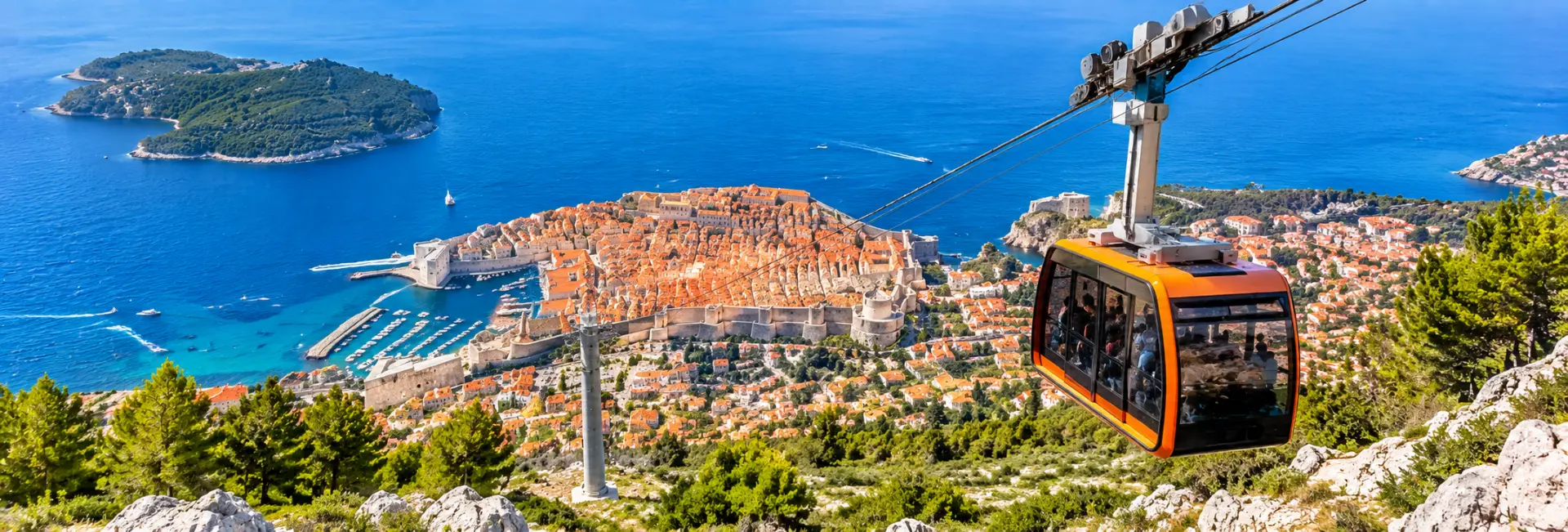
Rising directly behind the Old Town, Mount Srđ is the hill that gives Dubrovnik its most famous panorama. The summit stands roughly 412 meters above the Adriatic, and the Dubrovnik Cable Car lifts visitors from a station just outside the city walls to a terrace at 405 meters in only a few minutes. From up there, terracotta rooftops, the line of the walls, the island of Lokrum and the Elaphite Islands spread out in one sweep.
The summit offers more than a view. Napoleonic-era Fort Imperial sits beside the upper station and holds a museum about Dubrovnik during the Homeland War, while a large cross, a restaurant, binocular terraces and an open-air amphitheatre round out the site. It is a place where scenery, military history and living memory sit side by side.
You can reach the top by cable car, on foot along a zigzag trail, or by road, so the hill suits different budgets, fitness levels and schedules. Plan on one to two hours at the summit if you want to enjoy the views, see the fort and have a drink or meal.
History of the Cable Car and Mount Srđ
A Hill Named for Its Forests
Long before cabins and viewing platforms, the hillside was covered in oak and pine woodland. The local word for such woods, dubrava, is widely believed to be the root of the name Dubrovnik. Over the centuries the slopes were stripped of trees, and the barren, stony face you see today is a very different landscape from the one that inspired the city's name.
Forts on the Skyline
The hill's height made it strategically valuable. The French built Fort Imperial here during their occupation in the early 1800s, and the Austrians later expanded the defenses, adding outer works such as Fort Strinčjera along the ridge. These forts were designed to protect the city from an attack coming over the high ground to the north.
The Original Cable Car
The first cable car opened in 1969 and was the only one of its kind on the Adriatic at the time. Its small cabins carried about 15 people each, but the ride gave tourists a rare view of the walls and rooftops from above. The upper area also gained leisure uses in those years, and Fort Imperial was even used as a nightclub for a period in the 1980s.
Destruction and Rebirth
During the siege of Dubrovnik that began in October 1991, the cable car and its upper station were destroyed in the shelling. The line stayed out of use for almost two decades. A new system, backed by an investment of around five million euros, opened in July 2010 with larger cabins, a modern upper station and the same route up the hillside.
The Cable Car Ride
The Route
The lower station stands about 38 meters above sea level on Petra Krešimira IV street, just north of the walls. From there the line runs 778 meters to the upper station at 405 meters, a climb of 367 meters. The cabins pass over a single support column on the way, which keeps the view below mostly open.
Cabins and Capacity
The system is a reversible aerial tramway with two cabins that balance each other, so one rises as the other descends. Each cabin can carry up to 32 passengers, and the ride takes roughly three and a half minutes. Departures leave about every 15 minutes, or sooner once enough passengers have gathered.
Operations and Weather
The cable car opens daily in the morning and runs later in the summer months. Service is paused during high winds, thunderstorms or heavy rain, so it can close on days that look fine from the ground. The operator posts live status updates on its website, which is worth checking before you walk up to the station.
Accessibility
Both stations are designed to be accessible. The lower station has a ramp, and the upper station has an elevator, so wheelchair users and families with strollers can reach the summit without climbing stairs. Pets are not allowed in the cabins.
Fort Imperial & the Homeland War Museum
Napoleon's Fortress
Fort Imperial was built by the French while they controlled Dubrovnik, with construction beginning around 1806 and finishing a few years later. A local story says it was completed on 15 August, Napoleon's birthday. After the Austrians took over the city in 1815, they enlarged the fortress, and it spent much of the following century and a half with little military use.
The Defense of Dubrovnik in 1991
That changed in 1991. The fort became the first line of defense for the city, and the command post of the local Croatian Army brigade was based here. It took heavy fire, most intensely during a major assault on 6 December 1991. Its walls still show the scars, and the fort has become a symbol of the city's resistance.
The Museum Today
Inside, the exhibition Dubrovnik in the Homeland War, 1991 to 1995, tells the story of the siege through original documents, photographs, video footage, artwork, unit flags and military equipment, including mines and weapons. The tone is sober, and some of the material can be upsetting, so allow time to move through it at your own pace.
Even visitors who mainly come for the scenery often find that the museum changes how they see the Old Town below, since it shows how close the city came to being lost.
Views & What to See at the Top
The Panorama
The main attraction is the view. Three terraces at the upper station look out over the Old Town, Lokrum island, the Elaphite Islands, Gruž harbour, the Lapad peninsula and the open Adriatic. Binocular telescopes help you pick out details such as the Stradun, church domes and boats around the old harbor.
The Cross
A large white stone cross stands near the fort and is visible from far out at sea. An earlier cross was brought down in the fighting of 1991, and a replacement was raised afterward. It is both a landmark and a memorial for the people who defended the hill.
Panorama Restaurant and Bar
The upper station houses a restaurant and bar serving Mediterranean dishes at lunch and dinner, along with wines, cocktails and desserts. Tables with a direct view of the city are popular, especially around sunset, so reservations are handled directly through the restaurant rather than the cable car company.
Amphitheatre, Shops and Facilities
There is a small amphitheatre that seats up to 120 people. In summer it hosts free evening events such as live music, open-air film screenings and children's activities. You will also find a souvenir shop, restrooms and a water refilling station.
The Trail to Fort Strinčjera
For a quieter side of the hill, a flat gravel track runs from Fort Imperial about 1.3 kilometers north-west to Fort Strinčjera, an Austro-Hungarian fortification now overgrown with vegetation. The path passes through patches of forest and grazing land, and memorials near the ruins mark where defenders fell in 1991.
Ways to Experience Mount Srđ
Riding the Cable Car
This is the easiest and most popular option. Tickets can be bought for a round trip or a single ride, and they are generally valid for a long period rather than for one fixed day, so a one-way ticket can be used later. There are no reservations for individual rides, and everyone joins the same queue at the lower station.
Hiking Up the Zigzag Trail
A well-worn path climbs the bare southern face of the hill in long switchbacks. Expect a steady uphill walk of roughly an hour or more, with almost no shade, so start early or time it for the evening. Many people hike up and ride the cable car down, or buy a one-way ticket for the descent.
Buggy Safaris and Tours
Organized buggy tours operate on the hill and its tracks, combining driving with stops at viewpoints. Many guided Old Town tours also bundle the cable car ride with a walk around the city walls, which can save time on a short stay.
By Road
It is possible to drive to the summit from the village of Bosanka, but the road is narrow and unsuited to large vehicles, particularly in high season. Taxis and tour vehicles use it, and parking at the top is limited.
Best Time to Visit
Time of Day
Sunset is the signature moment, when the stone of the Old Town glows and the sea turns gold. It is also the busiest time, so arrive early to secure a good spot on the terraces. Mornings usually offer the clearest air and softer light for photographs, along with shorter queues.
Season
Spring and autumn combine comfortable temperatures with calmer crowds. Summer brings the longest opening hours and the free evening events, but also heat and long lines at the lower station. In winter the hill is quiet and the views can be exceptionally crisp, although hours are shorter and strong winds sometimes halt service.
Visitor Tips
- Check the official website for current opening hours, ticket prices and the live operating status before you set out.
- Buy tickets directly at the lower station cash desk or ticket machine if you want to avoid the extra fee that applies to online and third-party sales.
- Expect queues in summer, and consider going early in the morning or after the afternoon peak.
- From the Old Town, walk to the lower station via Pile or Ploče gate in roughly 8 to 12 minutes, or use the steeper stairs from Buža gate for a shorter but tougher climb.
- If you arrive by cruise ship at Gruž port, take local bus number 8 or a taxi rather than attempting the long walk.
- Bring a light jacket, since it can be breezy and noticeably cooler at the top, even in warm weather.
- If you hike, carry water, wear sturdy shoes and avoid the midday heat.
- Treat the museum and the memorials with respect, as they commemorate people who lost their lives in 1991.
Nearby Attractions
The lower station is a short walk from the eastern edge of the Old Town, so the cable car pairs easily with other sights.
- Buža Gate and the Old Town walls: The nearby gate leads to the steep stairs and the best-known walk along the fortifications.
- Stradun and Luža Square: The Old Town's main street and central square are a few minutes' walk away.
- Revelin Fortress: A 16th-century fortress guarding the eastern entrance to the Old Town, close to Ploče gate.
- Lazareti: A former quarantine complex now used for cultural events, just beyond Ploče gate.
- Banje Beach: The city's best-known beach, a short walk from the Old Town's eastern side.
- Lokrum Island: Visible from the summit and reachable by boat from the old harbor.
FAQs about visiting the Dubrovnik Cable Car and Mount Srđ
What is the Dubrovnik Cable Car? +
It is an aerial tramway that carries passengers from a station just north of the Old Town walls up to the top of Mount Srđ. The upper station sits at 405 meters and offers panoramic views over the city and the Adriatic.
Where is the cable car located and how do I get there? +
The lower station is at Petra Krešimira IV 10a, opposite the fire station. From the Old Town it is a walk of around 8 to 12 minutes from Pile or Ploče gate, or you can take bus number 8 or a taxi from Gruž port.
How long does the ride take? +
The journey takes roughly three and a half to four minutes each way, covering 778 meters of track. Cabins depart about every 15 minutes or as soon as enough passengers are ready.
Do I need to book the cable car in advance? +
No, individual rides cannot be reserved, and everyone joins the same queue. You can buy tickets online, at the lower station or at some authorized outlets in town, though extra fees may apply away from the station itself.
What are the opening hours and ticket prices? +
The cable car opens daily in the morning and stays open later in summer, but exact hours and prices change through the year. Check the official timetable and price page before your visit for current details.
Is it worth going up Mount Srđ? +
Yes, particularly if you want a clear overview of the Old Town's layout and walls, or if you are interested in the city's modern history. Visitors who like photography, sunsets or a dinner with a view tend to rate it highly.
Can I walk up instead of taking the cable car? +
Yes, a zigzag trail climbs from the foot of the hill to Fort Imperial. It takes roughly an hour or more, has little shade and is best done early in the day or in the evening, with water and sturdy shoes.
What is there to do at the top? +
You can enjoy the views from the terraces, visit the Homeland War Museum in Fort Imperial, eat or drink at the Panorama restaurant and bar, browse the souvenir shop and explore the trail to Fort Strinčjera. In summer there are also free evening events at the amphitheatre.
Is the cable car accessible, and does it run in all weather? +
Both stations have step-free access, with a ramp at the bottom and an elevator at the top. Service stops in high winds, thunderstorms or heavy rain, so check the live status on the official website if the weather looks unsettled.
