
Table of Contents
Overview
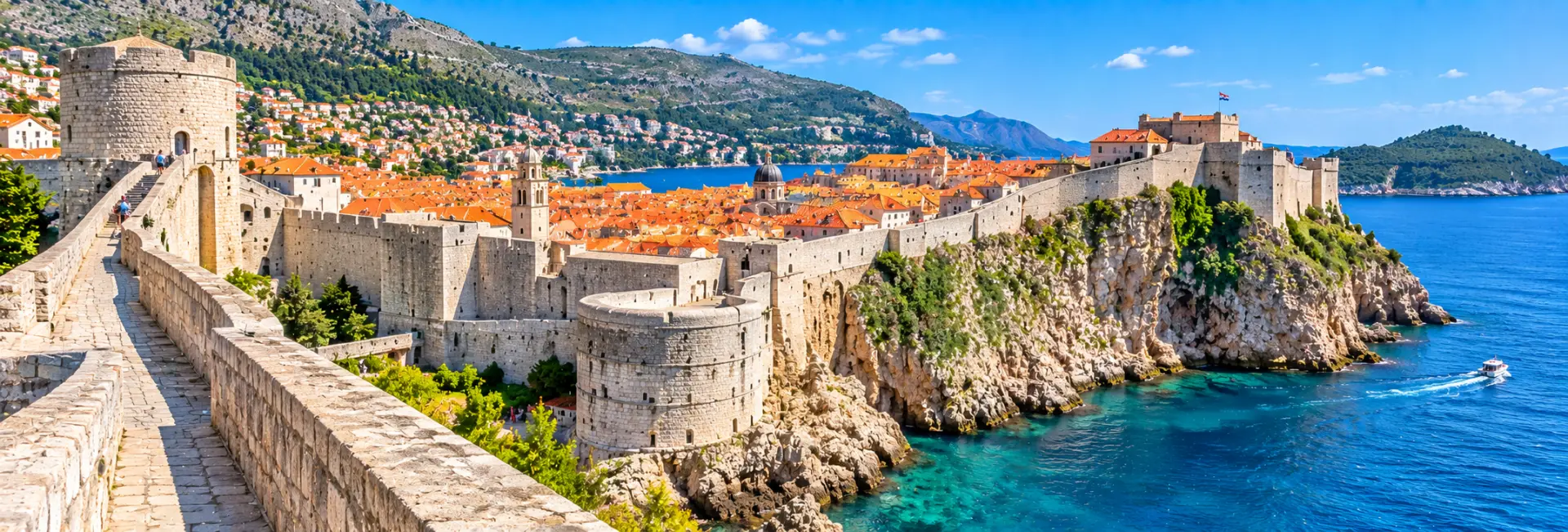
The Walls of Dubrovnik form a continuous stone ring around the Old Town, and they are the single most recognisable feature of the city. Together they run for about 1,940 metres, rising as high as 25 metres in places and reaching up to roughly six metres in thickness on the landward side. They are also the only way to see the whole Old Town at once, from the terracotta roofs to the deep blue of the Adriatic.
Walking the full circuit is one of the most popular things to do in Dubrovnik, and for good reason. The route passes towers, bastions, cannon platforms and forts, while every few steps opens a new view over the harbour, the cliffs or the narrow streets below. It is a combination of history lesson, workout and photo opportunity.
Most people complete the loop in about one and a half to two hours, depending on how often they stop. Because the route involves many steps and little shade, it rewards planning, and the later sections of this page explain how to do that.
History
Early Defences
Dubrovnik's defences were built up gradually over several centuries. The earliest stages date to the medieval period, and most of the structure standing today was completed between the thirteenth and seventeenth centuries. The city, as the capital of the independent Republic of Ragusa, invested heavily in fortifications because its freedom depended on them.
Modernising for Gunpowder
In the fifteenth century the threat of cannon fire and Ottoman expansion pushed the city to rebuild its defences. In 1461 the Florentine architect Michelozzo di Bartolomeo arrived to modernise the walls and supervise the work. The famous Dalmatian builder Juraj Dalmatinac then took over, and Minčeta Tower was completed in 1464. On the landward side, additional sloping walls were added to absorb artillery fire.
Later Additions
Fortification work continued into the sixteenth and seventeenth centuries. Revelin Fortress, which guards the eastern gate, belongs to the mid-sixteenth century, and the last major addition, the Bastion of Saint Stephen, was finished around 1660. A new opening at Buža Gate, on the northern side, was cut in the early twentieth century for the convenience of residents.
Survival and Care
In 1667 a devastating earthquake destroyed much of the city, yet the walls came through largely intact. In the twentieth century many sections had become overgrown, and in 1952 the Society of Friends of Dubrovnik Antiquities was founded to restore them. The walls were damaged during the siege of 1991 and were repaired afterwards.
Architecture & Design
The fortifications work as a layered system rather than a single wall. The commonly cited count includes three round and fourteen square towers, five bastions, two corner forts and the large Saint John Fortress, with the detached Revelin and Lovrijenac forts guarding the approaches.
Thick Land Walls, Slimmer Sea Walls
The walls facing inland are the thickest, because the main threat came from land. Along the sea they are slimmer, since cliffs and water already formed a natural barrier. The difference is easy to feel as you walk, because the landward stretch feels like a broad rampart while the seaward stretch is a narrower path above rocks and waves.
Defensive Details
The builders layered the defences so that an attacker would face one obstacle after another. A western outer wall running between Bokar and Minčeta was added in the fourteenth century to shield the main wall, and an underground corridor with casemates below the outer wall allowed cannons to be fired from protected positions. On the landward side, the sloping supporting walls helped deflect artillery fire, which mattered a great deal once gunpowder weapons spread.
Gates and Bridges
Pile Gate in the west and Ploče Gate in the east were once sealed each night with drawbridges. The gates are approached across stone bridges that replaced earlier wooden ones, and the Pile entrance is further protected by a double gateway and a circular fort.
Materials
The walls are built of local pale limestone, which turns warm gold at sunrise and sunset. Look closely and you can see different stonework from different centuries, with the older sections showing rougher blocks and the later bastions more regular masonry.
Recognition / Status
The walls form a major part of the Old City of Dubrovnik, which UNESCO inscribed on the World Heritage List in 1979. The inscription celebrates the city's outstanding medieval architecture and the strength of its fortifications. The site was placed on the List of World Heritage in Danger in 1991 during the siege and removed in 1998 after restoration.
The walls are today owned by the city of Dubrovnik. Keeping them in good condition is a constant task, since the stonework is exposed to sun, salt and the footsteps of very large numbers of visitors every year.
Key Forts & Highlights
Minčeta Tower
Standing at the northern corner, Minčeta is the highest point of the defences and the most iconic tower. It began as a small square fort in 1319 and was rebuilt into the round, crowned form seen today in the 1460s. The climb is rewarded with some of the best views of the entire circuit.
Bokar Fortress
Bokar, in the western corner above Pile Gate, is a rounded fortress built in the fifteenth century. Its position gives a superb look across to Lovrijenac and down on the small harbour below.
Saint John Fortress
Guarding the old harbour on the southeast, Saint John Fortress protected the port from the sea. It now houses the Maritime Museum and the aquarium, and it is also one of the three points where you can start your walk.
Revelin Fortress
This detached fort stands outside the eastern gate and watches over the harbour. It is now used for exhibitions and events during the summer festival season.
Fort Lovrijenac
Lovrijenac stands on a rocky cliff about 37 metres above the sea, separate from the main walls. It was a vital outpost for the western approach, and its dramatic setting made it a famous backdrop for the television series Game of Thrones. The walls ticket often includes entry, so check the current terms.
Ways to Experience It
- Walk the full circuit on foot, which is the classic and most rewarding option
- Start at Pile Gate for the main entrance and the western views first, or start at Saint John Fortress or the Ploče entrance if the main gate is busy
- Join a guided tour to hear the story of the architects, sieges and earthquakes
- Combine the walk with visits to Lovrijenac and the Revelin and Saint John forts
- Photograph the walls from the water on a boat trip for a very different view
- See them from a distance, for example from Lokrum Island, for a wider view of the whole fortified town
- Look at them in the evening from the streets and the harbour, when the lit stonework glows
Following the Route
If you start at Pile Gate, you climb first onto the western section, with the harbour and Fort Lovrijenac visible below. The path then leads towards Minčeta Tower in the north, where the walls are at their highest and the streets of the Old Town fall away beneath you.
From there the route runs along the landward stretch towards the eastern gate, with views over Revelin Fortress and the old harbour. It then curves round Saint John Fortress and follows the southern walls, a stretch of roughly 800 metres above steep cliffs and open sea, before returning to Bokar and the starting point.
The walking route is one-way, so follow the signs and the staff directions, and keep your ticket handy in case it is checked along the route.
Best Time to Visit
Time of Day
The best moment is when the walls open in the morning. The air is cooler, the light is soft and most of the day's visitors have not yet arrived. Late afternoon can also work, particularly once cruise ship passengers start heading back to their vessels, and the evening light across the water is memorable.
Season
Spring and autumn give the most comfortable conditions, with warm days, clearer air and fewer people. Midsummer brings long opening hours, but also high temperatures and heavy crowds, and the stone can be punishingly hot by midday. Winter is quiet and atmospheric, though the opening hours are shorter and the weather less predictable.
Avoiding the Rush
Check the cruise ship calendar before you choose your day. On busy days the main entrance at Pile Gate can have long queues, and the narrow walkways become congested between about ten in the morning and mid-afternoon.
Visitor Tips
- Buy tickets in advance from the official source, since the city has been moving towards booking ahead, and avoid unofficial resellers
- The ticket is generally valid for one lap and one entry, so plan to complete the circuit in a single visit
- Check whether a Dubrovnik Pass would suit you, as it can include the walls along with other attractions
- Bring water, sun protection and a hat, because shade is limited and there are few places to buy drinks on the route
- Wear sturdy shoes with grip, since the limestone is polished and the walkway involves many steep steps, roughly a thousand in total
- Expect narrow stretches and low sections, and move to the side when taking photos so that others can pass
- Plan for about two hours, plus extra if you want to visit the forts
- Note that the route is not suitable for wheelchairs or strollers, and the steps may be difficult for those with limited mobility
Hours, prices and entry conditions change by season and from year to year, so always check the official City Walls website before you go.
FAQs about visiting the Dubrovnik City Walls
How long are the Dubrovnik City Walls? +
The walls run for about 1,940 metres around the Old Town and reach up to about 25 metres in height. They form an unbroken circuit.
How long does it take to walk the walls? +
Most visitors need between one and a half and two hours, depending on their pace and how often they stop for photos. Allow more time if you want to visit the forts as well.
Do I need to buy tickets in advance? +
It is strongly recommended, particularly in summer, and booking ahead is becoming the norm. Official online tickets also let you avoid ticket-office queues.
Where are the entrances? +
There are three: Pile Gate in the west, the Ploče side in the east, and Saint John Fortress near the old harbour. Saint John is often the quietest.
Can I walk in either direction? +
No. The route is one-way, and staff can turn you back if you try to go against the flow. Follow the signs once you are on the walls.
Is there any shade or are there places to buy food? +
Shade is very limited, and facilities are few, so bring water and sun protection. Do not count on buying drinks along the route.
Are the walls suitable for children or older visitors? +
Children who are comfortable with steps usually enjoy it. The many stairs and uneven stone make it harder for those with limited mobility, and it is not accessible for wheelchairs.
Is it worth walking the walls? +
Yes, for most visitors it is the highlight of the Old Town. The views of the rooftops and the Adriatic are hard to match, and the walk gives helpful context for the rest of your stay.
