
Table of Contents
Overview
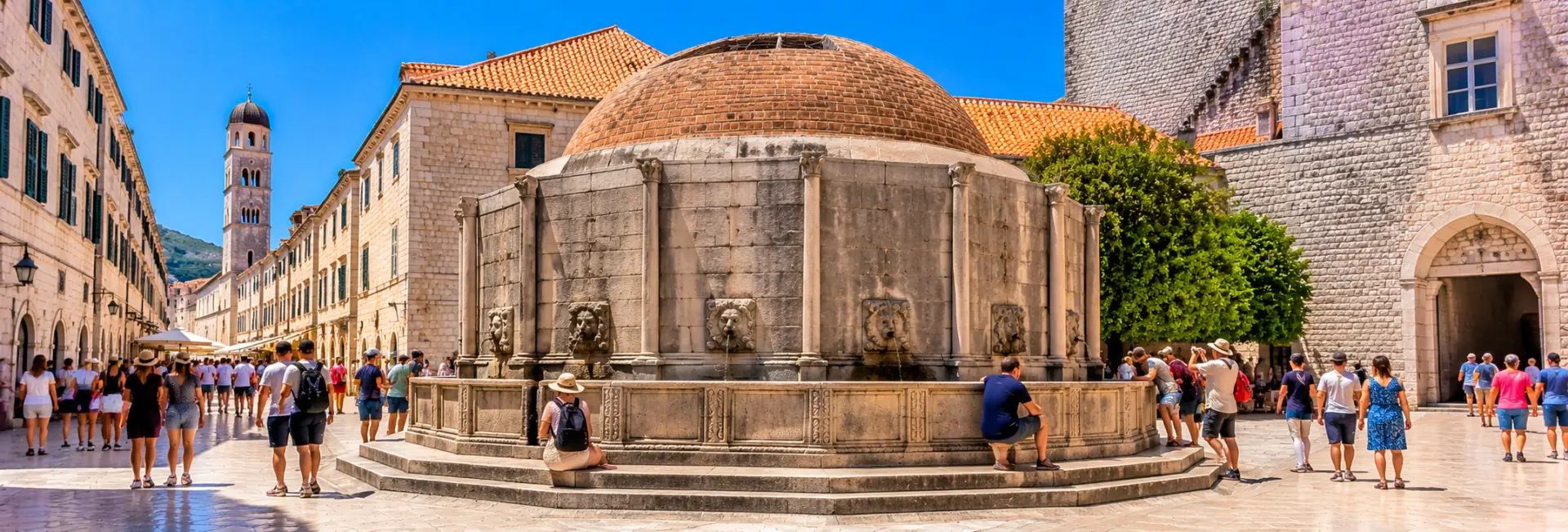
Onofrio's Large Fountain, known in Croatian as Velika Onofrijeva česma, is one of the first landmarks visitors meet in Dubrovnik. It stands in the small square just inside Pile Gate, at the western end of the Stradun, where the Old Town's main street begins. The stone drum with its carved masks and rounded top looks modest beside the grand gate, but it carries one of the most interesting stories in the city.
The fountain was built in the 15th century as the end point of an aqueduct that brought spring water into the walled town. It solved a problem that had limited Dubrovnik's growth for generations, and it was designed by the same Neapolitan engineer who planned the whole water system. The fountain still flows today, and visitors regularly stop to refill water bottles.
Few people plan a long visit here, yet the fountain rewards anyone who slows down for a few minutes. It is a handy meeting point, a place to rest on its wide stone edge, and a good introduction to how Dubrovnik grew rich and resilient.
History
A City Short of Water
For much of its early life, Dubrovnik depended on rainwater collected in cisterns and on wells. Summers on this stretch of the Adriatic are long and dry, and as the population and trade grew, the supply became harder to rely on. The authorities began to look for a lasting solution.
The Aqueduct of 1436
In 1436 the city government decided to bring water from a spring in the Šumet area, roughly 12 kilometers away, using gravity alone. The project was entrusted to builders including Onofrio di Giordano della Cava, an engineer from Naples. The channel followed the contours of the land and passed around the hill of Srđ before reaching the walls.
Building the Fountains
After the aqueduct was in place, Onofrio designed two fountains to mark its end points. The Large Fountain by Pile Gate was built between 1438 and 1440, according to most accounts. The smaller one in Luža Square, at the other end of the Stradun, followed in the early 1440s and supplied the market area.
Earthquake and Loss of Decoration
The 1667 earthquake did severe damage to the fountain. Much of its original sculptural decoration was lost, and what survives today is plainer than what Onofrio's contemporaries saw. Only the carved masks along the sides remain as clear reminders of the earlier ornament.
Centuries of Service
The fountain continued to supply drinking water for centuries, and it remained a working part of daily life until modern piped systems arrived in the late 19th century. The fountain was also damaged by shelling during the 1990s and was repaired afterwards. In recent years, renovation of the surrounding paving led archaeologists to uncover traces of an earlier public cistern, adding another chapter to the story of the city's water.
Recognition / Status
The fountain lies within the Old City of Dubrovnik, a UNESCO World Heritage Site since 1979. It is regarded as one of the city's best-known monuments and a key example of medieval and Renaissance civic engineering on the Adriatic.
- Located within the UNESCO-listed Old City of Dubrovnik
- One of two fountains marking the ends of the medieval aqueduct
- Subject of recent conservation work and archaeological investigation
- Free to visit at any hour as part of the public street space
Architecture & Design
A Sixteen-Sided Basin
The fountain takes the form of a large polygonal drum with sixteen sides, giving it a rounded profile when seen from a distance. Stonework is simple and sturdy, in keeping with the practical purpose of the structure, but the geometry gives it a clear, monumental presence in the small square.
The Carved Masks
Each side was fitted with its own carved mask, known as a maskeron, with a spout set into the mouth. The sculptor responsible for the decoration is not credited as clearly as the engineer, but the sixteen faces remain the best-known detail. Look closely and you will see that no two are exactly alike.
The Dome and Upper Structure
The fountain is topped by a low dome-like cap. Accounts differ on how much of the original upper structure survived the earthquake, but the present form is certainly simpler than the lavish original. Even so, the top gives the fountain its recognizable silhouette.
Water Management in Stone
The design also shows how the aqueduct's flow was managed. Water entered the basin and poured from the masks into a drainage pool at the base, so people could draw water and the excess could be channeled away. It was a practical solution to public supply, built with an attention to appearance that signaled civic pride.
What to See at the Fountain
The Masks and Spouts
Walk slowly around the circle and study the sixteen masks. Each has its own expression, and water still runs from their mouths into the basin below. It is easy to miss these details in the rush of crowds, so take a moment to stand close.
The Surrounding Square
The fountain stands in Poljana Paska Miličevića, a small open space shaped by the Franciscan Monastery and its bell tower on one side and the Church of St. Saviour opposite. Few spots in the Old Town pack so much architecture into so little ground.
Its Smaller Sibling
At the opposite end of the Stradun, beneath the bell tower in Luža Square, the Small Onofrio Fountain stands as the matching end point of the aqueduct. It is more ornate in character and is often attributed to a Milanese sculptor working in the 1440s. Comparing the two gives a good sense of how the system was bookended by a large and a small monument.
The View Toward the Gate
Looking back toward Pile Gate from the fountain gives a framed view of the bridge, the arch and the walls above. It is one of the most photographed angles in the city, especially in soft morning light.
Ways to Experience It
Self-Guided Stop
Because the fountain is right at the entrance to the Old Town, it fits naturally into a self-guided walk. Pause for a few minutes, read the surrounding architecture, then continue along the Stradun toward Luža Square.
Guided Tours and Meeting Point
Many walking tours and food tours begin or pass here, so it is a common meeting place. Guides often use the fountain to explain how the aqueduct worked and why water mattered so much to a trading republic.
Refilling Your Water Bottle
The water from the fountain is drinkable, and tap water in the Old Town is generally considered safe. Bringing a reusable bottle is a simple way to enjoy the same supply that has served the town for centuries and to stay hydrated on hot days.
Combined With the City Walls
The main entrance to the City Walls is only a few steps away, so the fountain makes a natural warm-up before the climb. Many visitors take a quick look here and then head straight up to the ramparts.
Best Time to Visit
Time of Day
Early morning and evening are the calmest times, when the square is less crowded and light falls softly on the stone. Mid-morning to late afternoon in summer is busy, with tour groups gathering and passing through the gate.
Season
The fountain can be visited year round at no cost. July and August bring the biggest crowds, especially when cruise ships are in port, while spring and autumn offer a more relaxed atmosphere. In winter you may have the square almost to yourself, although the weather can be changeable.
Visitor Tips
- There is no ticket or opening time, and the fountain can be seen at any hour.
- Bring a refillable bottle and top up at the spouts, especially on warm days.
- Step aside when taking photos so you do not block the narrow flow of people from the gate.
- The fountain is on the flat limestone of the square, so reaching it involves no steps from Pile Gate.
- Do not climb on the structure or sit on the masks, and keep an eye on belongings in busy periods.
- The wide edge of the basin is a popular place to sit, but it can be slippery when wet.
- Allow about 10 to 20 minutes here, longer if you plan to read the details or meet a tour.
- Combine the stop with the nearby Franciscan Monastery, which has a quiet cloister and a historic pharmacy.
Nearby Attractions
Because the fountain sits at the start of the Old Town, a wide range of sights is only minutes away.
- Pile Gate: The grand western entrance with its drawbridge, statues and bridge.
- City Walls: The main ticket entrance is right beside the fountain.
- Church of St. Saviour: A Renaissance church opposite the fountain that survived the 1667 earthquake.
- Franciscan Monastery: A short distance along the Stradun, with a cloister and a very old pharmacy.
- Stradun: The polished limestone main street leading to Luža Square.
- Small Onofrio Fountain: The aqueduct's other end point, beneath the bell tower in Luža Square.
FAQs about visiting Onofrio's Fountain
What is Onofrio's Large Fountain? +
It is a sixteen-sided stone fountain built in the 15th century just inside Pile Gate. It marked the end of the aqueduct that brought fresh water into Dubrovnik.
Who built Onofrio's Fountain? +
It was designed by Onofrio di Giordano della Cava, a Neapolitan engineer who also planned the city's aqueduct and its two main fountains.
When was it built? +
Most accounts date the fountain to between 1438 and 1440, following the aqueduct project begun in 1436. The smaller fountain in Luža Square was completed shortly afterward.
Can I drink the water from the fountain? +
Yes, the water is drinkable, and many visitors refill their bottles here. Tap water in the Old Town is generally regarded as safe.
Where is Onofrio's Fountain located? +
It stands in Poljana Paska Miličevića, immediately inside Pile Gate at the start of the Stradun. You will pass it on the way into the Old Town from the western entrance.
Is there an entrance fee? +
No, the fountain is part of the public street space and is free to visit at any time. Only nearby attractions such as the City Walls require tickets.
How long should I spend there? +
Ten to twenty minutes is usually enough to see the masks and the surroundings. You may want a little longer if you are meeting a tour or refilling water.
What is the difference between the large and small Onofrio fountains? +
The Large Fountain by Pile Gate is a big sixteen-sided basin with carved masks, while the Small Fountain in Luža Square is more compact and ornate. Both were built to mark the ends of the same aqueduct.
