
Table of Contents
Overview
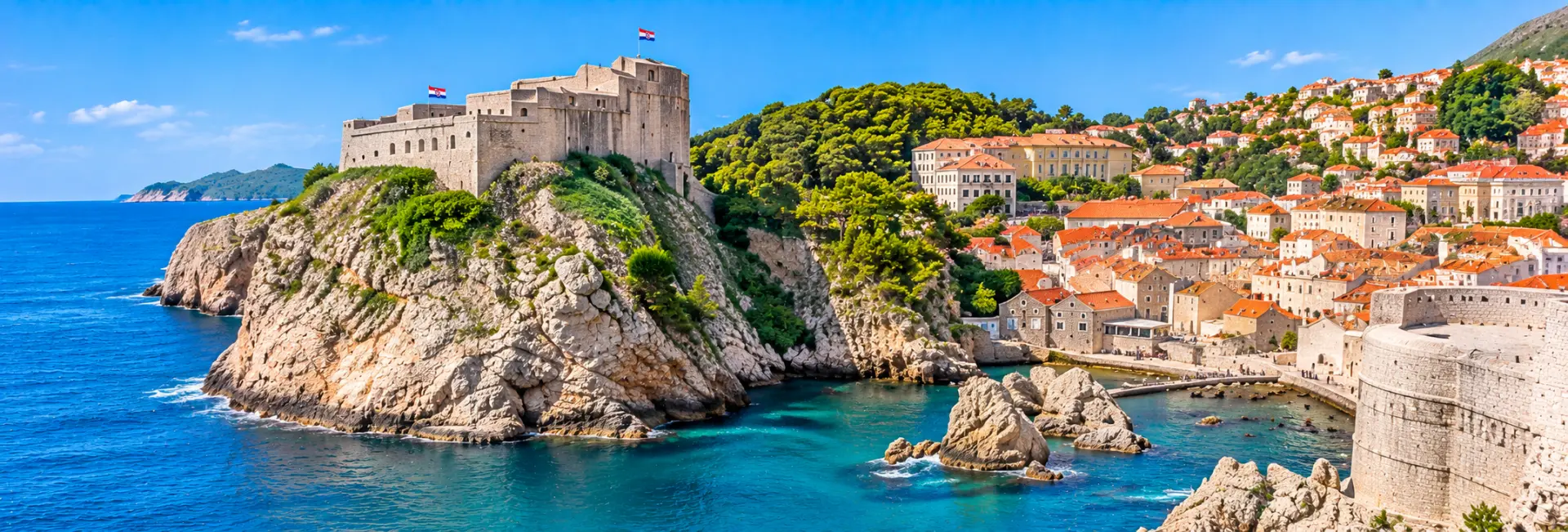
Fort Lovrijenac, also known as the Fortress of Saint Lawrence, rises from a sheer rock about 37 metres above the Adriatic, just outside the western edge of Dubrovnik's Old Town walls. It stands apart from the main fortifications, which is part of what makes it so dramatic from a distance. Locals sometimes call it the Gibraltar of Dubrovnik, a nod to its commanding position over the sea and the land approaches.
The fort was built to guard the city's western flank and to give the Republic of Ragusa a strong point against any rival power that wanted a foothold on this cliff. It was never merely a military site. It carries the Republic's most famous statement on liberty, it has become a stage for open-air theatre, and in recent years it has drawn visitors who recognise it from television.
A visit combines a short climb, a surprisingly spacious interior and some of the best views of the Old Town and its walls. Most people spend about 45 minutes to an hour here, longer if they enjoy taking photographs from its terraces.
History
A Legend of Defiance
The best-known story about the fort's origins comes from the old chronicles of Ragusa. It says that, in the early eleventh century, Venice planned to build a tower on this rock and so control the city. When the people of Dubrovnik heard of the plan, they raced to build their own fort first, and they supposedly finished it in just three months. Chroniclers have dated this event to 1018 or 1038.
What the Records Say
Historians are more cautious than the legend. The first firm written mention of the fort dates from 1301, when the city council appointed a commander for it. The structure was altered and strengthened over many centuries, and building work is said to have continued into the sixteenth century, which is why the fort has the layered, stepped look it has today.
A Fort for Deterrence
Lovrijenac was equipped with cannons, and sources mention ten on its upper level. Its main job was to discourage attack by being visible and formidable. It helped protect the sea route to the western gate, as well as the approach by land, and it kept watch over the harbour at Pile.
Saint Lawrence
The fort takes its name from Saint Lawrence, known in Croatian as Lovrijenac. A small chapel dedicated to him stands within the walls, and a church to the same saint is thought to have occupied the rock before the fortress was built.
Architecture & Design
A Triangle on a Rock
The fort follows the shape of the cliff, forming a triangle with three stepped terraces rising one above the other. The lower terrace faces the sea, while the higher ones face the land, so each level has its own purpose and outlook. Defensive platforms with parapets give the upper levels a strong, closed profile.
Walls of Different Thickness
The most unusual feature is the great difference in the thickness of the walls. The sections facing the sea and any outside attacker are between about four and twelve metres thick, which made them extremely hard to batter down. The wall facing the city, by contrast, is only around 60 centimetres thick.
This was a deliberate design choice. If an enemy ever took the fort, the defenders on the city walls could smash the thin wall with cannon fire and stop their rivals from using the position against them. By some accounts, it also meant that a commander who turned against the Republic could be dislodged quickly.
Entrance and Drawbridges
Two drawbridges lead into the fort, and above the gate is a Latin inscription that has become its motto. It reads Non bene pro toto libertas venditur auro, which means that liberty is not sold for all the gold in the world. The words capture the independent spirit that Dubrovnik prided itself on for centuries.
The Courtyard
Inside, a courtyard with a cistern opens up at the centre of the fort. This sheltered space is large enough for performances and gives visitors a quiet pause from the climb and the wind on the terraces.
Recognition / Status
Fort Lovrijenac is regarded as part of the wider Dubrovnik fortification system, which forms an important element of the Old City of Dubrovnik. UNESCO inscribed the Old City on the World Heritage List in 1979. Together with Minčeta, Bokar, Revelin and Saint John, Lovrijenac is one of the major forts that define the city's defensive landscape.
The fort is also an important cultural symbol. Its freedom inscription is quoted in local civic life, and the fort is often presented as an emblem of the Republic's resistance to outside control. It belongs to the city of Dubrovnik, which manages it alongside the City Walls.
Theatre & The Dubrovnik Summer Festival
Hamlet at Lovrijenac
The fort's courtyard and terraces serve as one of the most atmospheric open-air stages in Europe. The Dubrovnik Summer Festival was founded in 1950, and Shakespeare's Hamlet was staged inside the fort as early as 1952. The play has been performed here many times since and has become a symbol of the festival.
Why It Works
The setting makes a natural match for the story. The thick stone, the sea and the sense of enclosed danger stand in well for the Danish castle of Elsinore. Audiences sit in an old fortress with the Adriatic behind the stage, which gives performances a feeling that is hard to recreate in a conventional theatre.
Other Events
The fort also hosts other dramatic performances and cultural events during the summer, and its terraces can be used for private functions. If you plan to visit in summer, check whether a performance is scheduled, since access can be restricted on those days.
Fort Lovrijenac and Game of Thrones
For many visitors, the fort is best known as the exterior of the Red Keep in Game of Thrones. The production used Dubrovnik as the setting for King's Landing, and Lovrijenac appeared as the royal fortress in several seasons. Its high walls, open terraces and cliff-top position suited the series well.
Spotting the Locations
- The terraces, where scenes of royal ceremony were set
- The view back towards the Old Town walls, which fans recognise from the show
- The nearby Pile area, used for other King's Landing scenes
Even if you have never watched the series, the connection adds to the appeal. It explains why the fort often appears on guided tours alongside the Jesuit Staircase and the Old Town, and why it can feel busy at certain hours.
Ways to Experience It
- Climb the steps from the Pile area and explore the three terraces at your own pace
- Take photographs back towards the Old Town and the city walls, one of the best angles on the whole fortified town
- Combine the fort with a walk along the City Walls, since the walls ticket usually covers entry
- Join a Game of Thrones or Old Town tour, which often includes a stop here
- Attend a Summer Festival performance if one is scheduled during your stay
- View the fort from the water on a boat or kayak trip to see how it grows out of the rock
Best Time to Visit
Time of Day
Morning and late afternoon are the most pleasant times for the climb, particularly in July and August, when the midday heat makes the steps feel much longer. Early visits also give you quieter terraces and softer light for photographs.
Season
Spring and autumn offer comfortable temperatures and thinner crowds. In summer the fort is at its liveliest, with festival performances and long opening hours, but it is also at its hottest and busiest. Winter is calm, though the opening hours are shorter.
Light and Views
The view across to the Old Town is attractive at any hour, but evening light turns the stone a warm gold. If you want a photograph of the city walls with the fort in the foreground, a clear day with low sun is ideal.
Visitor Tips
- Check the ticket arrangement: the fort has a standalone ticket, but entry is usually free with a valid City Walls ticket used within a few days, so confirm current terms before buying twice
- Expect steep, uneven stone staircases, which can be hard for visitors with limited mobility or knee problems
- Wear shoes with good grip, since the stone can be worn and slippery
- Bring water and sun protection, as the terraces are exposed
- Be careful near edges and parapets, particularly with children
- Visit the fort at a different time from your City Walls walk, so that you are not facing two stair-heavy outings back to back
- Check opening hours before you go, as they change with the season and can be affected by events
Ticket prices and opening times change from year to year, so confirm them with official sources.
Nearby Attractions
- Pile Gate and the Stradun: the main entrance to the Old Town, only a short walk away
- Bokar Fortress: the round fort on the western corner of the walls, with a fine view of Lovrijenac
- Pile Bay and the small beach below: a handy place to pause after the climb
- Dubrovnik City Walls: the great medieval circuit that the fort complements
- Onofrio's Fountain: a landmark just inside Pile Gate
- Lokrum Island: a short boat trip from the Old Port, if you want a quieter escape
FAQs about visiting Fort Lovrijenac
What is Fort Lovrijenac? +
It is a medieval fortress on a 37-metre rock just outside the western walls of Dubrovnik's Old Town. It was built to defend the western approach, and it is also called Saint Lawrence Fortress.
Is Fort Lovrijenac part of the City Walls? +
It is part of the wider fortification system but stands apart from the main wall circuit. A valid City Walls ticket is usually enough to enter it.
How much does it cost to enter? +
There is a standalone ticket, and entry is generally included with a City Walls ticket for a limited time after you buy it. Check current prices on official sources before you go.
How long do I need? +
Allow about 45 minutes to an hour, including the climb, the terraces and the courtyard. Add time if you want to take many photographs or sit and enjoy the view.
Is it the Red Keep from Game of Thrones? +
Yes, the exterior of the fort stood in for the Red Keep in King's Landing in several seasons of the series. Many Game of Thrones tours include a stop here.
What does the inscription over the gate mean? +
The Latin text says that liberty is not sold for all the gold in the world. It reflects the independent identity of the Republic of Ragusa.
Can you see performances at the fort? +
Yes, the courtyard and terraces host plays during the Dubrovnik Summer Festival, including Hamlet. Check the festival programme for dates, as the fort may be closed to ordinary visitors on performance days.
Is Fort Lovrijenac accessible for people with limited mobility? +
Access involves many steep and uneven stone steps, so it is difficult for visitors with limited mobility. It is best to plan the visit with this in mind.
