
Table of Contents
Overview
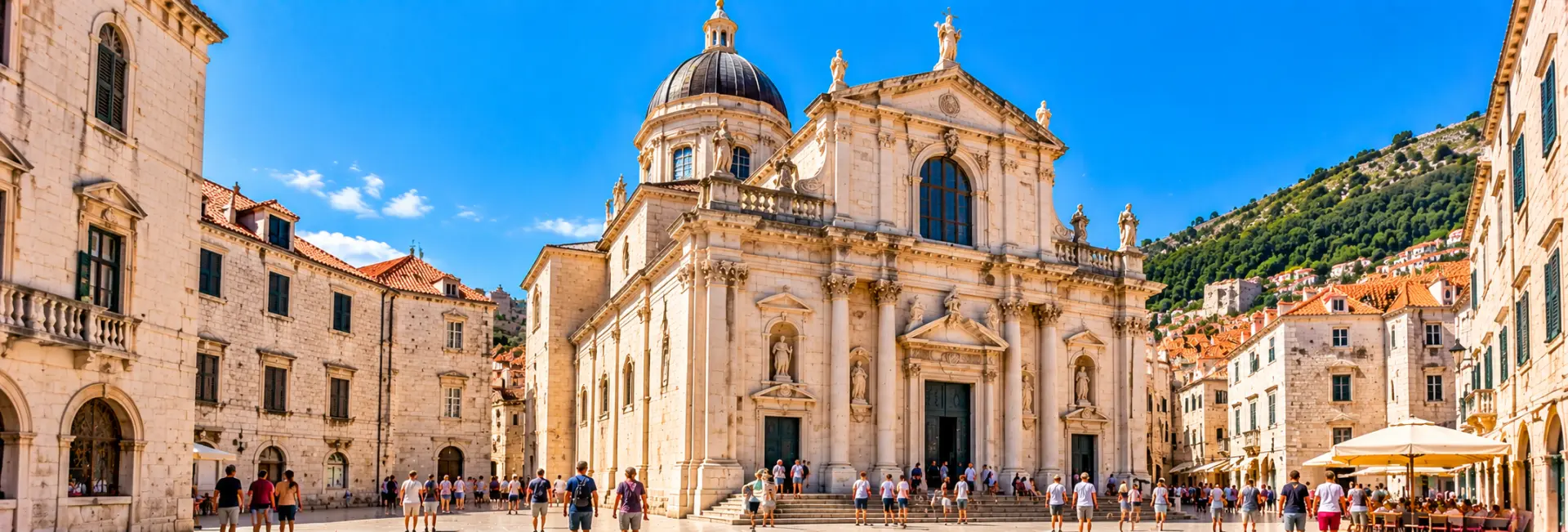
Dubrovnik Cathedral, formally the Cathedral of the Assumption of the Virgin Mary, is the main church of the Old Town and the seat of the Diocese of Dubrovnik. Locals often call it Velika Gospa, meaning Great Lady. Its Baroque dome is one of the most recognizable features of the city skyline, easily spotted from the City Walls and from Mount Srđ.
Inside, the cathedral combines a bright, airy nave with a Renaissance masterpiece above the main altar and a treasury filled with gold and silver reliquaries. The most famous of these hold relics of St. Blaise, the patron saint of Dubrovnik, who is honored throughout the city.
The cathedral stands in the southern part of the Old Town, close to the Rector's Palace and the Church of St. Blaise. It is both a working place of worship and a major sightseeing stop, so a visit offers art, history and a glimpse of living tradition in one compact space.
History
Layers Beneath the Floor
Churches have stood on this site for well over a thousand years. Archaeologists working after the 1979 earthquake uncovered remains of an earlier cathedral beneath the later Romanesque one, and many sources date the first basilica here to the 7th century. This long sequence of buildings is one reason the spot is regarded as one of the most historically significant in the city.
The Romanesque Cathedral and the Richard the Lionheart Legend
Between the 12th and 14th centuries the church was rebuilt as a large domed Romanesque cathedral. A popular legend says King Richard I of England, shipwrecked near Dubrovnik in 1192 on his way home from the Third Crusade, promised to build a church in thanks, and that his gift paid for this cathedral. Historians treat the story with caution, but it remains closely tied to the building's identity.
Destruction in 1667
The great earthquake of 1667 reduced the Romanesque cathedral to ruins. The city, which had lost many citizens and much of its wealth, nevertheless chose to rebuild its principal church as part of a wider reconstruction of the Old Town.
The Baroque Rebuilding
The senate, guided by the scholar and cleric Stjepan Gradić, commissioned plans from Rome. The design is credited to Andrea Buffalini, and construction began in the early 1670s under a series of Italian and local master builders. The Dubrovnik architect Ilija Katičić completed the work in 1713, giving the city a new landmark that reflected Roman and North Italian Baroque styles.
Recent Chapters
The cathedral was damaged again by the 1979 earthquake and later struck by at least one shell during the siege of Dubrovnik in 1991. Restoration followed each time, and the building has remained open as a church and visitor destination.
Recognition / Status
The cathedral stands within the Old City of Dubrovnik, a UNESCO World Heritage Site since 1979. It is also an active Catholic parish and the seat of the local diocese, so it is both a heritage monument and a living church.
- Located within the UNESCO-listed Old City of Dubrovnik
- Seat of the Roman Catholic Diocese of Dubrovnik
- Considered the first major architectural project in the city's rebuilding after 1667
- Houses a treasury regarded as one of the richest on the Adriatic
Architecture & Design
The Facade
The front of the cathedral is a dignified Baroque composition with Corinthian columns, cornices, pediments and balustrades topped with statues. Niches on the facade hold figures including St. Blaise and St. Joseph with the Child, which reinforces the church's local and devotional identity. The overall effect is grand but restrained, in keeping with the austere character of the Ragusan Republic.
Plan and Dome
Inside, the church follows a Latin cross layout with side chapels, a transept and a large dome rising above the crossing. The dome fills the interior with light and gives the space a vertical emphasis that contrasts with the narrow streets outside.
Altars and Decoration
Marble altars line the side chapels, many carrying paintings by Italian and Dalmatian artists from the 16th to 18th centuries. The altar of St. John of Nepomuk, made of violet marble, is often singled out as one of the finest. Carved stonework, stucco decoration and the pale walls create a light interior that sets off the richer details.
Notable Features Inside
Titian's Assumption
The star attraction is the polyptych of the Assumption of the Virgin above the main altar. It is attributed to the Venetian master Titian and his workshop and is dated to around 1552. Wealthy Ragusan citizens often bought art from major Italian studios and donated it to the cathedral, which explains the presence of such a distinguished work here.
Paintings and Side Chapels
The side altars show a range of religious subjects, from devotional scenes to saints and martyrs. They offer a quiet survey of how Dubrovnik's tastes and connections with Italy shaped its sacred art.
Other Details to Look For
- The cathedral's organ, part of the church's music tradition
- The stucco decoration that adorns the vaults and chapels
- The violet marble of the St. John of Nepomuk altar
The Cathedral Treasury
A Collection of Reliquaries
The treasury, entered from the left side of the main altar, holds well over a hundred reliquaries, with different sources counting between about 130 and 200 pieces. They date from the 11th to the 18th centuries and were made by goldsmiths from Dubrovnik and from places such as Venice and the Byzantine world. Together they show why the city's goldsmiths were so famed.
The Relics of St. Blaise
The most treasured items are the gilded reliquaries holding the head, an arm and a leg of St. Blaise. They are carried in procession through the city on the saint's feast day each February, one of Dubrovnik's most important annual traditions.
Other Notable Objects
Among the other treasures are a fragment said to be from the True Cross set into a 16th-century crucifix, a Romanesque-Byzantine icon of the Madonna and Child from the 13th century, and a copy of Raphael's Madonna of the Chair. A richly decorated jug and basin, made as a gift for King Matthias Corvinus of Hungary and never delivered because he died first, is another curiosity.
A Treasury With Three Keys
In earlier centuries the treasury was secured by a three-key system, with each key held by a different person, so it could be opened only when all three were present. That detail shows how seriously the Republic guarded the relics and the wealth they represented.
Cultural & Religious Significance
For the people of Dubrovnik, the cathedral is more than a monument. It is the center of the city's religious calendar and the place where the story of St. Blaise, the protector of Ragusa, is renewed each year. The patron saint appears on city gates, coins and fortifications, so seeing his relics in the treasury adds meaning to the symbols found across the Old Town.
The building also illustrates Dubrovnik's resilience. After the 1667 earthquake destroyed much of the city, the decision to rebuild the cathedral first sent a message that civic life and faith would continue. That determination echoes through later disasters, including the 1979 earthquake and the siege of the 1990s.
Finally, the cathedral's art collection tells a story about the Republic's wealth, its close ties with Italy and its pride in craftsmanship. Gifts from merchants, captains and nobles filled the church over generations, and the surviving works reflect that blend of devotion and prestige.
Visiting Etiquette & Tips
- Entry to the cathedral itself is generally free, while the treasury has a separate small ticket sold inside.
- Dress modestly, with shoulders and knees covered, as this is an active place of worship.
- Keep voices low and avoid using phones for calls, especially during services.
- Photography is not permitted in the treasury, and it is wise to be discreet elsewhere in the building.
- Opening hours vary by day and season, and access may be restricted during Mass, so check the current schedule before you go.
- The treasury is separate from most city passes, so confirm what is included before buying a pass.
- Accessibility is generally reported as good for the treasury, but confirm details if you need step-free access.
- Allow about 30 to 45 minutes for the church and treasury combined.
Best Time to Visit
Time of Day
Visit shortly after opening or close to closing to avoid tour groups that tend to pass through in the middle of the day. Morning light also shows the interior and altar painting at their best.
Season and Events
The cathedral is open year round, though hours are generally longer in summer. Early February is especially interesting, when the feast of St. Blaise brings processions and ceremonies through the Old Town and the relics play a central role.
Nearby Attractions
The cathedral sits in a cluster of important landmarks, so it fits easily into an Old Town walk.
- Rector's Palace: The Gothic-Renaissance seat of the former Republic, just steps away.
- Church of St. Blaise: The Baroque church dedicated to the city's patron saint, close to Luža Square.
- Sponza Palace: A Renaissance building once used as a customs house and mint.
- Luža Square: The central square with Orlando's Column and the bell tower.
- Gundulić Square: A lively market square where a statue of the poet Ivan Gundulić stands.
- Jesuit Stairs and Church of St. Ignatius: A dramatic Baroque stairway a short walk away.
FAQs about visiting Dubrovnik Cathedral
What is Dubrovnik Cathedral known for? +
It is known for its Baroque architecture, a Titian altarpiece attributed to the master and his workshop, and a treasury of gilded reliquaries including the relics of St. Blaise.
Is it free to enter Dubrovnik Cathedral? +
Entry to the main church is generally free. The treasury has a separate small entrance fee, usually paid inside the cathedral.
What is the dress code? +
Visitors are expected to cover their shoulders and knees and to behave quietly, since it is an active place of worship.
Can I take photos inside? +
Photography is not allowed in the treasury, and it should be done discreetly and respectfully in the main church.
How long should I spend there? +
Around 30 to 45 minutes is enough to see the church and the treasury. History and art enthusiasts may want longer.
Where is Dubrovnik Cathedral located? +
It stands at Ulica kneza Damjana Jude 1 in the southern part of the Old Town, near the Rector's Palace and Luža Square. The area is pedestrian only, so you reach it on foot.
When was the cathedral built? +
The current Baroque cathedral was built between the early 1670s and 1713 after the 1667 earthquake destroyed its Romanesque predecessor. Earlier churches stood on the same site for centuries.
Is the cathedral accessible for visitors with limited mobility? +
The treasury is reported to be accessible to wheelchair users, but arrangements can change. Contact the cathedral in advance if you need specific information.
