
Table of Contents
Overview
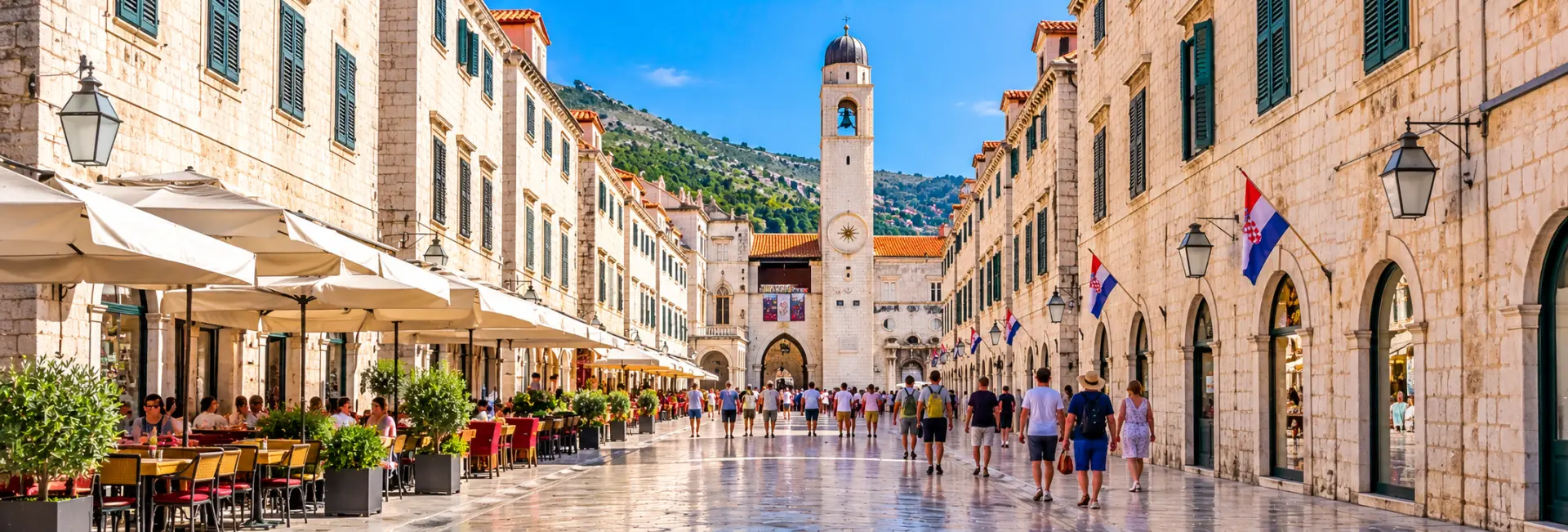
Stradun, known to locals as Placa, is the main street of Dubrovnik and the spine of the walled Old Town. It runs in a nearly straight line for about 300 metres, connecting Pile Gate in the west with the Luža area and the Ploče side in the east. Almost every visitor to Dubrovnik walks it at least once, and many walk it several times a day.
What makes it special is the combination of surface and setting. The pale limestone underfoot has been polished by centuries of footsteps until it shines, and on a wet day it mirrors the sky. On either side stand matching rows of baroque houses with shopfronts at street level, so the whole street feels like one carefully designed room open to the sky.
Stradun is also the town's living room. Locals meet here for the evening stroll, processions and celebrations pass along it, and the main sights of the Old Town are within a few steps of its length.
History
From Channel to Street
The site of Stradun was originally a narrow, marshy channel of water. It separated the early settlement of Ragusa, on a small island, from the settlement of Dubrava on the mainland. As the two communities grew closer, the channel was filled in and built over, creating a single town with a main street along the old waterway. Sources date this change anywhere between about the eleventh and thirteenth centuries.
The Name
The local name Placa comes from the Latin and Greek word for a street or open space. Stradun is a Venetian term that means big or wide street, and it refers more to the street's importance than to its real width.
Paving the Way
The street was first laid with brick in the fourteenth century, then paved in limestone in 1468. The surface was relaid with limestone slabs in 1901, which is the surface visitors walk on now. The pattern of the slabs and the polish from heavy foot traffic give it the appearance of a glossy marble promenade, although it is limestone.
The 1667 Earthquake
A devastating earthquake in 1667 destroyed most of the buildings along the street and across the city. The Republic of Ragusa responded with building regulations that set common rules for the height, frontage and layout of new houses. The street you see today is largely the result of that rebuilding.
Architecture & Streetscape
A Balanced Layout
The street is almost perfectly straight and is framed at each end by a matching set of landmarks. A large fountain and a bell tower stand in the west, and a smaller fountain and the city Bell Tower stand in the east, so that whichever way you walk, your eye is drawn towards a clear focal point. The arrangement divides the Old Town into two halves and gives the street its sense of order.
Uniform Baroque Houses
The houses along Stradun are strikingly similar, and that is no accident. After the earthquake, the new rules called for matching heights and aligned facades, with a shop on the ground floor and living space above. As a result, the street reads as a single composition rather than a collection of individual buildings.
The Shopfront Detail
Look at the ground-floor entrances and you will notice the same pattern repeated again and again. Each shop has a door and a window set within one stone frame, in a design that has become closely associated with Dubrovnik. Many of these frames now hold boutiques, cafes and souvenir shops, but the form has survived for centuries.
The Side Lanes
Stradun divides the Old Town into northern and southern halves. On the north side, narrow streets climb sharply up steps, while on the south side lanes run towards the sea. These lanes lie just a few steps from the main promenade but feel completely different, with quiet stairways, small courtyards and washing lines overhead.
Surface and Light
The limestone slabs reflect light in a distinctive way. At midday the street glows pale and bright, in the evening it turns golden, and after rain the surface darkens and gleams. This is one reason photographers favour early morning and dusk.
Landmarks Along the Street
The Western End
- Pile Gate: the grand entrance from which most visitors step down onto the street
- Onofrio's Large Fountain: a fifteenth-century fountain just inside the gate, long a source of fresh water for townspeople
- Church of the Holy Saviour: a Renaissance church beside the entrance that survived the 1667 earthquake
- Franciscan Monastery: a fourteenth-century complex with a cloister and a very old pharmacy, plus a bell tower that marks the western end
The Middle
Along the central stretch, the shops and cafes give way to side streets that lead to the cathedral, the Dominican monastery and the Jesuit Staircase. It is a good section for slowing down, because the buildings are at their most uniform and the lanes on both sides invite short detours.
- Dubrovnik Cathedral: a baroque church reached by a short walk along the southern lanes
- The Dominican Monastery: a quiet complex with a cloister, close to the eastern side
- The Jesuit Staircase: a sweeping baroque stairway that climbs from the southern edge of the old town and is a favourite photo spot
- The Old Port: the small harbour just beyond the eastern end of the street
The Eastern End
- Small Onofrio's Fountain: a smaller fountain at the eastern end, the counterpart to the large one in the west
- Luža Square: the open square that links the main civic buildings
- Orlando's Column: a stone column that was once the centre of public announcements and ceremonies
- Sponza Palace: a Gothic and Renaissance building that served as a customs house
- The Bell Tower: a tall baroque tower at the end of the street, rebuilt after the earthquake
- Church of Saint Blaise: the church dedicated to the city's patron saint
Events & Local Life
The Feast of Saint Blaise
Every year on 3 February, the street fills with a procession in honour of Dubrovnik's patron saint. Locals wear traditional dress, banners fly from the buildings and the celebration is one of the most important events in the city's calendar.
Festivals and New Year
Stradun is also a stage for concerts and outdoor performances during festival periods, and it hosts the main New Year's Eve gathering. In 2010 it even hosted an exhibition tennis match between John McEnroe and Goran Ivanišević.
The Evening Stroll
The most enjoyable local tradition is simply walking. In the early evening many residents come out for a stroll, meet friends and sit at cafes. If you want to see the street as a community space rather than a tourist corridor, this is the hour to be here.
On Screen
The street and the surrounding steps and squares appear in Game of Thrones, which used Dubrovnik as the setting for King's Landing. Some visitors choose to follow the filming locations on a guided walk.
Ways to Experience It
- Walk the street end to end, ideally twice: once in the morning light and once in the evening
- Take a guided Old Town tour, which usually starts at Pile Gate and follows the Stradun before branching into the lanes
- Climb a short section of the city walls near Pile Gate, which gives a rooftop view along the whole length of the street
- Photograph the street from the Pile Gate bastion, from the middle of the street itself and from the steps at the eastern end for three quite different compositions
- Sit at a cafe on a side lane and watch the crowd pass
- Visit the Franciscan pharmacy, Sponza Palace or the nearby churches in a short loop
- Look for the repeated shopfront design and the matching facades, which is a small game for architecture fans
Best Time to Visit
Time of Day
Early morning is best for photographs and for a peaceful walk, since the stone is empty and the light is soft. In the middle of the day, particularly in the warmer months, cruise groups and day trippers fill the street. After late afternoon the crowds thin again, and the evening brings a gentler, more local atmosphere.
Season
Late spring and early autumn give pleasant temperatures and manageable crowds. Midsummer is lively but very busy and hot, and the pale stone throws back strong glare. Winter is calm and cool, with the street at its quietest and a more intimate feeling, especially around the Saint Blaise celebration in early February.
In the Rain
Rain is not necessarily bad news. The limestone turns glossy and the street takes on a mirrored look that many people find beautiful, although you should take care on the slick surface.
Visitor Tips
- Wear shoes with good grip, because the polished limestone can be slippery, especially when wet
- Use Pile Gate as the entrance if you need step-free access, as it has a ramp, while the eastern approach involves stairs
- Check the cruise ship schedule and avoid the busiest hours, usually mid-morning to mid-afternoon on ship days
- Explore the side lanes for quieter cafes and restaurants away from the main promenade
- Keep to one side and step out of the flow when taking photos, so that others can pass
- Remember that people live above the shops, so keep noise down in the evening
- Allow about 15 minutes for a straight walk, and much longer if you plan to stop at the landmarks
- Watch your belongings in crowded stretches, as in any popular tourist area
Opening times and event dates change, so check current local information before you go.
FAQs about visiting Stradun
What is Stradun? +
Stradun, also called Placa, is the main street of Dubrovnik's Old Town. It is a pedestrian street about 300 metres long, paved in polished limestone and lined with baroque houses.
Is Stradun free to walk? +
Yes. It is a public street and open at all hours. Entry to the nearby museums, churches and city walls is paid separately.
How long is Stradun? +
It is roughly 300 metres long, or close to 298 metres by some measurements. A direct walk takes about 5 minutes, though most visitors spend much longer.
Why do all the buildings look the same? +
After the earthquake of 1667, the city introduced rules for rebuilding, which set matching heights, frontages and layouts. That is why the houses along the street share a uniform baroque look.
Is the street made of marble? +
It looks like marble because of the polish, but it is limestone. Centuries of footsteps have made it smooth and reflective.
What is the best time to see Stradun without crowds? +
Early morning and the evening are the most peaceful times. Midday on days with cruise ships is the busiest.
Is Stradun accessible for wheelchairs and strollers? +
The street itself is flat and level, and Pile Gate has a ramp, so it works well for most visitors. The eastern approach involves steps, and many side lanes are stepped.
What can I see near Stradun? +
The Franciscan Monastery, Onofrio's Fountains, Sponza Palace, Orlando's Column and the Bell Tower are all on or beside the street. The cathedral, the Rector's Palace and the city walls are a short walk away.
