
Table of Contents
Overview
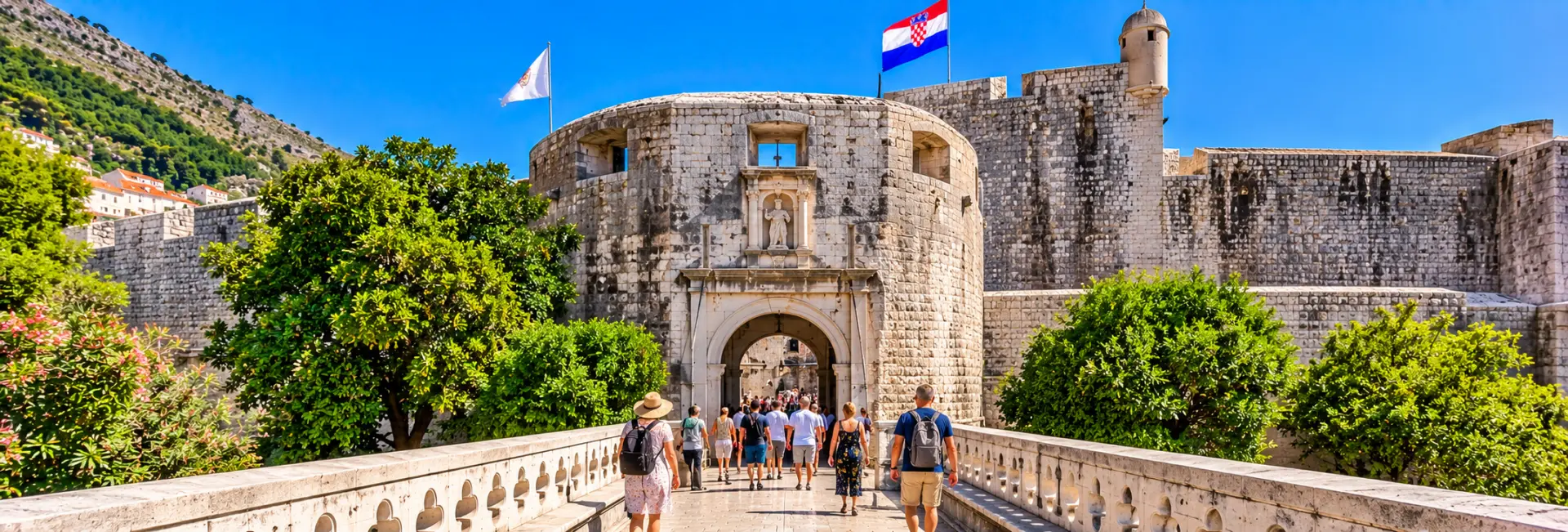
Pile Gate, called Vrata od Pila in Croatian, is the main western entrance to Dubrovnik's Old Town and the place where most visitors take their first steps into the walled city. It is not a single doorway but a fortified approach made up of an outer gate, an inner gate and a stone bridge across the former defensive trench. Together they form one of the most photographed entrances in the Adriatic.
Passing through the inner arch, you step directly onto the Stradun, the polished limestone main street that runs through the heart of the Old Town. Just inside, Onofrio's Large Fountain and the main entrance to the City Walls are within a few steps, so the gate works as the natural starting point for almost any visit.
The gate is open around the clock and free to walk through. Even a short stop is rewarding, since the carved details, the drawbridge mechanisms and the statues of the city's patron saint reward anyone who slows down and looks up.
History
Early Defenses
Dubrovnik's western approach was its most exposed side, so it received the heaviest fortification. Medieval accounts describe an early stone bridge here from the late 14th century, replacing earlier timber crossings over the trench. Over the following decades the city kept strengthening this entrance as threats from land and sea changed.
The 15th-Century Upgrades
The inner gate dates from around 1460 and is tied directly into the main city wall. In 1471 the defensive trench was widened, and the architect Paskoje Miličević designed a new stone bridge with arches to replace the earlier one. A wooden drawbridge section remained at the end of the bridge so the entrance could be sealed on demand.
The Outer Gate of 1537
The outer gate took its present form in the 1530s, with the work completed in 1537. Its semicircular Renaissance arch gave the entrance a more monumental look, and it was designed to work with the nearby towers and bastions that covered the approach with cannon fire.
Nightly Closing Ritual
In the days of the Republic of Ragusa, the drawbridge was lifted every evening and the gate locked. According to a long-standing account, the keys were handed to the rector, who was the head of government. This routine reflected how seriously the city took its security, and it ended only when the Republic itself ended in the early 19th century.
Modern Times
The gate lived through the French arrival in 1806, the Austrian period and the shelling of the Old Town in 1991 and 1992. A commemorative plaque between the gates records the damage inflicted on the city during the siege. Today the entrance is open to all and carries far more tourists than traders.
Recognition / Status
Pile Gate is part of the Old City of Dubrovnik, which UNESCO inscribed on the World Heritage List in 1979 and extended in 1994. The listing celebrates the city's Gothic, Renaissance and Baroque architecture and the way it was rebuilt after the 1667 earthquake and restored after damage in the 1990s.
- Located within the UNESCO-listed Old City of Dubrovnik
- One of the three main entrances to the walled Old Town, alongside Ploče Gate and Buža Gate
- Serves as the principal entry point for the City Walls walk
- Widely regarded as the grandest and busiest gate in the city
Architecture & Design
A Gate Built in Layers
The most striking thing about Pile Gate is that it is a sequence of defenses rather than a single arch. A visitor first crosses the bridge, then passes the outer gate, descends a short ramp and stairs, and finally walks through the inner gate. Each stage forced attackers into a narrow, exposed route under the eyes of defenders on the walls above.
The Outer Gate
The outer arch is round and Renaissance in style, with clean stonework and a shallow niche above it. Chains and counterweights for the former drawbridge are still visible beside the opening, giving a physical sense of how the mechanism worked. The walls overhead once carried cannon, and some remain in place.
The Inner Gate
The inner gate is older and more Gothic in character, with a pointed arch and the heavy proportions of a medieval fortification. It leads straight out of the cool shadow of the passage into the bright openness of the Stradun, a contrast that many visitors remember as the moment Dubrovnik truly begins.
The Moat and Bridge
The trench beneath the bridge no longer holds water. Instead it is filled with greenery and small gardens, which softens the scene. The arched bridge itself is a fine example of 15th-century stone engineering and carries visitors comfortably across the drop.
What to See at the Gate
The Statues of St. Blaise
St. Blaise, the patron saint of Dubrovnik, appears on both gates, usually holding a small model of the city in his hand as a sign of protection. The statue above the outer arch is one of the older images of the saint in the city. The one above the inner gate is credited to the 20th-century sculptor Ivan Meštrović, one of Croatia's most celebrated artists.
Drawbridge Mechanisms
Look for the weights and chain slots on either side of the outer entrance. They show how the wooden drawbridge was raised each night and give a helpful sense of scale for the defenses.
The Siege Plaque
Between the two gates, a commemorative plaque records damage inflicted on the city during the siege of 1991 and 1992. It is easy to miss in the rush of foot traffic, but it adds a human dimension to a place otherwise famous for medieval stonework.
Views from the Bridge
From the bridge, the view stretches along the western walls toward Fort Lovrijenac on its rocky headland and the Bokar fortress above the sea. On a clear day the combination of bastions and water makes for a memorable first impression.
Screen Appearances
The gate and its approach have featured in television productions, including the series Game of Thrones, and some fans come specifically to see the setting of one of the show's best-known scenes.
Ways to Experience It
As a Starting Point for Walking Tours
Most guided Old Town tours begin here. A guide can explain the layers of fortification, point out the smaller details most people miss and lead you along the Stradun to the main squares and monuments.
Self-Guided Exploration
You can easily explore on your own. Walk across the bridge, pause between the gates, then continue along the Stradun to Luža Square and the old harbor, which takes only a few minutes at an unhurried pace.
Walking the City Walls
The main City Walls entrance is just inside the gate, next to the Church of St. Saviour, and ticket sales are nearby. Starting at Pile means a steeper staircase than at the other entrances, but it puts you on the sea-facing side early and lets you finish near the harbor.
Photography and Quiet Moments
Photographers favor the bridge and the open square outside the gate for classic shots of the outer arch. Early morning and late evening are the best times for a clear frame without crowds.
Best Time to Visit
Time of Day
Early morning is the best time for a calm look at the gate, with soft light on the stone and relatively few people on the bridge. Late evening is atmospheric too, as lighting picks out the arches and the heat of the day fades. The middle of the day, particularly in summer, is when the area is most congested.
Season
Dubrovnik is busiest in July and August, and the gate can become a bottleneck when several cruise ships arrive at once. Spring and autumn offer more comfortable temperatures and thinner crowds, while winter is quiet and gives you the entrance almost to yourself, although the weather can be changeable.
Visitor Tips
- Entry through the gate is free and available at any hour, so you can come back as often as you like.
- Most city buses end their routes at Pile, and taxis drop passengers off outside the walls, because vehicles cannot enter the Old Town.
- A ramp makes the entrance step-free, so it is the most practical access point for wheelchairs and strollers.
- Keep valuables secure in the crowd, as busy entrances attract opportunistic thieves in many tourist cities.
- Cruise-ship days can create queues, so check arrival schedules if you want a quieter visit.
- The stone paving is smooth and can be slippery when wet, so wear shoes with good grip.
- Buy City Walls tickets near the entrance, and check current prices and opening hours on the official site.
- Step aside to take photos so you do not block the narrow passage between the gates.
Nearby Attractions
Pile Gate sits at the start of the Old Town, so a great many sights are close at hand.
- Onofrio's Large Fountain: A sixteen-sided fountain just inside the gate, built in the 15th century as the outlet of the city's aqueduct.
- The City Walls: The famous circuit above the Old Town, accessed right beside the gate.
- Stradun: The main street leading to Luža Square, Sponza Palace and the Rector's Palace.
- Franciscan Monastery: A short walk along the Stradun, with a quiet cloister.
- Fort Lovrijenac: A cliff-top fortress just outside the western walls, reached by a staircase from the square near the gate.
- Bokar Fortress: A sturdy bastion that protects the western approach, visible beside the sea.
FAQs about visiting Pile Gate
What is Pile Gate in Dubrovnik? +
Pile Gate is the main western entrance to the walled Old Town, made up of an outer gate, an inner gate and a stone bridge. It opens straight onto the Stradun, the city's main street.
How old is Pile Gate? +
The inner gate dates from around 1460, the bridge was rebuilt in 1471 and the outer gate was completed in 1537. The complex has been maintained and restored many times since.
Is Pile Gate free to enter? +
Yes, you can walk through the gate for free at any hour. Only the City Walls, which start just inside, require a ticket.
How do I get to Pile Gate? +
Most city buses finish their route at Pile, and taxis drop passengers off just outside the walls. From the Old Town it is an easy stroll along the Stradun, and the walk from the old harbor takes only a few minutes.
Is Pile Gate accessible for wheelchairs and strollers? +
Yes, a ramp makes the entrance step-free and it is the most practical access point for wheelchairs and strollers. Beyond the gate, the Stradun is flat and smooth.
How long should I spend at Pile Gate? +
Around 15 to 30 minutes is enough to enjoy the bridge, statues and plaque. Allow more if you plan to climb the City Walls or join a guided tour from here.
When is the best time to see Pile Gate? +
Early morning and late evening are the calmest and most photogenic times. Midday in July and August is the busiest, especially when cruise passengers arrive.
Where does the City Walls walk start? +
The main entrance is just inside Pile Gate, beside the Church of St. Saviour. Tickets are sold nearby, and other entrances exist at Ploče Gate and near St. John's Fortress.
