
Table of Contents
Overview
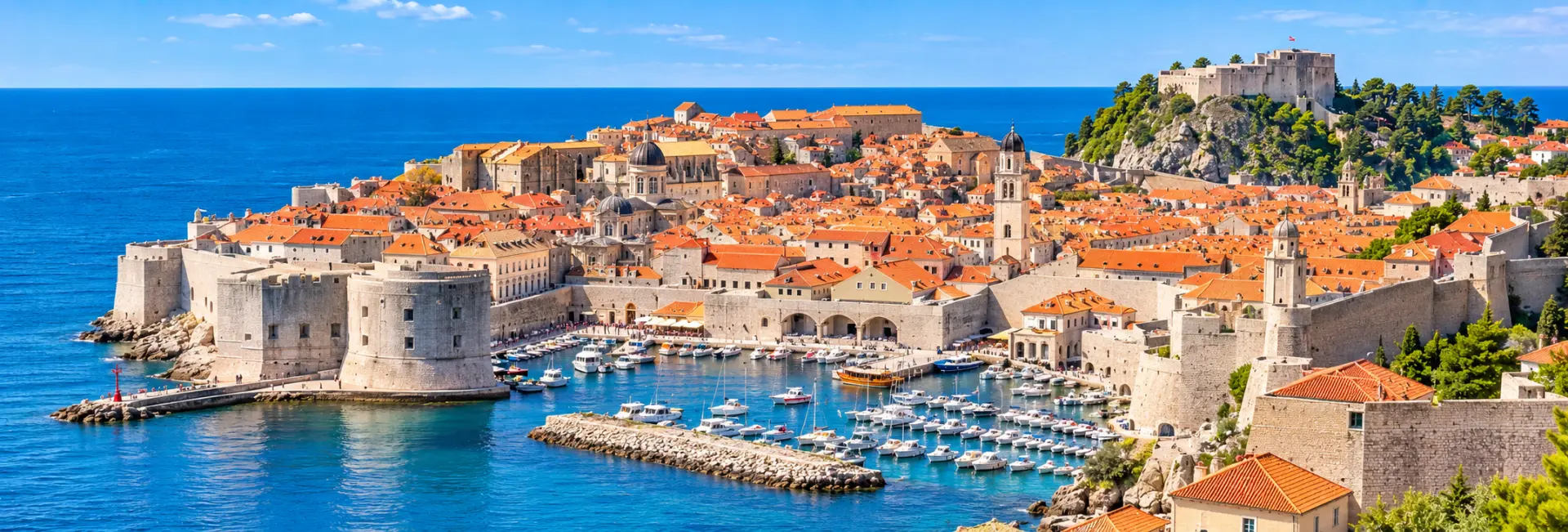
Dubrovnik Old Town is a compact, fully walled city on the southern Dalmatian coast of Croatia, packed with stone palaces, baroque churches, fountains and monasteries. It is small enough to cross on foot in a few minutes, yet dense enough to fill several days of sightseeing. Its nickname, the Pearl of the Adriatic, reflects both its setting on the sea and the pale limestone that glows in the evening light.
For centuries the town was the capital of the independent Republic of Ragusa, a maritime state that grew rich through trade and survived largely through clever diplomacy. That independent spirit is still visible in the layout of the streets, the public buildings and the strength of the defences. A modern visitor can walk the same marble street, climb the same bastions and look over the same harbour as merchants and senators did hundreds of years ago.
The Old Town is also a living neighbourhood, not a museum. Locals still live, worship and shop here, which is a good reason to move gently through the narrow lanes and treat the place with care.
History
Origins
The settlement is generally traced back to the seventh century, when refugees from the destroyed Roman town of Epidaurum, near modern Cavtat, founded a new community on a rocky islet. The name Ragusa was recorded in various forms from at least the tenth century, while the name Dubrovnik appears from the late twelfth century. The two names were used side by side for hundreds of years.
The Republic of Ragusa
The city received its own statutes in 1272, and in 1358 the Treaty of Zadar ended Venetian rule and left it self-governing. Its golden age ran through the fifteenth and sixteenth centuries, when its fleet and its diplomats made it a significant power in the Mediterranean far beyond its size.
Earthquake and Decline
In 1667 a catastrophic earthquake destroyed much of the town, although the walls survived largely intact. The city was rebuilt in a baroque style, and many of the grand churches and palaces seen today date from this reconstruction. Trade slowly declined, and in 1808 French forces abolished the Republic.
The Twentieth Century
Dubrovnik developed into a popular tourist destination in the twentieth century, especially after its World Heritage listing. In 1991, during the Croatian War of Independence, the city was besieged for about seven months, and the Old Town was shelled despite its protected status. The attacks drew worldwide condemnation and became a defining moment in the story of the town.
Recognition & Restoration
UNESCO inscribed the Old City of Dubrovnik on the World Heritage List in 1979, citing its outstanding medieval architecture and fortifications. In 1991, the year of the siege, the site was placed on the List of World Heritage in Danger. After years of repairs, it was removed from that list in December 1998.
The damage was considerable. Roughly 650 artillery hits were recorded on the Old Town, and more than half of its buildings were affected to some degree. Repair work between about 1995 and 1999 followed UNESCO guidance and aimed to restore buildings in their original style.
Today the restoration is almost invisible. If you look closely at some of the rooftops, you may notice slightly different shades of terracotta tile, which are the quiet reminders of where the shells fell.
Architecture & Streetscape
The Stradun
The heart of the town is the Stradun, also called the Placa, a limestone-paved street about 300 metres long that runs from Pile Gate in the west to the Ploče end in the east. The stone is polished smooth by centuries of footsteps and reflects the sky, so it can look like water after rain. Shops, cafes and historic buildings line both sides.
Side Streets
Dozens of narrow lanes climb steeply on the northern side of the Stradun, laid out in a tidy, regular grid. Staircases, laundry lines and tiny courtyards give these streets a lived-in feel that contrasts with the main thoroughfare. The southern lanes, closer to the sea, are quieter and often lead to small restaurants.
A Blend of Styles
Gothic, Renaissance and baroque styles sit side by side. Gothic windows and carved doorways survive on some palaces, Renaissance loggias and cloisters appear in others, and the baroque dominates the churches rebuilt after 1667. The shared use of local pale stone ties it all together.
The City Walls
The walls are the signature feature of Dubrovnik. They run for about 1,940 metres around the town without a break, rise as high as 25 metres in places, and are up to about six metres thick on the landward side. They are much thinner along the sea, where cliffs and water provided extra protection. Most of the construction took place in stages between the thirteenth and seventeenth centuries.
What You Will See
- Towers, bastions and cannon platforms that show how the defences developed over time
- Minčeta Tower, the highest and most imposing point on the circuit
- Views over the terracotta rooftops, the Old Port and the open Adriatic
- Glimpses into courtyards, gardens and the everyday life of the town below
Fort Lovrijenac
Standing apart on a cliff about 37 metres above the sea, Fort Lovrijenac guarded the western approach. It is often considered part of the wider defensive system and offers a different angle on the town and coast.
The Gates
There are three main entrances. Pile Gate, built in its present form in 1537, is the busiest and carries a statue of the patron saint, Saint Blaise. Ploče Gate guards the eastern end, and the smaller Buža Gate opens onto the northern side of the town.
Notable Landmarks
Onofrio's Fountain
Just inside Pile Gate stands the large fountain built in the fifteenth century to bring fresh water to the townspeople. It is a popular meeting point and a good first stop on the Stradun.
Sponza Palace and Rector's Palace
Sponza Palace, a sixteenth-century building with Gothic and Renaissance features, once served as a customs house and a centre of trade. Nearby, the Rector's Palace was the seat of the Republic's elected head of state, and today it houses a museum of cultural history.
Luža Square
This open space at the eastern end of the Stradun links the main buildings of civic life. It holds Orlando's Column, a bell tower and the Church of Saint Blaise, and it is the natural centre of public gatherings and festivals.
Churches and Monasteries
- Dubrovnik Cathedral, a baroque church rebuilt after the 1667 earthquake
- The Church of Saint Blaise, dedicated to the city's patron
- The Franciscan Monastery, known for its cloister and its historic pharmacy
- The Dominican Monastery, with a tranquil cloister and an important art collection
- The Jesuit Staircase and church, a baroque set piece that also featured in Game of Thrones
The Old Port
The small harbour on the eastern side was once the commercial heart of the Republic. Today it holds fishing boats and excursion boats, with stone walls framing a classic photo of the town.
Ways to Experience It
- Walk the full circuit of the city walls, ideally early in the day
- Stroll the Stradun and then climb into the back lanes to see the quieter side of the town
- Join a guided walking tour to learn about the Republic, the earthquake and the siege
- Visit the main museums, palaces, churches and cloisters, some of which can be combined on a multi-site pass
- Take a boat from the Old Port to nearby Lokrum Island for a quiet swim and a break from the crowds
- Look for Game of Thrones locations, since much of the town stood in for King's Landing
- Attend an event during the Dubrovnik Summer Festival, which fills squares and courtyards with concerts and theatre
- Enjoy a slow evening on a terrace, when the streets quieten and the stone glows
Best Time to Visit
Season
Late spring and early autumn are the sweet spots. The days are warm, the sea is pleasant and the crowds are noticeably thinner than in midsummer. July and August are the busiest and hottest months, and the stone streets can feel like an oven in the afternoon. Winter is calm and cool, though some businesses close for the season.
Time of Day
Cruise ship passengers tend to flood the town from mid-morning until late afternoon, so early morning and evening are far more peaceful. Arriving before the walls open or staying after the day trippers have left gives you the best chance of seeing the town in its calmer mood.
Special Dates
The feast of Saint Blaise on 3 February is an important local celebration with a procession through the Old Town, and the summer festival season adds extra atmosphere between July and August.
Visitor Tips
- Book your walls ticket in advance where possible, as the city has been moving to advance booking to manage numbers
- Walk the walls first thing in the morning, when it is cooler and quieter, and bring water, a hat and sun protection since there is little shade
- Wear shoes with good grip, as the polished stone and steep steps can be slippery
- Check the cruise ship schedule before choosing your day, because the city limits how many visitors enter at once under its Respect the City programme
- Enter through Pile Gate if you need step-free access, since it has a ramp, while Ploče Gate involves stairs and many side streets are stepped
- Dress respectfully when entering churches and avoid swimwear in the streets
- Keep noise down in the evenings, as many residents live above the lanes
- Expect to leave vehicles outside the walls, since the Old Town is pedestrian only
Ticket prices, opening hours and visitor rules change often, so confirm them with official sources before you go.
FAQs about visiting Dubrovnik Old Town
What is Dubrovnik Old Town known for? +
It is known for its complete medieval city walls, its marble-paved main street and its history as the capital of the independent Republic of Ragusa. It is also a UNESCO World Heritage Site and a famous filming location for Game of Thrones.
Is it free to enter the Old Town? +
Yes, walking through the gates and streets is free. Paid entry applies to the city walls and to most museums, palaces and monasteries.
How long do I need in Dubrovnik Old Town? +
One full day covers the walls, the Stradun and the main landmarks at a fair pace. Two days lets you add museums, a boat trip to Lokrum and some unhurried time in the back streets.
Do I need to book the city walls in advance? +
Advance booking is increasingly the norm and is the safest option, especially in peak season. Check the official city sources for the current rules.
How long does the walk around the walls take? +
Allow about 1.5 to 2 hours at a relaxed pace with photo stops. The route is just under two kilometres, but it includes many steps and plenty of views.
Can I visit with limited mobility or a stroller? +
Pile Gate has a ramp, and the Stradun itself is flat, so it is a workable route for wheelchairs and strollers. The walls and many side streets involve steep stairs and are not accessible.
Which entrance should I use? +
Pile Gate on the western side is the busiest and most convenient for buses and taxis. Ploče Gate on the east is quieter, and Buža Gate on the north leads down a long flight of steps to the Stradun.
Is the Old Town too crowded in summer? +
It can be very busy from mid-morning to late afternoon, especially on days when several cruise ships are in port. Early mornings and evenings, or visits in May, June, September and October, are far more comfortable.
