
Table of Contents
Overview
The Rector's Palace, known locally as Knežev dvor, is one of the most important historic buildings in Dubrovnik's Old Town. For roughly four centuries it was the nerve center of the Republic of Ragusa, the independent maritime city-state that traded across the Mediterranean until 1808. Elected rectors lived and worked here, and the same building housed council chambers, offices, an armory, a gunpowder store, a guardhouse and a prison.
Today the palace is home to the Cultural History Museum, part of the Dubrovnik Museums group. The arcaded front, carved stone capitals and quiet atrium are a highlight before you even reach the furnished rooms upstairs. It stands on Pred Dvorom street beside Luža Square, between Dubrovnik Cathedral and the Church of St. Blaise, which places it right in the middle of any first Old Town walk.
People visit for three reasons: the architecture, the story of how a small republic governed itself, and the collections that show how Ragusan nobles lived. It suits a short stop for the curious and a longer, slower visit for anyone who enjoys history.
History
Early Origins
The site was used for defensive purposes long before the palace we see today. Medieval records show the building growing in status over time, described first as a small fortification, then as a larger castle, and eventually as a palace. By the 13th century the local government was meeting here, and the rector lived in rooms on the upper floor.
Rebuilding in the 15th Century
A fire in 1435 destroyed much of the older structure, and the city decided to build a grander replacement. The commission went to Onofrio della Cava, a master builder from Naples who had already designed Dubrovnik's water supply system and its famous fountains. His design was in the Gothic style, and parts of it can still be recognized today in the upper-floor windows.
A gunpowder explosion in 1463 damaged the palace again. The reconstruction that followed in the 1460s introduced Renaissance elements, especially in the ground-floor portico. Michelozzo Michelozzi of Florence was consulted on the redesign, and local masters carried out the work, with names such as Juraj Dalmatinac and Salvi di Michiele linked to it.
Earthquake and Baroque Changes
The catastrophic earthquake of 1667 reshaped much of Dubrovnik. The palace needed repairs afterward, and the atrium and other areas were altered in the Baroque taste of the period. These layers of rebuilding are the reason the palace blends several styles rather than following one clean plan.
From Government Seat to Museum
The Republic of Ragusa came to an end under Napoleonic rule, and the palace stopped serving as the seat of government in 1808. In 1872 the building began a new life when the history department of the Dubrovnik Museums moved in. That museum remains here and is now known as the Cultural History Museum.
Recognition / Status
The Rector's Palace stands inside the Old City of Dubrovnik, which was inscribed on the UNESCO World Heritage List in 1979 and extended in 1994. UNESCO describes the city as a Mediterranean sea power from the 13th century onward that preserved its Gothic, Renaissance and Baroque churches, monasteries, palaces and fountains despite the 1667 earthquake.
The historic core was damaged again during the armed conflict of the 1990s, and a major restoration effort coordinated by UNESCO followed. The palace is one of the best-known monuments within this protected area.
- Located within the UNESCO-listed Old City of Dubrovnik
- Functions as a public museum, the Cultural History Museum
- Counted among the city's most important examples of civic architecture
- Used to appear on the reverse of Croatia's former 50-kuna banknote
Architecture & Design
The Street Front and Loggia
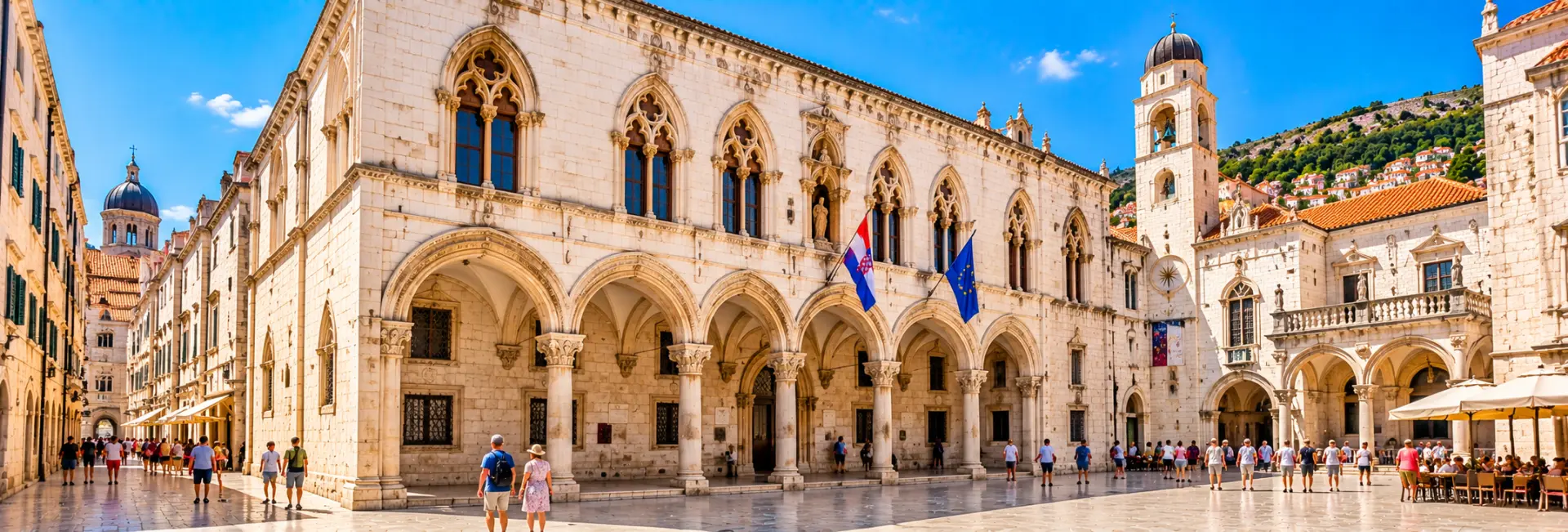
The most recognizable feature is the arcade of rounded arches along the front, supported by sturdy columns with carved capitals. Stone benches run beneath the arches, creating a covered public space where citizens once gathered to wait for hearings and announcements. The Renaissance character of this portico contrasts with the pointed Gothic windows on the floor above.
Windows and Upper Floor
The first floor, where the rector lived and the councils met, carries the pairing of Renaissance arcades below and Gothic windows above. This mix became so admired that it influenced other buildings in the city, including nearby Sponza Palace.
The Atrium
Inside, a small courtyard ringed by arches leads to a monumental stone staircase up to the principal rooms. The Baroque touches added after the 1667 earthquake sit alongside the earlier Gothic and Renaissance work. The space is compact but atmospheric, and its acoustics make it a favorite setting for chamber music.
A Capital With a Story
Among the carved capitals, one is often pointed out for its depiction of Asclepius, the Greek god of healing. Local tradition holds that it came from the ancient settlement of Epidaurum, the predecessor of today's Cavtat, and was reused here centuries later.
Rooms & Collections
The Ground Floor
The ground floor reflects the practical side of government. Courtrooms, the old prison cells and areas once used as an armory and watch house show how justice and security were handled within the same walls as politics. Some of these rooms also display church art and objects from the Republic's institutions.
The Rector's Apartments and State Rooms
Upstairs, a series of rooms has been restored to resemble life in the 18th century. You will find portraits of Ragusan nobles and officials, elaborate furniture, clocks, costumes, sedan chairs and carriages, alongside the robes and formal attire worn by magistrates. Walking through the private quarters and offices gives a clear sense of how closely work and daily life were tied together for each rector.
The Museum Collections
The Cultural History Museum holds roughly 20,000 objects organized into around fifteen collections, spanning the mid-14th to the early 20th century. Subjects include paintings and prints, furniture, textiles, ceramics, glass, icons, weapons, documents, photographs and postcards. The numismatic collection features coins from Dubrovnik's own mint across several centuries, and one display shows the original keys to the city gates.
Notable Highlights
With so much packed into a compact building, it helps to know what to look for. These are the details visitors most often remember.
- Miho Pracat monument: A bust in the atrium honors a wealthy shipowner from the island of Lopud who left a large bequest to the Republic. He is widely described as the only citizen to receive such a public tribute.
- The Latin motto: An inscription above the door of the Great Council hall urges officials to forget private affairs and attend to public ones.
- The Asclepius capital: A carved column top in the portico, tied to a legend about ancient Epidaurum.
- Period clocks: Some clocks are reportedly set to the evening hour when French troops entered Dubrovnik in 1806, a quiet reminder of the Republic's final years.
- City gate keys and coins: Everyday objects that connect the abstract idea of a republic to physical symbols of control and trade.
- The prison cells: A sobering contrast to the elegant rooms above.
The Rector and the Ragusan Republic
The palace makes more sense once you understand the political system behind it. The Republic of Ragusa was ruled by its noble families, and the rector was the figurehead of the executive branch. He had to be a nobleman over the age of 50, and he was elected by his peers for a term of just one month.
The short term was a deliberate safeguard against any one person gathering too much power. During his month in office the rector stayed inside the palace, leaving only for official duties and major religious occasions. Many men served more than once during their lifetimes, but never consecutively, so authority kept circulating among the ruling class.
Real decisions were shared. Day-to-day government was handled by the Minor Council, foreign affairs were the job of the Senate, and all adult nobles sat in the Great Council, which acted as the legislature. The palace housed these bodies and their records, so a single visit covers the whole machinery of the state.
That ideal of public service over personal interest is summed up in the Latin motto displayed in the building, one of the best-known phrases associated with Dubrovnik's history.
Ways to Experience It
Self-Guided Museum Visit
Most visitors explore on their own, moving from the atrium through the ground-floor rooms and then up the staircase to the period apartments. Information panels give context for each space, and the route is easy to follow without a guide.
Guided Tours
Many Old Town walking tours include the palace, either as an exterior stop or as part of a visit inside. A guide can add stories about specific rectors, political rivalries and the objects on display, which makes the visit richer for first-timers.
Passes and Combined Tickets
The museum is included in the Dubrovnik Pass, which also covers the City Walls and other attractions. A separate Dubrovnik Museums pass exists for visitors who mainly want to see several city museums. Check the current terms before buying, as they can change.
Concerts in the Atrium
During the Dubrovnik Summer Festival, the atrium becomes an intimate concert hall, with classical and chamber music performed beneath the arches. Attending an evening performance is one of the most memorable ways to experience the palace, and tickets for these events are usually sold separately from museum entry.
Best Time to Visit
Season
Spring and early autumn are the most comfortable times to explore the Old Town on foot, with milder temperatures and smaller crowds than midsummer. Summer is the busiest period, but it also brings the Summer Festival and its atrium concerts. Winter is calm and uncrowded, although opening hours are shorter than in the warmer months.
Time of Day
Arriving soon after opening usually means quieter rooms and cooler stone corridors in warm weather. Late afternoon can also work well once large tour groups have moved on. Midday in peak season tends to be the most crowded.
Visitor Tips
- Opening hours change with the season, and the museum is closed on certain public holidays, so confirm the schedule on the official Dubrovnik Museums website before you go.
- Ticket prices and pass terms can change, so check current details rather than relying on older guidebooks.
- Plan for about an hour, or longer if you like reading every panel and exploring the collections in detail.
- The principal rooms are on the upper floor and reached by a stone staircase, so contact the museum in advance if you need information on step-free access.
- Rules on photography can differ between rooms and exhibitions, so look for signs or ask staff.
- The Old Town streets are paved in polished stone that can be slippery when wet, so wear shoes with good grip.
- If you plan to attend a festival concert, book ahead, as the atrium has limited seating.
- Pair the visit with the cathedral and nearby squares to make the most of a compact, walkable area.
Nearby Attractions
The palace sits in the most historic part of the Old Town, so there is plenty to see within a few minutes' walk.
- Dubrovnik Cathedral: Right next door, with a treasury of religious art and relics.
- Church of St. Blaise: Dedicated to the city's patron saint, and a short distance from the palace.
- Luža Square: The lively central square beside the palace, home to Orlando's Column and the clock tower.
- Sponza Palace: A beautifully carved building that once served as the customs house and mint.
- Stradun: The polished limestone main street connecting the Old Town's two gates.
- City Walls: The famous circuit of fortifications offering sweeping views over the rooftops and the Adriatic.
FAQs about visiting the Rector's Palace in Dubrovnik
What is the Rector's Palace in Dubrovnik? +
It is a Gothic-Renaissance palace in the Old Town that served as the seat of government and the home of the elected rector of the Republic of Ragusa until 1808. Today it houses the Cultural History Museum.
Where is the Rector's Palace and how do I get there? +
It is at Pred Dvorom 3, beside Luža Square in the heart of the Old Town. Because the historic center is largely pedestrian, you reach it on foot after arriving at one of the city gates, such as Pile or Ploče.
Is the Rector's Palace worth visiting? +
Yes, especially if you want to understand how Dubrovnik was governed and how its nobles lived. It combines notable architecture, period rooms and museum collections in one central stop, and it adds context to the rest of the Old Town.
How long does a visit take? +
Most people spend around an hour inside. History enthusiasts who read the displays closely or attend a special exhibition may want to allow longer.
Do I need a ticket, and is it free? +
Entry to the museum is paid, though it is included with the Dubrovnik Pass. Prices and pass details change, so check the official Dubrovnik Museums website for current information.
When is the best time to visit? +
Spring and autumn offer pleasant weather and fewer crowds, while summer is busy but includes festival concerts in the atrium. Going shortly after opening is a good way to avoid peak crowds in any season.
Can I attend a concert at the Rector's Palace? +
Yes, the atrium is a well-known venue during the Dubrovnik Summer Festival, with classical and chamber performances. Tickets are generally separate from museum admission, and popular dates sell out, so book early.
Why did the rector only serve for one month? +
The short term was designed to prevent any single person from gaining lasting power. During that month the rector stayed in the palace and left only for official or religious occasions.
Is the palace suitable for children and visitors with limited mobility? +
Older children who enjoy history often like the prison cells, period costumes and old coins. The main rooms are on the upper floor, reached by stairs, so visitors with mobility needs should contact the museum beforehand to ask about access.
