Table of Contents
Overview
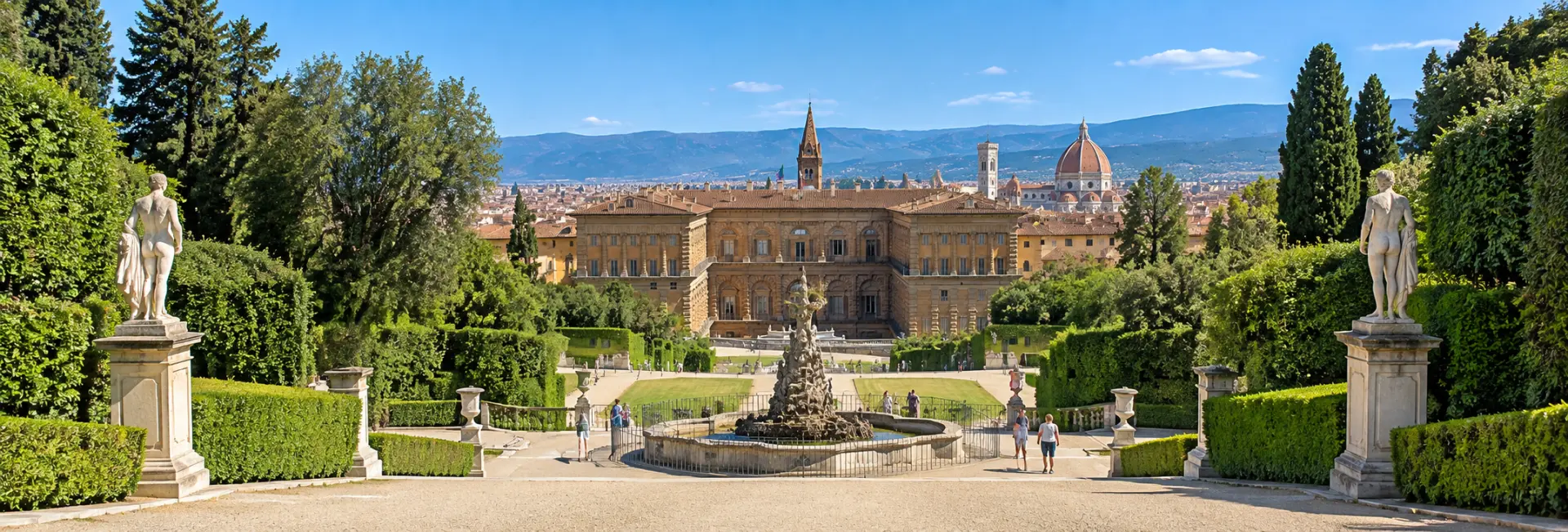
The Boboli Gardens rise in grand green terraces on the hillside directly behind the Pitti Palace, on the south bank of the Arno in Florence's Oltrarno district. Laid out from 1550 for Cosimo I de' Medici and his wife Eleonora di Toledo, the gardens were designed as an outdoor extension of the palace itself, a stage for court entertainment as much as a place to walk. Today they cover roughly 45,000 square metres of clipped hedges, gravel avenues, and centuries-old cypress and holm oak, dotted with fountains, grottoes, and antique and Renaissance statuary.
Because the gardens climb steeply from the palace up toward Forte di Belvedere, a visit doubles as one of the best vantage points over the Florence skyline, and in 2013 the Boboli Gardens were added to UNESCO's World Heritage List as part of the wider Medici Villas and Gardens in Tuscany. The layout is often described as the model for the classic Italian garden, and its influence on later formal gardens across Europe is one of the reasons art and garden historians still study it closely today.
History
From Private Land to Medici Garden
The land the gardens now occupy first entered history in 1418, when the wealthy Pitti family began buying up the hillside to build their own palace. When the Medici acquired the unfinished Palazzo Pitti in 1549, Cosimo I and Eleonora di Toledo commissioned the sculptor and architect Niccolò Pericoli, known as Il Tribolo, to lay out formal gardens on the slope behind it. Work began the following year and continued after Tribolo's death under Bartolomeo Ammannati and later Bernardo Buontalenti and Giorgio Vasari, who each left their mark on the garden's growing network of terraces, avenues, and grottoes. Their combined work set the geometric, axis-based approach that later became the hallmark of the Italian Renaissance garden style, with clipped hedges and long sightlines standing in deliberate contrast to the wilder countryside beyond.
Expansion Under Later Rulers
Because the hillside had no natural water source of its own, engineers built a dedicated aqueduct drawing from the Arno to feed the gardens' fountains and pools, later enlarged under Cosimo's son Ferdinando I and still known today as the Acqua Ferdinanda. The gardens reached roughly their present size in the seventeenth century, and later still, the House of Habsburg-Lorraine and then the House of Savoy, who succeeded the Medici as rulers of Tuscany, continued adding new features and adapting the layout to the tastes of their own eras rather than leaving it as a fixed Renaissance relic. An eighteenth-century Rococo coffee house, the Kaffeehaus, and the green-painted Limonaia used for wintering the estate's citrus trees both date from this later phase of building, reflecting tastes quite different from the Mannerist grottoes and statuary the Medici had favoured two centuries earlier.
Opening to the Public
For roughly two centuries the gardens remained a private preserve of the ruling family, used for elaborate court festivities, theatrical spectacles, and, according to tradition, some of the earliest public performances of opera, drawing nobility from across Tuscany to watch. It wasn't until 1766, under Grand Duke Pietro Leopoldo of Lorraine, that the gates were finally opened to ordinary visitors. The gardens have remained a public park ever since, surviving further renovations under successive rulers, and in 2013 UNESCO inscribed them, together with the wider group of Medici villas and gardens across Tuscany, on its World Heritage List.
Key Structures & Highlights
Statues, fountains, and follies from four centuries of continuous building are scattered across the gardens' terraces, and a handful of set pieces stand out as the highlights of any visit.
The Amphitheater and Egyptian Obelisk
Directly behind the palace, the horseshoe-shaped amphitheater began life as the quarry that supplied stone for the Pitti Palace itself, before being reshaped into a turf theatre lined with statues drawn from Roman mythology. Grand Ducal festivities and spectacles once played out here in front of the Medici family and their guests. At its centre stands a granite obelisk brought from Egypt, originally raised on the orders of Ramesses II, one of several ancient artefacts that the Medici and their successors added to the gardens over the centuries to give the space a sense of antiquity to match its Renaissance design. The amphitheatre's shape, tiered seating, and enclosing hedges still hint clearly at its earlier life as a working quarry, long before it was reimagined as a garden set piece.
The Grotta del Buontalenti
Tucked near the Ammannati courtyard entrance, the Grotta del Buontalenti is an elaborate artificial cave built between the 1580s and 1590s, its walls once dripping with real water and encrusted with faux stalactites and painted scenes. Copies of Michelangelo's unfinished Prigioni sculptures originally stood in its outer chamber, while an inner room holds a marble Venus by Giambologna, and further sculpture groups depicting figures from classical mythology are set into niches deeper inside, all combining to give the grotto a theatrical, almost dreamlike atmosphere very different from the garden's clipped formal avenues outside. Visits inside the grotto are sometimes limited or timed separately from general garden admission, since its fragile decoration requires careful conservation.
Neptune Fountain and the Isolotto
Higher up the hillside, the Fountain of Neptune, sculpted by Stoldo Lorenzi and nicknamed "the Fork" by Florentines because of Neptune's trident, marks a popular resting point with sweeping views back over the city. Further along the garden's central cypress-lined avenue, known as the Viottolone, the path opens onto the Isolotto, an oval moated island that forms one of the garden's most photographed corners. At its centre rises Giambologna's Ocean Fountain, surrounded by orange trees and statuary, a set piece that captures the theatrical, water-centred character the Medici and their successors built into the whole garden. The walk along the Viottolone itself, flanked by tall cypresses planted in the seventeenth century, is one of the most photographed stretches in the entire garden.
Ways to Experience It
The Boboli Gardens are included on the same ticket as the Pitti Palace museums, so most visitors combine the two, though the gardens can also be entered on their own from several separate gates around the hillside.
- Buy a combined ticket covering the Boboli Gardens, the Silver Museum, the Costume Gallery, and the Porcelain Museum, all housed around the same hillside
- Enter through one of four gates - Piazza Pitti, the Ammannati courtyard, Porta Romana, or Forte di Belvedere - depending on where the rest of your day is taking you
- Book tickets online in advance during peak season, since queues at the ticket office can be long on busy mornings
- Plan for a longer, unhurried walk if you want to see the Isolotto and the upper terraces near Forte di Belvedere, both a fair climb from the main entrance
Best Time to Visit
Because the gardens sit on a steep hillside with very little shelter in places, cooler months and the early hours of the day tend to make for the most comfortable visit. Spring brings the gardens to life with new growth after the relatively bare winter months, while a visit in late autumn or winter often means near-empty paths, even if a handful of fountains and features close for seasonal maintenance. Summer visits are best tackled early in the morning, both to avoid the worst of the heat on the exposed upper terraces and to beat the crowds arriving from the Pitti Palace next door.
Visitor Tips
A few practical details make the difference between an easy stroll and a tiring one, since the gardens are considerably larger and hillier than they first appear from the entrance.
- Wear comfortable, sturdy shoes - gravel paths and long flights of stone steps run throughout the gardens
- Bring water and sun protection for the open terraces near the top of the hill, which offer little shade
- Budget at least two hours, and closer to half a day if you also want to see the Pitti Palace museums
- Check ahead for any areas under restoration, since individual fountains or statues are periodically covered by scaffolding for conservation work
- Pick up a garden map at the entrance, since the paths can be confusing and some highlights sit well off the main routes
- Visit early on hot days, since shade is limited across much of the upper garden
Nearby Attractions
The gardens sit right at the edge of Florence's Oltrarno district, within easy walking distance of some of the city's best-known sights on both sides of the Arno.
- Pitti Palace - the Medici residence the gardens were built to complement, now home to several museums covering painting, costume, and decorative arts
- Ponte Vecchio - Florence's famous medieval bridge lined with jewellers' shops, a short walk north along the river
- Oltrarno neighbourhood - a quieter district of artisan workshops, small squares, and local trattorias on the same side of the Arno
- Forte di Belvedere - a fortress at the top of the hill behind the gardens, often used for temporary exhibitions and offering some of the widest views over the city
- Piazzale Michelangelo - another popular Florence viewpoint, a walk or short bus ride further along the hillside to the east
FAQs about visiting the Boboli Gardens
What are the Boboli Gardens? +
They're a large Renaissance garden on the hillside behind the Pitti Palace in Florence, laid out from 1550 for the Medici family and now a UNESCO-listed open-air museum of statues, fountains, and grottoes.
How old are the Boboli Gardens? +
Work on the gardens began in 1550, though the land itself was first developed in the early fifteenth century by the Pitti family before the Medici acquired the palace and commissioned the garden.
Are the Boboli Gardens and the Pitti Palace on the same ticket? +
They can be, since the standard combined ticket covers the Boboli Gardens along with the Silver Museum, Costume Gallery, and Porcelain Museum, all part of the same Pitti Palace complex, though the gardens can also be visited on a standalone ticket.
How long does it take to visit the Boboli Gardens? +
Most visitors spend around two hours walking the main paths and highlights, though the gardens are large enough that a full, unhurried visit including the Isolotto and upper terraces can easily fill half a day.
Are the Boboli Gardens UNESCO listed? +
Yes, they were added to UNESCO's World Heritage List in 2013 as part of the wider group of Medici Villas and Gardens in Tuscany.
What are the must-see spots in the Boboli Gardens? +
The amphitheater with its Egyptian obelisk, the Grotta del Buontalenti, the Neptune Fountain, and the Isolotto with Giambologna's Ocean Fountain are generally considered the highlights of a visit.
Is the walk through the Boboli Gardens difficult? +
The gardens climb a steep hillside with long flights of stairs and gravel paths, so comfortable shoes are recommended, though the paths themselves are well maintained and suitable for a leisurely pace.
What's nearby the Boboli Gardens? +
The Pitti Palace, Ponte Vecchio, the Oltrarno neighbourhood, Forte di Belvedere, and Piazzale Michelangelo are all within a short walk or ride of the gardens.