Table of Contents
Overview
A few streets southeast of the Duomo, the Basilica of Santa Croce anchors one of Florence's liveliest squares while holding some of the city's most solemn ground inside. As the largest Franciscan church in the world, it was built to embody the order's ideals of humility, yet over the centuries it grew into something closer to a national mausoleum, earning the nickname "Temple of the Italian Glories."
That nickname is well earned: the floor and walls hold the tombs and memorials of Michelangelo, Galileo, Machiavelli, the composer Gioachino Rossini, and dozens of other figures central to Italian art, science and political life. Add in fresco cycles by Giotto and his followers, one of the earliest surviving stained glass collections in Florence, and a Renaissance chapel by Brunelleschi tucked into the cloister, and the basilica packs an outsized amount of history into a single Franciscan complex.
Roughly one million visitors pass through Santa Croce each year, making it one of the most visited monuments in Florence despite standing somewhat in the shadow of the Duomo and the Uffizi. For many, the draw isn't a single masterpiece but the cumulative weight of walking the same nave where centuries of Italian genius, from Renaissance sculptors to modern scientists, were laid to rest.
History
Founding and Construction
Tradition credits Francis of Assisi himself with founding a small oratory on this marshy spot outside Florence's medieval walls, though the building seen today dates from a later, far grander project. Construction of the present church began on 12 May 1294, funded by some of Florence's wealthiest families and, according to Vasari, designed by the sculptor and architect Arnolfo di Cambio, who was also shaping the city's cathedral and town hall at around the same time.
The main structure took roughly a century to complete, reaching substantial finished form by 1385, though the church would not be formally consecrated until 1442, by Pope Eugene IV. For centuries afterward, the building's exterior remained bare, unfaced stone, a striking contrast to the richly decorated interior that was steadily filling with chapels, tombs and frescoes underneath.
The Counter-Reformation and a Modern Facade
In 1560, changes driven by the Counter-Reformation led to the removal of the church's choir screen and a significant remodeling of the interior under Giorgio Vasari, a shift that damaged or destroyed several earlier frescoes and altars in the process. Some frescoes, including scenes from the life of St Francis, were simply plastered over rather than removed, inadvertently preserving them until later restorers rediscovered the paintings underneath.
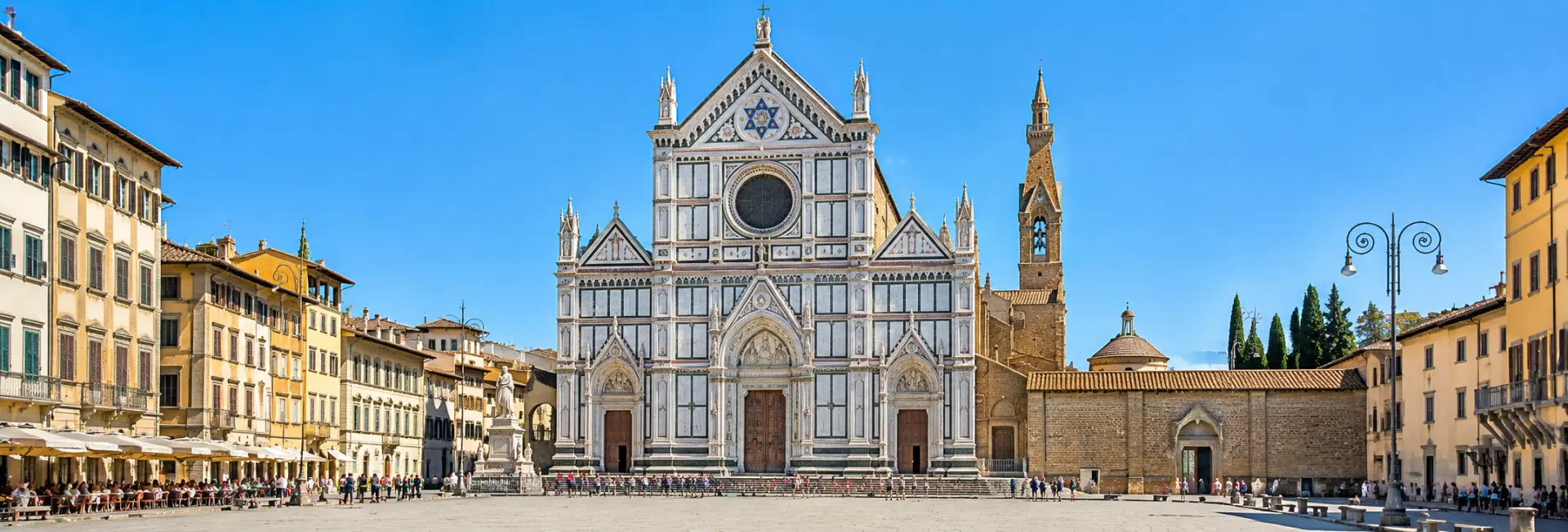
The basilica's famous marble facade is a nineteenth-century addition rather than an original medieval feature. Built between 1857 and 1863 to a design by the Jewish architect Niccolò Matas, it incorporates a prominent Star of David into its composition; Matas himself was denied burial alongside his Christian peers inside and was instead interred beneath the church's threshold, marked with an inscription.
Flood, Restoration and Recent History
In 1966, the Arno River overflowed catastrophically across Florence, and Santa Croce, sitting in a low-lying part of the city, took some of the worst damage of any building in town. Floodwater carrying mud, sewage and heating oil rose several meters inside the church, damaging artworks including Cimabue's famous crucifix, and recovery efforts stretched on for decades afterward.
More recently, the basilica has undergone extensive structural restoration, a program that drew renewed urgency after a fatal masonry collapse in 2017 prompted a temporary closure and safety review. Conservation work on the complex continues today, carried out alongside the basilica's ordinary function as both an active church and one of Florence's most visited museums.
Architecture & Design
Santa Croce's floor plan takes the shape of an Egyptian or Tau cross, a form associated with Saint Francis, and stretches some 115 metres in length, making it an imposing structure despite the deliberate architectural austerity favored by the Franciscan order. A wide nave flanked by two aisles is divided by rows of octagonal columns, while an open timber roof, rather than stone vaulting, covers the nave in a style typical of Franciscan churches of the period.
- A neo-Gothic marble facade added in the nineteenth century, patterned in white, green and pink stone
- Sixteen chapels lining the transept and apse, many endowed by wealthy Florentine families such as the Bardi and Peruzzi
- A bell tower rebuilt in 1842 after lightning destroyed its medieval predecessor
- Two adjoining cloisters, the larger begun by Brunelleschi and completed after his death
Within the first cloister stands the Pazzi Chapel, built as the chapter house and widely credited to Filippo Brunelleschi, the same architect responsible for the dome of Florence Cathedral. Its interior is deliberately restrained, decorated not with frescoes but with glazed terracotta roundels by Luca della Robbia, and it is regarded as one of the defining works of early Renaissance architecture.
Beyond the cloisters, the church's interior decoration reflects centuries of shifting taste rather than a single unified plan. Gothic pointed arches frame the nave, while later Renaissance and even Baroque additions appear throughout the side chapels and tomb monuments, giving Santa Croce a layered architectural character quite different from the more uniform interiors of Florence's other major churches.
Cultural & Religious Significance
As the principal Franciscan church in Florence, Santa Croce has served as an active center of worship for the order for more than seven centuries, and it remains a functioning parish and conventual church today rather than a museum alone. Its scale and prominence made it a natural gathering point for the city more broadly, hosting public sermons, civic gatherings, and even the Piazza Santa Croce's long-running tradition of calcio storico, a historic form of football still played there once a year.
From the fifteenth century onward, the church's role expanded well beyond religious life as it became customary to bury or commemorate especially honored Florentines and, later, notable Italians from across the country within its walls. That accumulation of tombs transformed Santa Croce into what is often called the "Pantheon of Florence," a place where visiting a single church means walking among the resting places of figures who shaped art, science, literature and Italian political thought across five centuries.
The basilica's dual identity as both sacred space and civic monument has also made it a magnet for writers and artists in its own right. Nineteenth-century Romantic authors visiting the tombs of Machiavelli, Michelangelo and Galileo often read the basilica as a symbol of Italy's fractured political fortunes and its enduring cultural genius, a theme later echoed in works ranging from George Eliot's Romola to E.M. Forster's A Room with a View.
Notable Features
Giotto's fresco cycles in the Bardi and Peruzzi Chapels, depicting scenes from the lives of St Francis and St John the Evangelist, rank among the most important surviving works of early Renaissance painting and remain a primary reason art historians make the trip to Santa Croce. Restoration work in the twentieth century stripped away centuries of overpainting and whitewash to reveal Giotto's original brushwork, though some sections remain permanently lost.
- The tombs of Michelangelo, Galileo Galilei and Niccolò Machiavelli, among the most visited monuments inside the church
- A nineteenth-century cenotaph honoring Dante Alighieri, who is actually buried in Ravenna
- Cimabue's monumental crucifix, badly damaged in the 1966 flood and now displayed in the refectory
- The Pazzi Chapel, with its terracotta decoration by Luca della Robbia and frieze by Desiderio da Settignano
- The Scuola del Cuoio, or Leather School, operating in the former friars' dormitory, where visitors can watch artisans at work
The complex also preserves some of Florence's earliest stained glass, dating to the early fourteenth century and still fitted into windows around the high altar chapel, alongside a small museum housed largely in the old refectory that displays artworks recovered or restored after the 1966 flood.
Visiting Etiquette & Tips
- As an active place of worship, Santa Croce asks visitors to dress modestly, covering shoulders and knees
- A single ticket covers the basilica, the cloisters, the Pazzi Chapel and the Museo dell'Opera di Santa Croce, so budget time to see all four
- Photography is generally allowed in most areas, though flash photography can damage fragile frescoes and should be avoided
- Quiet, respectful behavior is expected throughout, particularly near the tombs and during any active religious services
- The piazza outside can get busy with events and market stalls, so checking ahead helps if a quieter visit is the goal
Best Time to Visit
Mornings shortly after opening tend to be the calmest time to explore the basilica, before tour groups and day-trippers from other parts of Tuscany arrive in force. Afternoons, especially in peak summer months, can bring long queues at the entrance and crowded chapels, particularly around the most famous tombs and frescoes.
Visiting in the shoulder seasons of spring and autumn generally means smaller crowds and more comfortable temperatures for exploring the surrounding piazza afterward. Because much of the basilica's interior lighting depends on natural light through its stained glass and windows, a bright, clear day also makes a noticeable difference when viewing the frescoes and stonework in detail.
Nearby Attractions
Piazza Santa Croce, the lively square in front of the basilica, is worth lingering in on its own, ringed with cafes, leather shops and the annual site of Florence's historic football matches. From there, several of Florence's other major sights are within easy walking distance.
- The Florence Cathedral (Duomo), roughly 800 metres northwest and the natural next stop for most visitors
- The Uffizi Gallery, a short walk toward the Arno River, home to one of Italy's premier art collections
- The Casa Buonarroti, a small museum dedicated to Michelangelo housed in a property once owned by his family
- The Arno riverfront and Ponte Vecchio, a pleasant walk south through the historic center
FAQs about visiting the Basilica of Santa Croce
Why is Santa Croce called the "Temple of the Italian Glories"? +
Because it holds the tombs and memorials of dozens of Italy's most celebrated figures, including Michelangelo, Galileo, Machiavelli and Rossini.
Is Dante buried in Santa Croce? +
No. Dante is buried in Ravenna; the monument inside Santa Croce is a nineteenth-century cenotaph honoring him rather than his actual tomb.
How much time should I plan for a visit? +
Most visitors spend one to two hours covering the basilica, cloisters, Pazzi Chapel and museum, though art enthusiasts often stay longer for the Giotto frescoes.
Do I need to book tickets in advance? +
Advance booking isn't always required but is recommended in peak season to avoid queues, since a single ticket covers the whole complex.
Is Santa Croce still an active church? +
Yes, it functions as both a working Franciscan church and parish alongside its role as one of Florence's most visited museums.
What should I wear to visit? +
Modest dress is expected, covering shoulders and knees, as is standard for active places of worship in Italy.
Can I take photos inside? +
General photography is usually allowed, but flash is discouraged, since it can damage the fragile centuries-old frescoes.
What else is nearby worth seeing? +
The Florence Cathedral, the Uffizi Gallery, and the Casa Buonarroti museum are all within easy walking distance of the piazza.