Table of Contents
Overview
The Uffizi Gallery is one of the world's most important art museums, holding the single greatest concentration of Italian Renaissance painting anywhere. Housed in a 16th-century building originally constructed for Florence's civic administration, it sits just steps from Piazza della Signoria along the banks of the Arno River.
Millions of visitors pass through its halls each year to see works by Botticelli, Leonardo da Vinci, Michelangelo, Raphael, Titian, and Caravaggio, among others, most of it drawn from the private collection amassed by the Medici family over several centuries. Few museums anywhere pack as much artistic significance into a single, walkable building.
The gallery is consistently ranked among the most visited museums in Italy, and its collection is widely regarded as offering the clearest single overview available anywhere of how Italian painting developed from the late medieval period through the High Renaissance and beyond.
History of the Museum
Built as Offices, Not a Museum
Construction began in 1560 under architect Giorgio Vasari, commissioned by Cosimo I de' Medici to consolidate Florence's various administrative and judicial offices into a single complex. The building's name, Uffizi, simply means "offices" in Italian, reflecting its original bureaucratic purpose rather than any artistic ambition.
From Private Collection to Public Museum
The Medici family began using the upper floor of the building to display parts of their extensive art collection as early as 1581, and the gallery was gradually opened to visitors by request over the following two centuries. When the Medici line died out in the 18th century, the family's last heiress, Anna Maria Luisa de' Medici, negotiated an agreement ensuring the collection would remain in Florence permanently for public benefit rather than being dispersed or sold off.
Official Opening and Modern Expansion
The Uffizi opened officially to the public in 1769 and was formally established as a museum in 1865. Since then, its collection has grown considerably beyond its original Medici holdings, and the museum has undergone repeated rounds of expansion and reorganization, including an ongoing modernization project aimed at improving circulation and display space for its ever-growing number of visitors.
That modernization effort has continued into the present day, with the museum's current director overseeing a rolling series of room redesigns intended to reduce bottlenecks around the most popular works and present the collection with clearer historical context. Recent changes to how the Botticelli rooms are arranged are part of this broader, ongoing rethinking of how the galleries guide visitors through six centuries of art.
Architecture & Building
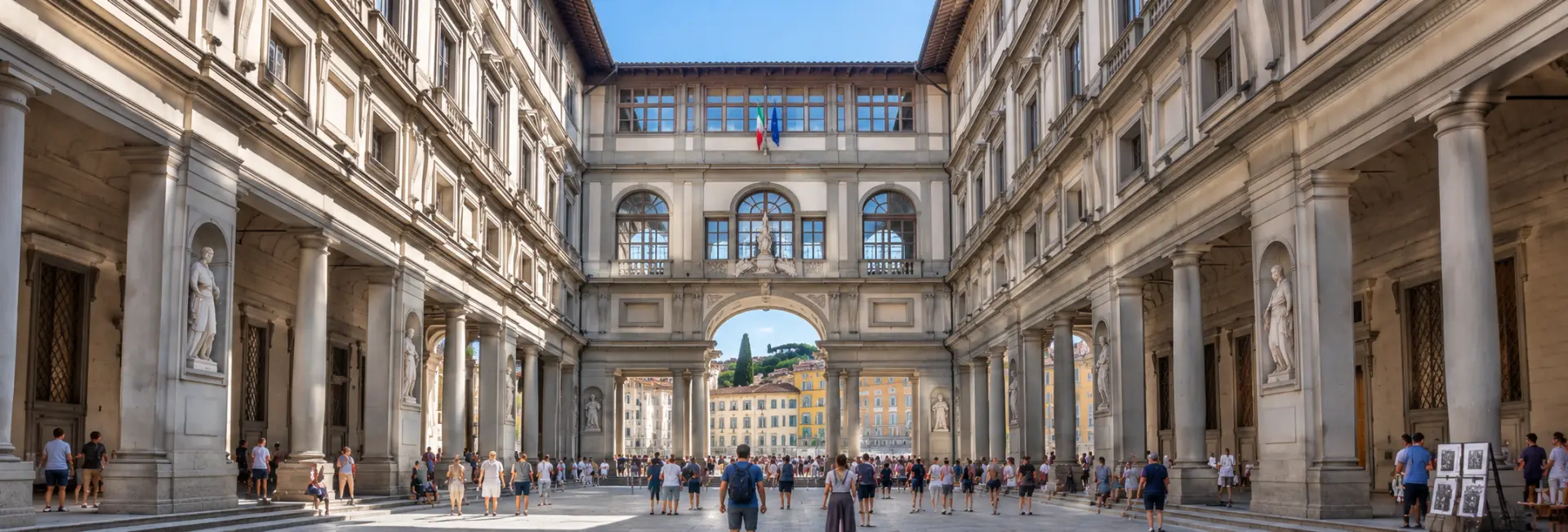
Vasari designed the Uffizi as a U-shaped complex of two long wings connected by a shorter section facing the Arno, framing a narrow courtyard that opens dramatically onto the river. Construction continued after Vasari's death under architects Alfonso Parigi and Bernardo Buontalenti, reaching completion around 1581.
The building's facade is relatively restrained compared to other Medici commissions of the period, its long arcaded ground floor and repeating window bays creating a rhythmic, almost processional approach toward the riverfront. The gallery itself occupies the top floor of the complex, a design choice that originally kept the art collection above the working government offices below.
The narrow courtyard between the two wings, often compared to a formal street rather than an open piazza, was designed to draw the eye toward the Arno at its far end, a deliberate piece of urban theater that still shapes how most visitors first experience the building today. The Uffizi's structural design, including its long, load-bearing walls and generous window openings, was itself considered innovative at the time, anticipating later museum architecture built specifically to display art rather than to house administrative functions.
Collections & Highlights
The Uffizi's collection spans the 13th to 18th centuries but is most famous for its unmatched holdings of Italian Renaissance painting, arranged largely in chronological order across a long sequence of galleries.
- Sandro Botticelli's "The Birth of Venus" and "Primavera," recently rehung in adjoining rooms allowing visitors to view both major works together
- Leonardo da Vinci's "Annunciation," one of his earliest surviving paintings
- Michelangelo's "Doni Tondo," his only known finished panel painting
- Raphael's "Madonna of the Goldfinch"
- Titian's "Venus of Urbino"
- Caravaggio's "Medusa" and "Bacchus"
Beyond painting, the museum also holds an extensive collection of ancient sculpture assembled by the Medici, including Roman-era statues that once decorated the family's gardens and villas, now displayed alongside the later Renaissance works they helped inspire.
The galleries are broadly arranged in chronological order, beginning with Byzantine and early Gothic altarpieces and moving through the flowering of Florentine painting in the 15th century before reaching the High Renaissance and Baroque rooms toward the end of the visitor route. This sequence allows visitors to trace the evolution of Italian painting technique and style across several centuries within a single continuous walk, rather than encountering it as a series of disconnected highlights.
The Vasari Corridor
Built in 1565 atop the Ponte Vecchio, the Vasari Corridor is an elevated passageway roughly a kilometer long that once allowed the Medici family to walk unseen from the seat of government at Palazzo Vecchio, through the Uffizi, across the bridge, and on to the Pitti Palace on the opposite bank of the Arno.
After years of closure for restoration, the corridor has reopened to the public with timed, separately ticketed access, and it now displays a collection of portraits and artworks along its length. Because the visit is one-directional, ending at the Pitti Palace side, visitors typically explore the main Uffizi galleries first before adding the corridor as a final stage of their visit.
Beyond its art, the corridor is notable simply for the vantage points it offers, including small windows overlooking the Ponte Vecchio's jewelry shops below and glimpses into the Church of Santa Felicita along its route. Its long closure before reopening had made it something of a legendary, rarely seen part of Florence for years, adding to the appeal it now holds for visitors able to walk its length in person.
Ways to Experience It
Given the size of the collection and the volume of visitors, most travelers benefit from planning their Uffizi visit in advance rather than arriving without a strategy. The museum's popularity means that spontaneous, same-day visits are often the most frustrating way to experience it, particularly during the busiest months of the year.
- Book timed-entry tickets online ahead of time, since walk-up lines can stretch for hours during peak season
- Add Vasari Corridor access as a separate, timed ticket if interested in the Medici's private passageway
- Join a guided tour for context on the collection's history and the Medici family's role in shaping it
- Focus on a shortlist of must-see works if time is limited, since the full collection can easily take half a day or more to see properly
- Use an audio guide or the museum's official app for self-paced background on individual works
Best Time to Visit
Early morning, right at opening, offers the calmest experience of the galleries, particularly the rooms holding the Botticelli paintings, which draw the heaviest crowds throughout the day. Late afternoon in the hour or two before closing can also be quieter, once large tour groups have moved on.
Spring and autumn tend to be less crowded than the peak summer months, though the Uffizi remains busy year-round given its status as one of the most visited museums in Italy. Booking a specific time slot in advance is generally more important than choosing a particular season, since demand for popular entry times can be high regardless of when you visit.
Visitor Tips
- Book tickets online in advance, ideally with a specific entry time, to avoid long walk-up lines
- Arrive close to your booked time slot, since early or late arrival can mean losing your reservation
- Plan for at least two to three hours to see the main collection without rushing
- Check current opening hours and any temporary room closures before visiting, since gallery reorganization is ongoing
- Consider a combined ticket with the Vasari Corridor or nearby Pitti Palace and Boboli Gardens if planning a fuller Medici-themed day
Nearby Attractions
- Piazza della Signoria and Palazzo Vecchio, directly adjacent to the museum
- The Ponte Vecchio, a short walk south along the Arno
- Florence Cathedral (Duomo) and Piazza del Duomo, roughly a 10 minute walk north
- The Pitti Palace and Boboli Gardens, across the Arno via the Ponte Vecchio
- The Bargello Museum, a short walk northeast, known for its Renaissance sculpture collection
FAQs about visiting the Uffizi Gallery
Do I need to book Uffizi tickets in advance? +
Yes, booking a timed-entry ticket online in advance is strongly recommended, since walk-up lines can be very long, especially during peak tourist season.
What are the must-see works at the Uffizi? +
Highlights include Botticelli's "The Birth of Venus" and "Primavera," Leonardo da Vinci's "Annunciation," Michelangelo's "Doni Tondo," and Caravaggio's "Medusa," among many other Renaissance masterpieces.
How long should I spend at the Uffizi? +
Most visitors need at least two to three hours to see the main collection, though art enthusiasts often spend half a day or more.
What is the Vasari Corridor? +
It is an elevated passageway built in 1565 connecting the Uffizi to the Pitti Palace across the Ponte Vecchio, originally built for the Medici family and now open to the public with a separate, timed ticket.
Is the Vasari Corridor included in the standard Uffizi ticket? +
No, it typically requires a separate ticket in addition to standard Uffizi admission, and access is limited to timed entry slots.
Why is the building called the Uffizi? +
The name means "offices" in Italian, reflecting the building's original 16th-century purpose as a home for Florence's administrative and judicial offices before it became an art gallery.
Is the Uffizi Gallery accessible for visitors with mobility needs? +
The museum offers elevator access to its upper-floor galleries, though visitors with specific accessibility needs should check current facilities before their visit.
What else is nearby? +
Piazza della Signoria, the Ponte Vecchio, Florence Cathedral, the Pitti Palace with its Boboli Gardens, and the Bargello Museum are all within easy walking distance.