Table of Contents
Overview
Palazzo Pitti is a monumental stone palace on the south bank of the Arno River in Florence, a short walk from the Ponte Vecchio. Begun in the mid-15th century as the private home of a Florentine banking family, it later became the seat of the Medici grand dukes and, in turn, the residence of two more ruling houses before passing to the Italian state.
Today the palace no longer functions as a private residence. Instead, its vast interior is divided among several museums covering painting, decorative arts, fashion, and modern art, while its hillside grounds form one of Italy's most celebrated formal gardens. Few buildings in Florence pack as much political and artistic history into a single address.
History
A Banker's Ambition
The palace's core dates to the late 1450s, when it was commissioned as the town residence of Luca Pitti, a wealthy Florentine banker who wanted a home to rival, and perhaps outshine, the properties of his political rivals, the Medici. Building slowed after Pitti fell out of favor in Florentine politics, and construction stalled altogether following his death in the early 1470s, leaving the palace only partly realized for decades.
The Medici Take Over
In 1549, the Pitti family sold the unfinished palace to Eleonora di Toledo, wife of Grand Duke Cosimo I de' Medici. Under Medici ownership the building was transformed from a single grand house into a proper seat of government and court life. Architects expanded the structure significantly, laid out a formal inner courtyard, and began developing the hillside behind the palace into an elaborate garden. Later in the 16th century, an elevated covered passageway was built to link Palazzo Pitti directly to the Medici's older seat of power across the river, allowing the family to move between the two without ever stepping into the street.
Later Rulers and the Italian State
When the Medici line ended in the 18th century, the palace passed to the House of Lorraine, who continued adding to its collections and living quarters. Napoleon briefly used the palace as a base during his Italian campaigns at the turn of the 19th century, and after Italian unification it served for a period as a royal residence for the House of Savoy, since Florence was briefly the capital of the newly unified country. In 1919, the last Savoy king donated the palace and its contents to the Italian state, opening the way for it to become the public museum complex it is today.
Architecture & Notable Rooms
Facade and Courtyard
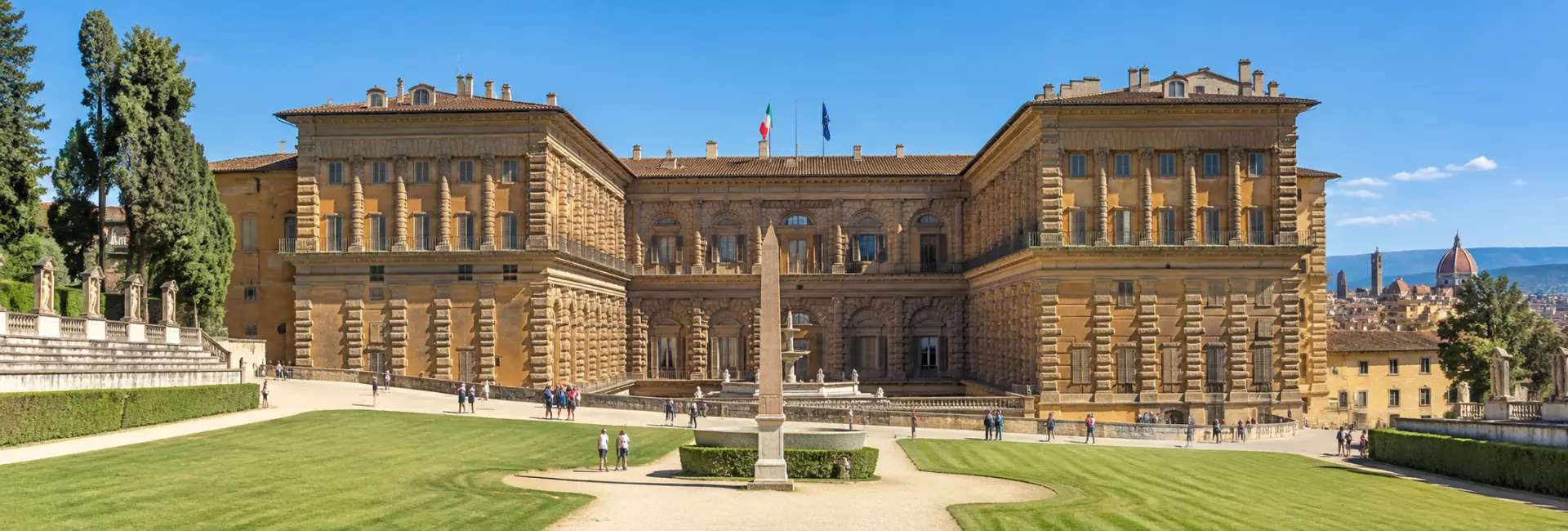
Palazzo Pitti is best known for its severe, fortress-like facade of rusticated stone blocks, a style that was unusual for a private residence when it was first built and became one of the defining features of Florentine Renaissance architecture. As the palace grew under Medici and later ownership, architects extended the original facade with matching wings, and a grand rear courtyard was added that opens directly onto the hillside gardens, blending the building almost seamlessly into its landscape.
Royal Apartments and the Palatine Gallery
Inside, the first floor holds a sequence of richly decorated staterooms once used by the Medici, Lorraine, and Savoy families in turn, many still furnished with period tapestries, frescoed ceilings, and gilded detailing. Adjoining these rooms is the Palatine Gallery, where paintings are still hung salon-style, floor to ceiling and grouped for visual effect rather than by chronology or artist, much as they would have appeared when the collection was a private display of dynastic wealth rather than a modern museum.
Museums & Collections
Rather than a single museum, Palazzo Pitti today houses a cluster of separate collections under one roof, each occupying a different part of the complex.
- Palatine Gallery and Royal Apartments – old-master paintings and gilded staterooms from the palace's time as a working residence
- Museo degli Argenti (Treasury of the Grand Dukes) – Medici jewelry, silverware, ivories, and other precious objects amassed over generations
- Gallery of Modern Art – 18th- to 20th-century Italian painting, including major holdings of the Macchiaioli movement
- Costume and Fashion Gallery – historic clothing and textiles, housed in an adjoining wing of the palace
- Porcelain Museum – Medici and Lorraine tableware displayed in a garden pavilion on the hill above the palace
A single visit rarely covers every collection in depth, so many visitors choose one or two galleries that match their interests rather than attempting the whole complex in one trip.
Boboli Gardens
Behind the palace, the Boboli Gardens climb the hillside in a series of terraces, avenues, and amphitheaters that rank among the earliest and most influential examples of the formal Italian garden style. Landscaping began soon after the Medici acquired the palace and continued for well over a century, giving the grounds a layered mix of design approaches even though the overall effect feels unified.
What's Inside the Gardens
The gardens combine sculpture, water features, and carefully framed views across the city. An open-air amphitheater near the palace was originally used for Medici court spectacles, while further up the hill, secluded groves and a rustic grotto complex give way to quieter, more intimate corners of greenery. Statues line many of the main pathways, ranging from ancient Roman pieces to works commissioned specifically for the site.
Cultural Significance
Palazzo Pitti sits within the Historic Centre of Florence, a UNESCO World Heritage Site recognized for its concentration of Renaissance architecture and art. The palace itself is a physical record of shifting power in Tuscany: built to challenge the Medici, then absorbed into their dynasty, then passed down through two further ruling houses before becoming public property.
Beyond its political history, the palace played a lasting role in shaping how art collections are displayed. The Palatine Gallery's dense, salon-style hanging is often cited as one of the best-preserved examples of how a princely collection actually looked before museums adopted the more sparse, chronological layouts common today.
Ways to Experience It
There's more than one way to approach a visit, depending on how much time and interest you have.
- Self-guided visit – explore the Palatine Gallery and Royal Apartments at your own pace, following the fixed circuit through the staterooms
- Garden-focused visit – buy garden access alone and spend a few hours walking the Boboli Gardens without touring the museum interiors
- Combined ticket route – pair Palazzo Pitti with the Uffizi Gallery and Vasari Corridor on a multi-site ticket, since all three are linked by Medici history
- Guided tour – join a small-group or private tour for context on the art and Medici history that isn't always explained on gallery labels
Best Time to Visit
Spring and early autumn offer the most comfortable weather for combining the museum interiors with a walk through the gardens, without the heaviest summer crowds or heat. Early morning entry, as soon as the palace opens, tends to be quieter than midday, especially in peak tourist season.
The Boboli Gardens are particularly worth timing around the weather, since much of the experience is outdoors and largely unshaded. A cooler morning or late afternoon visit is generally more comfortable than a midsummer midday walk up the hillside terraces.
Visitor Tips
A little planning goes a long way given the size of the complex.
- Check current opening hours and ticket options before you go, since these vary by season and by which museums are included
- Wear comfortable shoes if you plan to see the Boboli Gardens, which involve a steady uphill walk on gravel and stone paths
- Budget at least half a day if you want to see both the main museum galleries and the gardens without rushing
- Photography is generally allowed in most galleries without flash, but rules can vary by room, so check posted signage
- Accessibility is limited in parts of the historic building and gardens; check ahead if step-free access is a requirement
Nearby Attractions
Palazzo Pitti's location in the Oltrarno district puts several major sights within easy walking distance.
- Ponte Vecchio – Florence's famous medieval bridge lined with jewelry shops, just a few minutes' walk away
- Uffizi Gallery – reachable on foot or via the elevated Vasari Corridor that historically connected the two palaces
- Piazza della Signoria – the city's civic heart, home to Palazzo Vecchio and an open-air sculpture gallery
- Oltrarno neighborhood – the artisan quarter surrounding the palace, known for workshops, small squares, and local trattorias
FAQs about visiting Palazzo Pitti
What is Palazzo Pitti best known for? +
It's best known as the former residence of the Medici grand dukes, and today for its Palatine Gallery of old-master paintings, its decorative arts museums, and the Boboli Gardens on the hillside behind it.
How much time should I set aside for a visit? +
Plan on at least two to three hours if you're focusing on one museum, or a half day or more if you want to see the main galleries and walk through the Boboli Gardens as well.
Do I need to book tickets in advance? +
Booking ahead is strongly recommended, especially in peak season, since the palace's museums can involve long lines for walk-up visitors; check current ticket options before you travel, as pricing and combined-entry arrangements change from time to time.
Is Palazzo Pitti part of the same ticket as the Uffizi Gallery? +
The two sites are historically connected and can often be visited on a combined or multi-site ticket, but exact ticketing arrangements vary, so it's worth confirming current options when booking.
What's the best time of day or year to visit? +
Early morning visits and the shoulder seasons of spring and early autumn tend to be less crowded and more comfortable than midday visits in peak summer, particularly if you also plan to walk the gardens.
Is Palazzo Pitti suitable for visitors with limited mobility? +
Some areas of the museum and much of the Boboli Gardens involve stairs, uneven surfaces, and hillside paths, so visitors with mobility needs should check accessibility details in advance to plan accordingly.
Is it worth visiting with kids? +
The palace's grand rooms and the outdoor space of the Boboli Gardens can appeal to families, though younger children may find the painting galleries less engaging than the gardens and open-air amphitheater.
What's nearby that pairs well with a visit? +
The Ponte Vecchio, Uffizi Gallery, and Piazza della Signoria are all within easy walking distance, and the surrounding Oltrarno neighborhood is worth a stroll for its artisan workshops and local restaurants.
What do visitors sometimes wish they'd known beforehand? +
Many visitors underestimate how large the complex is and how much walking the Boboli Gardens require, so it helps to wear comfortable shoes and avoid scheduling the visit too tightly against other plans.