Table of Contents
Overview
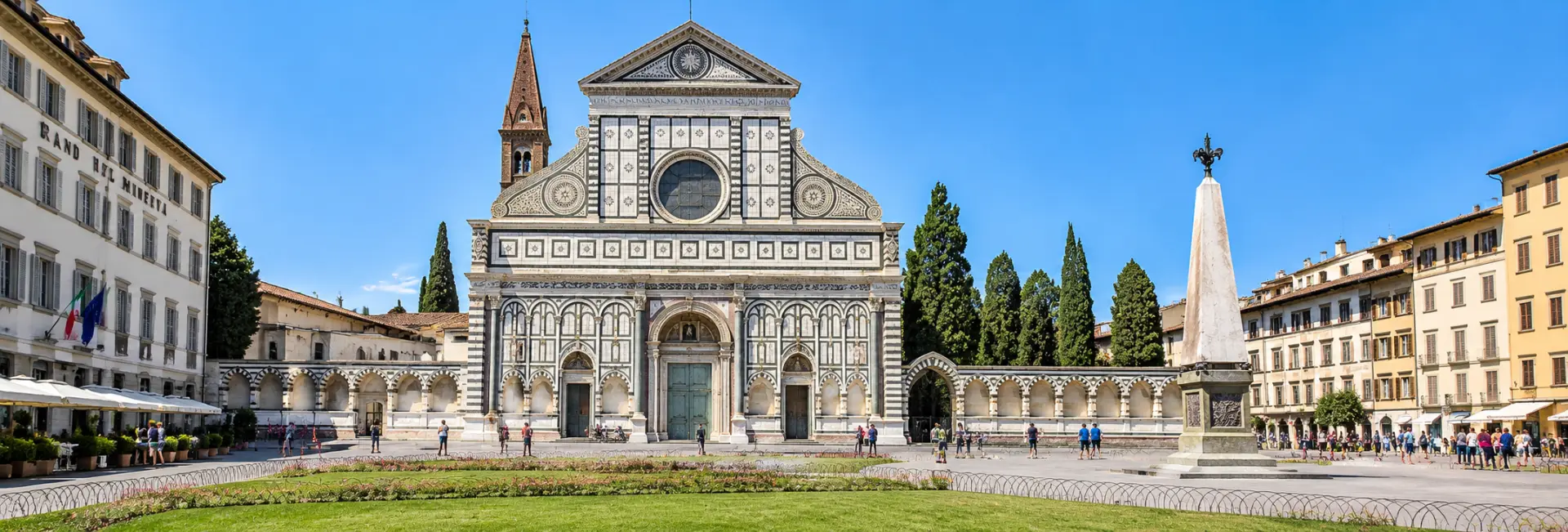
The Basilica of Santa Maria Novella stands on the square of the same name in central Florence, a short walk from the city's main railway station, which itself takes its name from the church next door. Begun by Dominican friars in the second half of the thirteenth century on the site of an older oratory, it grew over nearly two centuries into the first great basilica built in the city, and it remains the principal Dominican church in Florence. Its striped green-and-white marble facade, finished under the architect Leon Battista Alberti in 1470, is often ranked among the most harmonious in Italy.
Behind that facade lies one of the richest single collections of late medieval and early Renaissance painting anywhere in the city, spread across the nave, side chapels, and the convent's surviving cloisters, all funded over the centuries by some of Florence's wealthiest banking families. The church is also a working parish, which means a visit blends art history with the quieter, ongoing rhythm of an active place of worship.
History
From a Country Oratory to a Dominican Church
The site began as a small oratory called Santa Maria delle Vigne, named for the vineyards that once surrounded it outside Florence's city walls. In 1221 the Florence diocese handed the building over to a group of Dominican friars newly arrived in the city, and within a few decades the friars decided to replace it with a much larger church, calling the new building Santa Maria Novella, or "New Saint Mary," to distinguish it from the older structure. Ground was broken around 1279, and construction stretched on for nearly two centuries, with the lower, Romanesque-Gothic section of the facade largely finished by the mid-fourteenth century. The church's long, austere nave, stretching around 100 metres from entrance to altar, was deliberately built to a scale that would encourage quiet reflection over decorative excess, in keeping with Dominican preaching traditions.
Consecration and a Center of Learning
The church was finally consecrated in 1420, by which time the attached convent had already grown into one of the most important centres of learning in Christian Europe, a Studium Generale recognised as capable of granting its own academic degrees. Theologians and philosophers studied and debated there for generations, and the church's intellectual reputation ran alongside the long-standing rivalry between the Dominicans of Santa Maria Novella and the Franciscans of Santa Croce across town, a rivalry that shaped religious and artistic life in Florence for centuries. Among the scholars and writers linked to the church's intellectual circle, the poet Dante Alighieri is traditionally associated with debates held within its walls, a reflection of how closely the convent's academic life was woven into the wider culture of the city.
The Alberti Facade and Later Changes
In the fifteenth century, the wealthy Rucellai family funded a major renovation of the church's exterior, commissioning the architect and theorist Leon Battista Alberti to complete the upper section of the facade, finished in 1470. Alberti added geometric inlays of white and green marble from Prato, along with billowing-sail motifs that were the Rucellai family's own emblem, and the whole composition became one of the most influential church facades of the early Renaissance. The interior underwent further changes in later centuries, including a significant nineteenth-century restoration that returned much of the church to a more Gothic appearance, and a sixteenth-century remodelling overseen by the painter and architect Giorgio Vasari that altered several of the side altars.
Architecture & Design
The Latin Cross Plan and Interior
Beneath its famous facade, Santa Maria Novella follows a Latin cross plan, with a wide nave flanked by side aisles and a squared apse bordered by two further square chapels. The bays of the central nave are built as near-perfect squares, creating open spans that could hold large congregations for Mass and preaching, while the narrower aisle bays on either side were subdivided into smaller chapels reserved for wealthy Florentine families' funerary monuments and private devotion. Slender composite piers support a four-part vaulted ceiling that, beyond its structural role, was designed with the building's acoustics in mind, helping a preacher's voice carry the full length of the nave to a standing congregation.
Alberti's Facade and Its Proportions
When Leon Battista Alberti took on the upper facade in the 1450s, he inherited a lower section already built in typical Tuscan Romanesque style, complete with pointed Gothic niches originally meant to hold marble tombs. Rather than replace this earlier work, Alberti wove a new upper storey around it using a strict system of harmonic proportion, in which the whole facade is set within a large square and its parts are laid out through repeated halving and doubling of that same square's dimensions - a method Alberti borrowed from the ratios used in musical harmony. The result is best known for its pair of large scroll-shaped volutes, an architectural device that elegantly bridges the wide lower storey and the narrower upper one, and one that architects across Italy would go on to borrow for church facades of their own.
Cultural & Religious Significance
The Mother Church of Florentine Dominicans
As the principal Dominican church in Florence, Santa Maria Novella has long stood at the centre of the city's religious life, hosting Mass, preaching, and public feast-day ceremonies for the surrounding parish and beyond. Its attached convent doubled as an important seat of theological education, and the church itself was chosen to host sessions of the Council of Florence in 1439, a major gathering of the Catholic and Orthodox churches presided over by Pope Eugene IV that attempted, briefly, to reunite the two branches of Christianity. That association placed Santa Maria Novella at the centre of one of the fifteenth century's most consequential religious gatherings, well beyond its everyday role as a parish church.
A Church of Florence's Great Families
Much of what makes Santa Maria Novella so rich today reflects a long tradition of wealthy Florentine banking and merchant families competing to fund its chapels and decoration as a mark of piety and status. The Rucellai, Strozzi, Tornabuoni, and Gondi families, among others, each held rights to chapels within the church, commissioning leading artists of their day to fill them with frescoes, altarpieces, and family tombs. That pattern of private patronage, repeated across generations, is a large part of why the church's interior reads today less like a single unified design and more like a layered gallery of Florentine taste across two centuries.
Notable Artworks & Chapels
Santa Maria Novella's interior and its adjoining cloisters hold works from some of the most important names in Florentine painting, several of which marked turning points in the history of Western art.
Masaccio's Holy Trinity
Just inside the church, along the left side of the nave, hangs Masaccio's fresco of the Holy Trinity, painted around 1424-25. It's widely considered the first monumental painting to apply the newly developed rules of linear perspective with full confidence, creating the illusion of a deep, coffered chapel receding into the wall behind the figures. Its combination of mathematical precision and religious subject matter made it a landmark work for the artists who followed, and it remains one of the most studied paintings of the entire early Renaissance. For generations after it was painted, Florentine artists returning to study the fresco treated it almost as a textbook example of how perspective could be used to convince the eye rather than simply decorate a wall.
Giotto's Crucifix and the Tornabuoni Chapel
Suspended in the centre of the nave, a large painted Crucifix by Giotto, dating from around 1290, is considered one of his most important early works and helped establish a more naturalistic way of depicting Christ's body that later painters would follow for generations. Behind the main altar, the Tornabuoni Chapel holds an extensive fresco cycle painted by Domenico Ghirlandaio and his workshop between 1485 and 1490, depicting scenes from the lives of the Virgin Mary and John the Baptist, set against detailed backdrops of Florentine architecture and dress. A young Michelangelo is traditionally said to have trained in Ghirlandaio's workshop around the time these frescoes were completed, and the cycle is prized today for its detailed portraits of Florentine patrons and contemporary fashion woven into biblical scenes.
The Strozzi Chapel and the Green Cloister
To one side of the Tornabuoni Chapel, the Strozzi Chapel is decorated with frescoes by Filippino Lippi depicting scenes from the life of Saint John the Evangelist, painted in the final years of the fifteenth century. An older Strozzi family chapel elsewhere in the church holds an earlier fresco cycle of heaven and hell by Nardo di Cione and his brother Andrea, better known as Orcagna. Beyond the church itself, the adjoining Chiostro Verde, or Green Cloister, takes its name from the greenish tone of the grisaille frescoes of Old Testament scenes painted there by Paolo Uccello and others in the first half of the fifteenth century. Nearby, the Spanish Chapel, once the meeting hall of the Dominican confraternity, holds a further cycle of fourteenth-century frescoes illustrating the mission and teachings of the Dominican Order.
Ways to Experience It
The main body of the church and its museum complex, including the cloisters and the Spanish Chapel, are covered by a single admission ticket, separate from attending Mass, which remains free of charge.
- Buy tickets at the entrance or online in advance to skip the queue during busy periods
- Follow the included route through the Chiostro Verde and the Spanish Chapel, both part of the same ticket as the church interior
- Consider a guided tour focused on the Renaissance frescoes for deeper context on the Masaccio and Ghirlandaio cycles
- Check the schedule for Mass times if you'd like to attend a service rather than visit as a sightseer, since those hours run separately from paid visiting hours
Best Time to Visit
Mornings shortly after opening tend to be the quietest time to see the frescoes before crowds gather in front of the Tornabuoni and Strozzi chapels. Because the basilica is an easy stop for travellers arriving at the adjacent train station, it can get busy through the middle of the day, especially in high season, so an early or late visit generally makes for a more contemplative experience. Winter afternoons, when the low sun sometimes catches the stained glass and the marble facade outside, are also a favourite time for photographers. Weekday visits tend to be calmer than weekends, when the piazza outside fills with both tourists and locals.
Visitor Tips
Because the basilica is an active place of worship as well as a museum, a few points of etiquette are worth knowing before a visit.
- Dress modestly, covering shoulders and knees, as is expected in most Florentine churches
- Keep voices low and avoid visiting during scheduled Mass if you're there purely to see the artwork
- Check current photography rules at the entrance, since policies on flash and tripods can change
- Allow 45 minutes to an hour to see the church and cloisters at an unhurried pace
- Visit the adjoining historic pharmacy, run by the Dominican friars since the thirteenth century, for a fragrant detour after the church
- Arrive with a little historical context on the main chapels, since on-site descriptive panels are limited compared with the scale of the artwork
Nearby Attractions
The basilica sits at the edge of Florence's historic centre, within easy reach of several other major sights on foot.
- Florence Santa Maria Novella railway station - the city's main train station, immediately next to the church
- Piazza del Duomo and Florence Cathedral - the city's most iconic landmark, a short walk to the east
- Mercato Centrale - a lively covered food market a few minutes away, popular for a casual lunch
- Palazzo Strozzi - a Renaissance palace turned exhibition space, a short walk south
- Ognissanti church - home to further important Renaissance frescoes, a walk along the river to the west
FAQs about visiting the Basilica of Santa Maria Novella
What is the Basilica of Santa Maria Novella known for? +
It's known for its harmonious Renaissance facade by Leon Battista Alberti and for housing major works of early Renaissance art, including Masaccio's Holy Trinity and Giotto's painted Crucifix.
How old is the Basilica of Santa Maria Novella? +
Construction of the current church began around 1279 on the site of an earlier oratory, and it was consecrated in 1420, though the facade wasn't fully completed until 1470.
Who designed the facade of Santa Maria Novella? +
The lower, Romanesque-Gothic section dates from the fourteenth century, while the upper section, funded by the Rucellai family, was designed by the architect Leon Battista Alberti and completed in 1470.
Is there an entrance fee to visit Santa Maria Novella? +
Yes, a paid ticket covers the church interior, the Chiostro Verde, and the Spanish Chapel, while attending Mass as a place of worship remains free.
What are the must-see artworks inside? +
Masaccio's Holy Trinity fresco, Giotto's painted Crucifix, the Ghirlandaio frescoes in the Tornabuoni Chapel, and Filippino Lippi's frescoes in the Strozzi Chapel are generally considered the highlights.
How long does a visit take? +
Most visitors spend around 45 minutes to an hour taking in the church and adjoining cloisters at a relaxed pace.
Is Santa Maria Novella close to the train station? +
Yes, Florence's main railway station is named after the basilica and sits immediately next to it, making the church an easy stop right after arriving in the city.
What's nearby the basilica? +
Florence Cathedral, Mercato Centrale, Palazzo Strozzi, and the Ognissanti church are all within a short walk.