Table of Contents
Overview
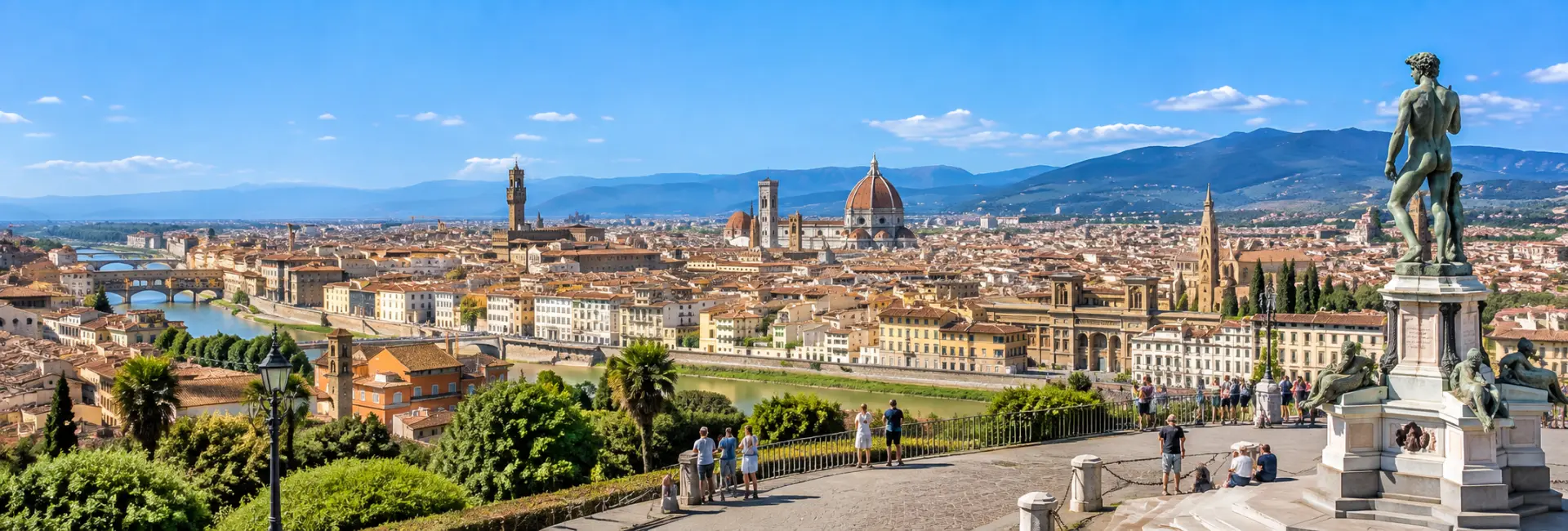
Piazzale Michelangelo is the spot where nearly every visitor to Florence eventually ends up, drawn by a single view: the Duomo, the Palazzo Vecchio, and the Arno's bridges laid out below a wide stone terrace on a hill south of the river. Unlike Florence's medieval churches and palaces, the square itself is a 19th-century creation, built specifically to give the city one grand, unobstructed vantage point.
The terrace takes its name from the Renaissance sculptor Michelangelo, honored here with bronze copies of some of his best-known works, and it has become as much a part of the classic Florence experience as any of the historic sites it overlooks. Locals and visitors alike treat it less as a monument to visit and more as a place to simply be, especially as the sun goes down over the city.
What makes the view work so well is elevation combined with distance: high enough above the historic center to take in the whole skyline at once, but close enough that individual landmarks, from the Duomo's dome to the crenellated tower of the Palazzo Vecchio, remain clearly identifiable rather than blurring into an anonymous cityscape.
History
Piazzale Michelangelo was built in 1869 as part of a sweeping urban renewal project carried out while Florence briefly served as the capital of a newly unified Italy. Architect Giuseppe Poggi oversaw the transformation of large parts of the city during this period, including the demolition of Florence's old fortified walls on the river's north side and their replacement with the broad, tree-lined boulevards known as the Viali di Circonvallazione.
On the hill south of the Arno, Poggi took a different approach, laying out the long, winding Viale dei Colli and capping it with a broad terrace deliberately designed for sweeping views back over the city. The result was Piazzale Michelangelo, conceived from the outset as a scenic destination rather than a functional civic space, an unusual project for its time, when most new public squares in European cities were still built around traffic, commerce, or monuments rather than a view.
Poggi's original plans were even more ambitious than what exists today. He envisioned the neoclassical loggia overlooking the terrace as a full museum dedicated to Michelangelo, gathering plaster casts or copies of the artist's major works under one roof. That museum concept was ultimately dropped, and in 1876 the loggia was converted into a restaurant and café instead, a role a version of it still fills.
The wider urban project that produced Piazzale Michelangelo reshaped much of Florence's relationship with the Arno, replacing medieval fortifications with open boulevards and, on this side of the river, an entirely new kind of public space built purely around scenery. More than a century and a half later, that original vision has held up remarkably well, with the terrace still functioning largely as Poggi intended.
Design & the Michelangelo Statues
The square's centerpiece is a bronze copy of Michelangelo's David, standing atop a stone pedestal at the terrace's midpoint and facing out over the city rather than toward any single landmark. Surrounding it are bronze copies of the four allegorical figures from the Medici Chapel at the Basilica of San Lorenzo, representing Dawn, Dusk, Day, and Night, works Michelangelo originally carved in marble for Medici family tombs elsewhere in Florence. Casting the statues in bronze rather than displaying marble originals outdoors was a deliberate practical choice, letting the square host faithful reproductions of major works without exposing irreplaceable marble sculpture to weather, pollution, and the wear of constant public access, the same concern that eventually moved the real David indoors to the Accademia in 1873.
Poggi's neoclassical loggia anchors the upper end of the terrace, its columned facade a deliberate counterpoint to the openness of the viewing platform below. An inscribed plaque set into the loggia's balustrade references Michelangelo's legacy, a quiet nod to the museum Poggi had originally hoped to build on this spot.
The overall layout keeps the statues secondary to the view rather than competing with it, a deliberate choice that has helped the square age well. Even as the surrounding city has changed considerably since the 1870s, the basic experience Poggi designed, an open terrace framing an unbroken view of Florence, remains essentially unchanged, and it is precisely that restraint in the square's design that keeps the skyline itself as the main attraction rather than the architecture around it.
Around the Hill
Piazzale Michelangelo sits partway up a hillside that holds several other worthwhile stops for visitors willing to continue a little further. A short climb above the terrace leads to the Basilica of San Miniato al Monte, a Romanesque church with an elegant green-and-white marble facade and views arguably even better than those from the piazzale itself, since fewer visitors make the extra climb.
- The Rose Garden, a terraced public garden just below the piazzale, free to enter and in bloom mainly through spring and early summer
- The Iris Garden, open only for a few weeks each year when the flowers are in bloom, typically late April through May
- The Rampe del Poggi, a scenic stepped pathway connecting the riverside near Piazza Giuseppe Poggi up to the terrace, an alternative to the road route
- The Basilica of San Miniato al Monte, a short uphill walk beyond the piazzale, with a quieter, less crowded viewpoint of its own
Taken together, these spots make the piazzale a natural anchor for an entire afternoon or early evening rather than a single quick photo stop, especially for visitors willing to walk a bit further off the main terrace and into the quieter streets and gardens around it.
Ways to Experience It
Most visitors treat the piazzale as a stop rather than a destination requiring a set amount of time, arriving to take in the view, snap photos by the David copy, and move on within twenty to thirty minutes. Others linger considerably longer, especially around sunset, when benches and low walls along the terrace fill with people simply watching the light change over the city.
The walk up from the city center, either via the Rampe del Poggi stairway or through the surrounding streets of the Oltrarno, is itself part of the experience for many visitors, offering glimpses of the view building gradually before the full panorama opens up at the top. Bus routes also serve the piazzale directly for those who prefer to skip the climb, and it works well as a stop on a longer walking route that also takes in San Miniato al Monte.
Street vendors and small food and drink stalls are a regular presence around the terrace, particularly in the evening, giving visitors an easy option for a snack or a cold drink while waiting for the light to change without needing to leave the square.
Best Time to Visit
Sunset is by far the most popular time to visit, when the terrace fills with visitors watching the sky change color over the Duomo and the surrounding hills. Arriving at least 45 minutes before sunset is worth it during busy months, since the best viewing spots along the wall fill up quickly.
For a quieter experience with similarly good light, early morning offers a strong alternative, with far fewer people and a cooler, calmer atmosphere, particularly in summer when afternoon heat can make the exposed terrace uncomfortable. Overcast days, while less dramatic than a clear sunset, can still offer a pleasant, uncrowded visit for anyone whose schedule doesn't line up with golden hour.
Visitor Tips
- Keep an eye on belongings, since crowded viewpoints like this one can attract pickpockets and pushy street vendors
- Wear comfortable shoes if walking up via the Rampe del Poggi, since the climb involves a steady set of stairs
- Arrive well before sunset in peak season to claim a good spot along the terrace wall
- Consider continuing uphill to San Miniato al Monte for a quieter view and a look at one of Florence's most striking Romanesque churches
- Check seasonal opening dates before planning around the Iris Garden, since it blooms for only a few weeks each year
Nearby Attractions
Piazzale Michelangelo sits on the Oltrarno side of the city, within walking distance of several sights on both sides of the Arno.
- The Basilica of San Miniato al Monte, a short uphill walk beyond the piazzale
- The Boboli Gardens and Palazzo Pitti, reachable on foot through the Oltrarno district below the hill
- The Ponte Vecchio, visible from the terrace and an easy walk down toward the river
- Forte Belvedere, a historic Medici fortress a short walk from the piazzale, offering its own elevated views over the city
FAQs about visiting Piazzale Michelangelo
What is Piazzale Michelangelo known for? +
It is known as the best panoramic viewpoint over central Florence, taking in the Duomo, the Palazzo Vecchio, and the Arno's bridges from a wide terrace built in 1869.
Is the David at Piazzale Michelangelo the original? +
No, it is a bronze copy. Michelangelo's original marble David is displayed in the Galleria dell'Accademia, and a separate marble copy stands in Piazza della Signoria.
Is Piazzale Michelangelo free to visit? +
Yes, the terrace is a public square and free to visit at any time. There is no entry fee to enjoy the view or see the statues.
How do I get to Piazzale Michelangelo? +
It can be reached on foot via the Rampe del Poggi stairway from Piazza Giuseppe Poggi, by a longer walk through the Oltrarno streets, or by direct bus routes from the city center for those who prefer not to climb.
What is the best time to visit? +
Sunset is the most popular time, when the sky and the city below turn gold, though early morning offers similarly good light with far smaller crowds.
How long should I plan to stay? +
Most visitors spend 20 to 30 minutes taking in the view and photographing the statues, though many linger much longer, especially around sunset.
Is it worth walking up to San Miniato al Monte as well? +
Yes, the church sits a short climb above the piazzale and offers an equally striking, generally quieter view, along with one of Florence's finest Romanesque facades.