Table of Contents
Overview
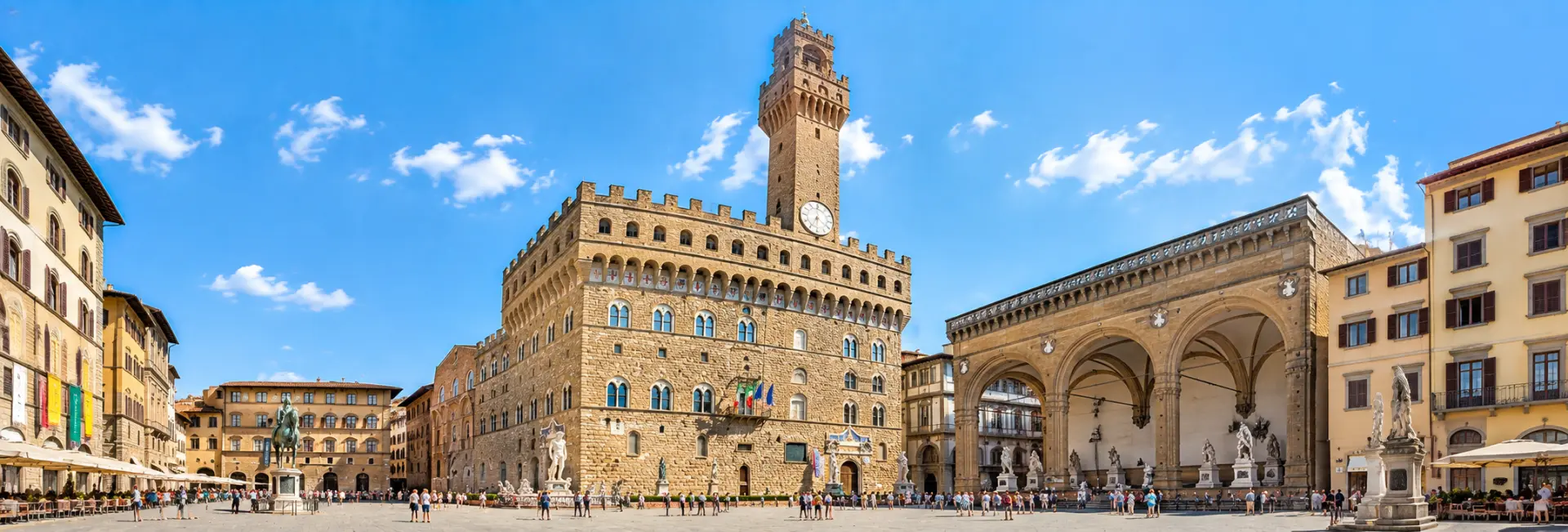
Palazzo Vecchio has served as the seat of Florence's government since 1299, making it one of the longest continuously used town halls in Europe. Its rugged, fortress-like stonework and tall bell tower dominate Piazza della Signoria, a deliberate show of civic strength from a city that was, at the time of construction, wealthy but politically fragile.
Beyond its role as city hall, the building spent decades as a Medici residence and still holds some of Florence's most elaborate Renaissance interiors, including a hall large enough to have once hosted a five-hundred-member council and a small study room built for a duke obsessed with alchemy. Layers of history sit stacked on top of each other here, from Roman ruins in the basement to a mayor's office still functioning on an upper floor today.
Visitors sometimes underestimate the palace on the way to the Uffizi next door, treating it as a photo stop in the square rather than a destination in its own right. Stepping inside quickly corrects that impression, since few buildings in Florence pack this much political history, artistic ambition, and architectural drama into a single, still-functioning structure.
History
A Fortress for a Fragile Republic
Construction began in 1299 under the direction of architect Arnolfo di Cambio, commissioned by the commune of Florence to give the city's magistrates a secure, defensible headquarters during a turbulent period of factional violence. Originally known as the Palazzo della Signoria, after the Signoria council that governed the Florentine Republic, the building took its imposing, almost military appearance directly from the instability of the era it was built in.
Savonarola and the Republic's Great Hall
In 1494, under the influence of the reformist friar Girolamo Savonarola, the Florentine Republic commissioned a vast new council chamber inside the palace to seat a governing body of five hundred citizens, a room that became known as the Salone dei Cinquecento, or Hall of the Five Hundred. Its scale, at 54 meters long, reflected an ambition to broaden political participation in the city, even though that particular republican experiment proved short-lived.
The Medici Move In
Cosimo I de' Medici took up residence in the palace in 1540, transforming it from a purely civic building into a ducal home and commissioning painter and architect Giorgio Vasari to redecorate much of the interior, including a dramatic overhaul of the Salone dei Cinquecento in the 1560s. When Cosimo later relocated his family across the river to the newly acquired Palazzo Pitti, the building he left behind picked up the nickname that has stuck ever since: Palazzo Vecchio, the "Old Palace."
Still Florence's Town Hall
Despite centuries of Medici and later Grand Ducal use, the building never fully lost its original civic function, and parts of it still serve as Florence's town hall today, with the mayor's office located on an upper floor. That continuity, stretching back more than seven centuries, makes Palazzo Vecchio one of the few buildings in Italy that has never stopped being a working seat of government, even as the museum sections around those offices opened progressively to the public over the 19th and 20th centuries.
The Salone dei Cinquecento
The Hall of the Five Hundred remains the palace's most overwhelming space, its gilded, coffered ceiling holding 39 painted panels celebrating Cosimo I's military victories over Pisa and Siena. Vasari and his workshop completed the room's current decoration between 1563 and 1565, replacing the original council chamber's simpler decor with a full-scale glorification of Medici power.
The room also holds one of art history's more tantalizing mysteries. In 1503, Leonardo da Vinci was commissioned to paint a mural of the Battle of Anghiari on one of the hall's walls, but his experimental technique failed to properly adhere to the plaster, and he abandoned the project unfinished. When Vasari redecorated the room decades later, he painted his own battle scene directly over that same wall, and many historians believe Leonardo's unfinished work may still survive, sealed behind Vasari's fresco. To date, no one has definitively confirmed whether it does.
The hall also displays Michelangelo's Genius of Victory, an unfinished marble sculpture originally intended for the tomb of Pope Julius II, left in Florence after that project stalled and eventually installed here as one of the room's few surviving works by a Renaissance master of the same era as Leonardo.
The Tower & Roman Ruins
The Torre di Arnolfo rises about 94 meters above the piazza, and climbing its roughly four hundred steps rewards visitors with one of the best rooftop views in Florence, taking in the Duomo's dome and the hills beyond the city. A one-handed clock installed in the tower in 1667 still keeps time today, a reminder that hour-only precision was considered perfectly adequate for centuries.
Beneath the palace, excavations have uncovered the remains of a Roman theater dating to the 1st century AD, from the era when Florence existed as the colony of Florentina. A separate guided route descends into this underground level, passing stone seating tiers and service corridors from the ancient structure, offering a striking contrast to the Renaissance splendor visible just above ground.
Ways to Experience It
A standard museum ticket covers the main halls, including the Salone dei Cinquecento and the Apartments of Eleonora of Toledo, and a visit at this level typically takes about an hour to ninety minutes. Separate, additional tickets are available for the tower climb and the underground archaeological route, both of which can be combined with the main museum ticket for a longer, more complete visit.
For visitors interested in the palace's more hidden corners, a guided "Secret Passages" tour covers the Studiolo of Francesco I, the private staircases used by the Medici, and the attic space above the Salone dei Cinquecento where Vasari's original wooden roof trusses are still visible. These tours run at scheduled times in limited groups, so booking in advance is essential.
Families with children are often drawn to the palace's dedicated children's museum program, which uses costumed guides and hands-on activities to walk younger visitors through the building's history in a more playful format than the standard adult tour offers.
Best Time to Visit
Weekday mornings, shortly after opening, tend to be the quietest time to see the Salone dei Cinquecento without a crowd blocking the view of its ceiling and frescoes. The palace draws fewer visitors than the Uffizi or the Accademia, so lines are generally shorter here even during peak season, though the tower climb can still involve a wait if timed poorly.
Climbing the tower is most rewarding on clear days, ideally in the late afternoon when the light over the city is softer and the rooftop views extend furthest toward the surrounding hills.
Visitor Tips
- Book tower and archaeological route tickets in advance if planning to combine them with the main museum visit
- Wear comfortable shoes for the tower climb, since it involves close to four hundred narrow, sometimes steep steps
- Reserve the Secret Passages tour well ahead of time, as group sizes are capped and slots fill quickly
- Check current opening hours before visiting, since the palace sometimes closes early or adjusts hours around civic events
- Allow extra time if visiting all three components: the main museum, the tower, and the underground ruins
Nearby Attractions
Palazzo Vecchio sits at the center of Florence's historic core, within a few minutes' walk of several other major sights.
- Piazza della Signoria, the square directly in front of the palace, lined with Renaissance statues
- The Uffizi Gallery, immediately adjacent, home to one of the world's great collections of Renaissance painting
- The Ponte Vecchio, a short walk south along Via de' Guicciardini
- The Bargello Museum, a short walk east, home to important early Renaissance sculpture
FAQs about visiting Palazzo Vecchio
What is Palazzo Vecchio known for? +
It is known as Florence's town hall since 1299, later a Medici residence, and for its Salone dei Cinquecento, a vast frescoed hall that may still conceal an unfinished mural by Leonardo da Vinci behind a later fresco by Giorgio Vasari.
Is Palazzo Vecchio still used as a town hall today? +
Yes, parts of the building continue to function as Florence's city hall, including the mayor's office, making it one of the few Italian palaces that never stopped serving its original civic purpose.
Is it worth climbing the tower? +
Yes, the roughly 94-meter Torre di Arnolfo offers one of the best rooftop views in Florence, though it requires climbing close to four hundred steps and is sold as a separate ticket from the main museum.
Did Leonardo da Vinci really paint something hidden in the palace? +
Leonardo began a mural called the Battle of Anghiari in the Salone dei Cinquecento in 1503 but abandoned it unfinished. Many historians believe it may still exist behind a later fresco painted over the same wall, though this has never been definitively confirmed.
How long does a visit to Palazzo Vecchio take? +
A visit to the main museum halls typically takes about an hour to ninety minutes, longer if combined with the tower climb, the underground Roman ruins, or the guided Secret Passages tour.
Do I need to book tickets in advance? +
It is recommended, especially for the tower climb, the archaeological route, and the Secret Passages tour, all of which have limited capacity and separate ticketing from the main museum.
What Roman ruins are under Palazzo Vecchio? +
Excavations beneath the palace have uncovered the remains of a 1st-century AD Roman theater from when Florence existed as the colony of Florentina, accessible today on a dedicated guided underground route.