Table of Contents
Overview
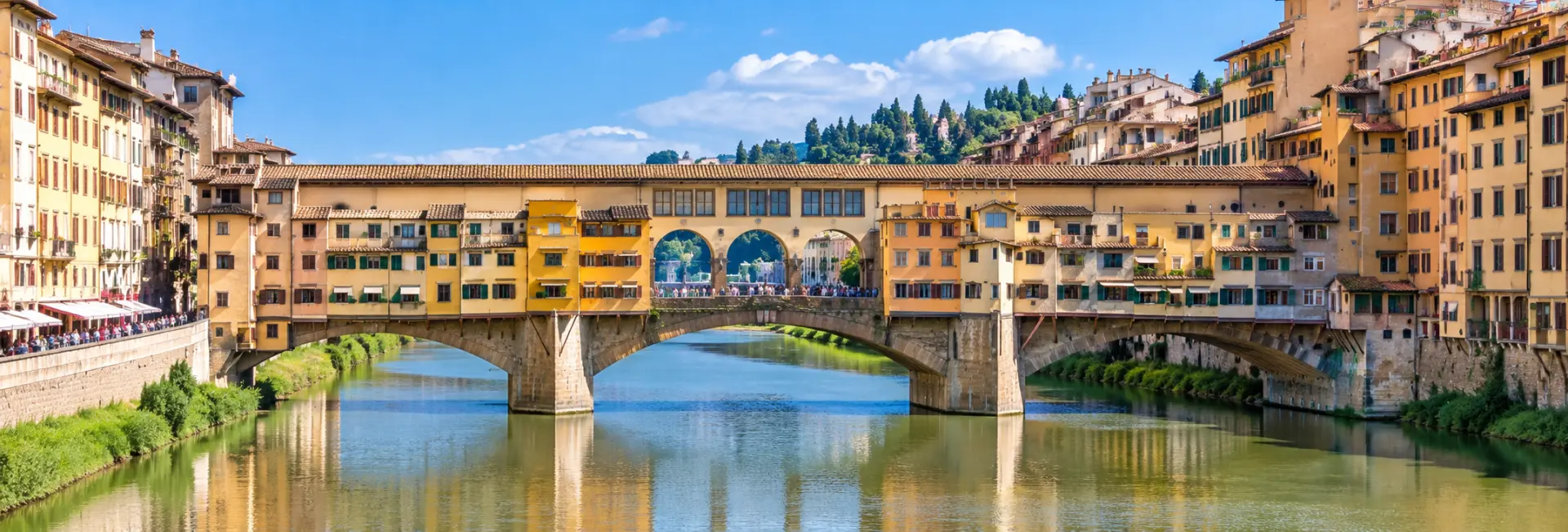
The Ponte Vecchio, or "Old Bridge," is the closest thing Florence has to a second skyline: a low stone crossing over the Arno River, packed edge to edge with jewelry shops that lean out over the water on wooden brackets. It has spanned the river in more or less its current form since 1345, making it the oldest bridge in a city that has rebuilt nearly everything else along the riverbanks at least once.
What sets it apart from most historic bridges is that it was never purely functional. For centuries it has doubled as a marketplace, a private passageway for Florence's ruling family, and, more recently, one of the most photographed spots in the city. Its survival of both catastrophic floods and a world war has only added to its reputation as a symbol of Florence itself.
Visitors often expect a quick photo stop and end up staying longer than planned, drawn in by the density of the place: shop windows glinting with gold on both sides, the Arno flowing beneath, and, if they look up, the outline of a private Medici passageway running along the rooftops above it all.
History
Roman Roots and Medieval Rebuilding
A crossing has existed at this narrow point of the Arno since Roman times, and written records of a bridge here date back to around the 10th century. That early bridge was repeatedly wrecked by flooding, including a major collapse in 1117, before the catastrophic flood of November 1333 destroyed it almost entirely, leaving only two central piers standing.
Florence rebuilt from scratch starting in 1345, this time using a stronger three-arch design traditionally credited to the painter and architect Taddeo Gaddi, though the true designer remains debated among historians. That 1345 structure, reinforced and modified over the centuries, is essentially the bridge still standing today.
The Medici Add a Private Corridor
In 1565, Cosimo I de' Medici commissioned the architect Giorgio Vasari to build an elevated, enclosed passageway connecting the Palazzo Vecchio to the Medici's residence at the Palazzo Pitti, allowing the family to move across the city without mixing with the public below. Vasari completed the roughly kilometer-long corridor in just five months, timed to be ready for a royal wedding, and routed it directly above the shops lining the bridge's eastern side. One noble family, the Mannelli, refused to let their medieval tower be torn down to clear the route, so Vasari simply built the corridor around it, a detour still visible at the bridge's southern end.
From Butchers to Goldsmiths
For its first two and a half centuries as a marketplace, the bridge was lined mainly with butchers, tanners, and fishmongers, whose trade left the crossing famously foul-smelling and its waste flowing straight into the Arno below. In 1593, Grand Duke Ferdinand I de' Medici issued a decree evicting those trades and reserving the bridge's shops exclusively for goldsmiths and jewelers, a change driven partly by his family's distaste for the smell drifting up into their private corridor overhead. That decree effectively set the bridge's identity for the next four hundred-plus years.
Surviving War and Flood
On the night of August 3 to 4, 1944, retreating German forces blew up every bridge across the Arno in Florence except the Ponte Vecchio. Accounts differ on exactly why it was spared, with some crediting a direct order from Hitler, who had visited and admired the bridge in 1938, and others pointing to local diplomatic pressure from the German consul in Florence. Either way, the Germans still demolished the medieval buildings flanking both ends of the bridge to block Allied access, which is why the buildings around it today look distinctly newer than the bridge itself.
The bridge faced a different threat on November 4, 1966, when a catastrophic flood sent the Arno surging through the city, tearing through shops on the bridge and lodging uprooted trees and debris against its arches. The bridge held, though many shopkeepers lost their stock and fittings to the floodwaters, and the event remains one of the worst natural disasters in the city's modern history.
Architecture & Design
The Ponte Vecchio rests on three stone segmental arches, a design that was notably advanced for its time. Unlike the semicircular arches common on older bridges, segmental arches are flatter and wider, which lets the structure sit lower over the water while still spreading its load efficiently, a feature that has helped it withstand centuries of flooding better than its predecessors.
Its most recognizable feature, though, is what sits on top of that stone structure rather than the structure itself: rows of small shops, originally built out over the water on timber brackets and later rebuilt in stone, that give the bridge its dense, almost solid appearance from a distance. Seen from the neighboring bridges along the Arno, the Ponte Vecchio barely reads as a bridge at all, more like a low block of buildings that happens to cross the river.
The only real gap in that solid line of shops is at the bridge's midpoint, where an open terrace on each side breaks the rows of storefronts and gives pedestrians their only direct, unobstructed view of the river. That open stretch has become the bridge's natural gathering point, where visitors pause to take photographs, look out toward the Uffizi and the hills beyond, or simply watch the water pass below.
The Shops & the Vasari Corridor
Today the bridge holds around fifty small shops, the overwhelming majority of them jewelers and goldsmiths continuing a trade that has been based here since the 1593 decree. Many are family businesses that have operated from the same premises for generations, and a handful still keep small workshops visible from the street where pieces are made and repaired by hand.
Above those shops runs the Vasari Corridor, the enclosed passageway built for the Medici in 1565. For decades it was open only to occasional private tours, but after a long closure for restoration it reopened to the public on a ticketed basis in December 2024, giving visitors a rare chance to walk the same private route the Medici once used, lined with a notable collection of painted self-portraits.
The corridor's route itself tells a small story of its own. Vasari built the entire kilometer-long passage in only five months, working against a deadline tied to a royal wedding, and when the Mannelli family refused to give up their tower to make way for it, he simply diverted the corridor around three sides of the building rather than force the issue, a compromise still visible in the corridor's odd jog at the bridge's southern end.
Notable Features
- The bronze bust of Benvenuto Cellini, the celebrated Florentine goldsmith, set at the bridge's midpoint since 1900 and now something of an unofficial wishing spot for visitors
- The Mannelli Tower at the bridge's southern end, a medieval defensive tower that forced the Vasari Corridor to be built around it rather than through it
- The open central section of the bridge, the only stretch not lined with shops, offering an unobstructed view up and down the Arno
- A commemorative plaque near the bridge referencing its rebuilding after the devastating flood of 1333
Ways to Experience It
Most visitors simply walk the bridge at their own pace, browsing the jewelry windows and stopping at the open central section for photos of the Arno and the Vasari Corridor overhead. It typically takes only ten to fifteen minutes to cross, though window-shopping easily stretches that out.
For a deeper look, tickets to the Vasari Corridor allow visitors to walk the enclosed passage above the shops and take in its collection of artist self-portraits, and this is best booked in advance given limited daily capacity. Guided walking tours of central Florence also commonly include the bridge as a stop, often paired with a wider look at the Medici family's history in the city.
Best Time to Visit
Early morning is the best window for a quiet, uncrowded walk across the bridge, before tour groups and day-trippers fill the central viewing area. Sunset draws the largest crowds, when the light turns the Arno gold and the surrounding hills glow behind the water, so arriving a little early to claim a spot at the railing is worth it.
Spring and autumn offer the most comfortable weather for lingering on the bridge and along the riverbanks nearby, while summer brings heavier crowds and stronger midday heat with little shade on offer.
Visitor Tips
- Keep bags and valuables close, since the bridge's narrow, crowded walkway is a known spot for pickpockets
- Book Vasari Corridor tickets in advance if that is part of the plan, since daily capacity is limited
- Visit early morning or later in the evening to avoid the densest midday crowds
- Compare prices and ask questions before buying jewelry, since quality and pricing vary considerably between shops
- Walk to the neighboring bridges, such as Ponte Santa Trinita, for the classic postcard view of the Ponte Vecchio itself
Nearby Attractions
The bridge sits right in the heart of Florence's historic center, within easy walking distance of several major sights on both sides of the Arno.
- The Uffizi Gallery, a short walk north, connected historically to the bridge via the Vasari Corridor
- Piazza della Signoria and the Palazzo Vecchio, Florence's political and civic heart for centuries
- The Palazzo Pitti and Boboli Gardens, on the opposite bank in the Oltrarno district
- Piazzale Michelangelo, a short uphill walk that offers a sweeping view back over the bridge and the whole city
FAQs about visiting the Ponte Vecchio
Why is the Ponte Vecchio famous? +
It is known as the oldest bridge in Florence, for its continuous row of jewelry shops dating back to 1593, and for being the only bridge in the city to survive World War II intact.
How old is the Ponte Vecchio? +
The current bridge dates to 1345, though a crossing has existed at this spot since Roman times, with written records going back to around the 10th century.
Is it free to walk across the Ponte Vecchio? +
Yes, walking across the bridge is free. There is a separate ticketed fee only for entering the Vasari Corridor above the shops.
What is the Vasari Corridor? +
It is an enclosed elevated passageway built in 1565 for the Medici family, connecting the Palazzo Vecchio to the Palazzo Pitti above the bridge's shops, and it reopened to ticketed visitors in December 2024 after a long closure.
Why does the Ponte Vecchio only have jewelry shops? +
In 1593, Grand Duke Ferdinand I de' Medici evicted the butchers and other food traders who originally occupied the bridge and reserved the shops for goldsmiths and jewelers, a tradition that has continued ever since.
How long does it take to visit? +
Simply crossing the bridge takes about ten to fifteen minutes, though most visitors spend closer to thirty minutes to an hour browsing shops and taking photos from the central viewpoint.
How did the Ponte Vecchio survive World War II? +
Retreating German forces destroyed every other bridge in Florence in 1944 but left the Ponte Vecchio standing, instead demolishing the buildings at either end to block access, a decision often attributed to a direct order tied to Hitler's earlier admiration for the bridge.
What is the best spot to photograph the Ponte Vecchio? +
The neighboring Ponte Santa Trinita and Ponte alle Grazie both offer classic views of the bridge from the river, while the open central section of the bridge itself is the best spot for photos looking along the Arno.