Table of Contents
Overview
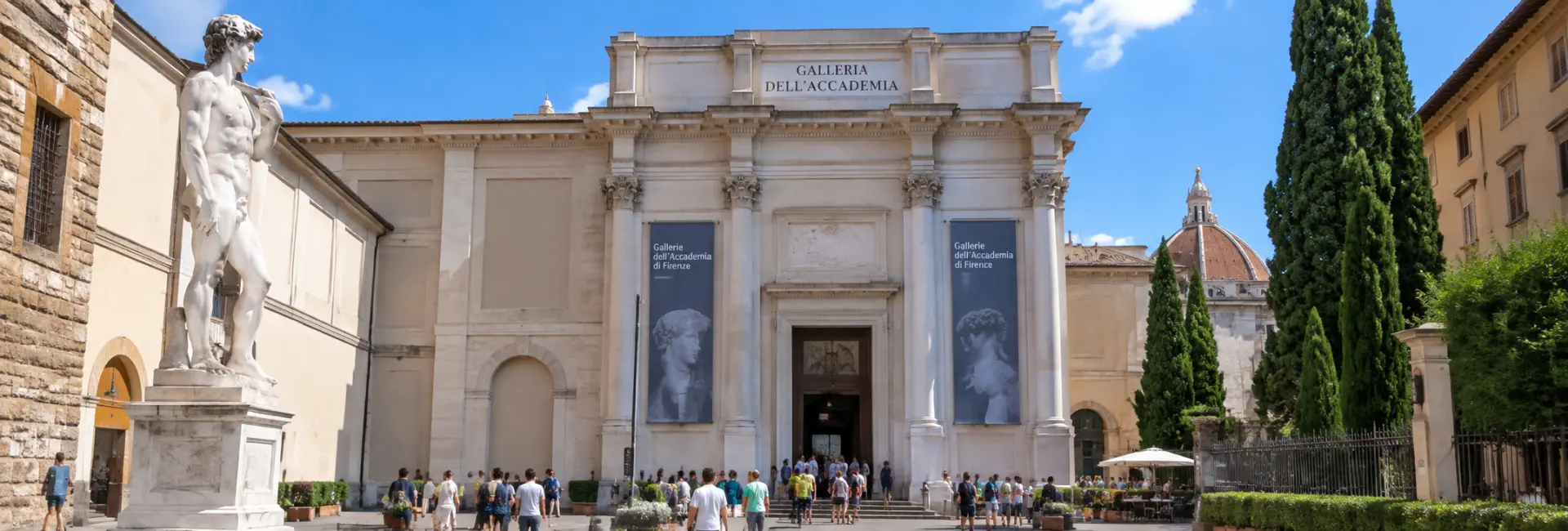
The Galleria dell'Accademia exists, in most visitors' minds, for a single reason: it is the permanent home of Michelangelo's David, one of the most recognizable sculptures ever made. That fame can overshadow just how much else is packed into this relatively compact museum, from other unfinished Michelangelo marbles to centuries of Florentine painting and a small but remarkable collection of historic instruments.
Unlike the sprawling Uffizi across town, the Accademia is deliberately focused. A single visit rarely takes more than an hour or two, yet it covers a striking range of material, moving from the gold-backed panel paintings of the 1300s through to Michelangelo's raw, half-finished marble figures, all housed inside a former hospital and convent complex just north of the Duomo.
Despite its modest size compared to Florence's larger museums, the Accademia consistently ranks among the most visited art museums in Italy, drawing well over a million visitors a year, almost entirely on the strength of a single statue. That popularity makes advance planning genuinely useful here in a way it might not be for a quieter, less concentrated collection.
History of the Museum
The gallery traces its origins to 1784, when Grand Duke Pietro Leopoldo of Lorraine founded it as a teaching collection for the adjoining Academy of Fine Arts, giving art students direct access to paintings and sculpture worth studying up close. That academy had itself grown out of an older drawing school established by Cosimo I de' Medici in the 1560s, linking the gallery's roots back to the very start of organized art education in Florence.
The collection expanded significantly in the 1780s and again in 1810, when religious suppressions under Pietro Leopoldo and later Napoleon closed numerous churches and convents across Tuscany, sending many of their paintings and altarpieces into the Accademia's growing holdings. The museum occupies buildings with their own long history, including the 14th-century Hospital of San Matteo and the former Convent of San Niccolò di Cafaggio, both repurposed over time into gallery space.
The single event that transformed the museum's identity came in 1873, when Michelangelo's David was moved indoors from Piazza della Signoria to protect it from weather damage after more than 350 years outdoors. A purpose-built domed room, known as the Tribune and designed by architect Emilio De Fabris, was completed in 1882 specifically to display the statue under a skylight, and it remains the Accademia's undisputed centerpiece.
Like much of central Florence, the museum did not escape the catastrophic Arno flood of November 1966, which damaged parts of the city's collections and infrastructure, though the David itself, safely elevated on its pedestal within the Tribune, was unharmed. The museum has continued to evolve since then, most notably with the addition of the Museum of Musical Instruments as a dedicated section in the early 21st century.
Michelangelo's David & the Prisoners
Carved between 1501 and 1504 from a single block of Carrara marble, David stands over five meters tall and depicts the biblical hero moments before his fight with Goliath, tense and watchful rather than triumphant. Originally intended for a niche on the Duomo's facade, the finished statue was instead placed in Piazza della Signoria as a civic symbol of the Florentine Republic, where it stood until its 1873 move indoors. A marble copy has occupied its original outdoor spot since 1910, so visitors can see both the original inside the Accademia and a faithful replica back in the square where it first stood.
Leading up to the Tribune, a long corridor displays Michelangelo's Prisoners, also known as the Slaves: four unfinished marble figures originally intended for the tomb of Pope Julius II in Rome. Left deliberately incomplete, with limbs and torsos still emerging from rough-cut stone, they offer a rare, unfiltered look at Michelangelo's carving process, something the smoothly finished David does not show. Scholars have long debated whether the figures were abandoned purely due to changing project plans or left unfinished by choice, since their raw, struggling forms carry an emotional power that a fully polished version might not have matched.
Nearby, the museum also displays Michelangelo's unfinished St. Matthew, part of an intended series of twelve apostle statues for the Duomo that was never completed, and the Pietà di Palestrina, a work whose attribution to Michelangelo remains debated among scholars. Taken together, this stretch of the museum gives a more complete picture of Michelangelo's working methods than David alone, showing both his finished mastery and the rougher, more experimental side of his process.
Paintings & Other Collections
Beyond its sculpture, the Accademia holds a substantial collection of Florentine painting spanning roughly the 13th to the 16th centuries, much of it drawn from churches and convents closed during the religious suppressions of the 1780s and early 1800s. Early rooms are dominated by gold-background panel paintings from the Gothic period, offering a useful contrast to the more naturalistic works that follow as the collection moves into the Renaissance.
- Works attributed to Sandro Botticelli, including devotional images of the Madonna and Child
- Paintings by Domenico Ghirlandaio, a leading Florentine painter of the late 15th century
- Renaissance and Mannerist works by artists including Perugino, Andrea del Sarto, and Bronzino
- The Gipsoteca, a hall of 19th-century plaster casts by sculptor Lorenzo Bartolini, used historically for teaching anatomy and sculptural technique
Walked through in sequence, these rooms trace the gradual shift in Florentine art from flat, symbolic religious imagery toward the more naturalistic, individually observed figures that define the Renaissance, a transition that can be harder to appreciate in the larger, more crowded Uffizi simply because there is so much more competing for attention there.
The Museum of Musical Instruments
One of the Accademia's lesser-known sections is its Museum of Musical Instruments, drawn from the collections of the Medici and later Lorraine grand-ducal courts. The instruments here were assembled not as museum pieces but as working tools of court musicians, giving the collection an unusually personal connection to the families that commissioned them.
Highlights include violins and a cello made by Antonio Stradivari for Grand Prince Ferdinando de' Medici around 1690, an earlier cello by Niccolò Amati, and one of the world's oldest surviving pianos, built by Bartolomeo Cristofori, the instrument's inventor, for the Medici court in the early 18th century. Multimedia listening stations let visitors hear recreations of how several of the instruments actually sounded, a detail that brings the otherwise silent display cases to life.
Ways to Experience It
Most visitors move through the Accademia in 30 minutes to an hour and a half, depending on how much time is spent with the paintings and musical instruments beyond the main sculpture halls. Because the museum admits only a limited number of visitors at set intervals, booking a timed-entry ticket in advance is strongly recommended, particularly during peak travel months.
Audio guides and guided tours are available and add useful context to the David and the Prisoners in particular, since much of their significance lies in details, such as tool marks and proportion choices, that are easy to miss without commentary. Visitors who want a quieter experience of Florentine painting often find that slowing down in the picture galleries, once past the more crowded route to the Tribune, rewards them with rooms that are far less busy than the David itself.
Best Time to Visit
Early morning, right at opening, and the last entry slot of the day tend to be the least crowded times to see David without a wall of visitors in front of the statue. Midday during peak season can mean a packed Tribune, even with timed-entry tickets, since everyone with a similar slot tends to head straight for the same room.
Visiting outside the busiest months of late spring and summer generally means shorter lines and a calmer pace throughout, though the museum's small size and timed-entry system make it relatively manageable to visit at almost any time of year with advance planning.
Visitor Tips
- Book tickets online in advance, since the museum limits the number of visitors inside at any one time
- Arrive a few minutes before your entry slot, since latecomers can lose their place in line
- Don't rush past the painting galleries on the way to David, since they are usually far quieter and equally rewarding
- Photography without flash is generally permitted, but check current signage, since rules can be updated
- The museum is closed on Mondays, so plan visits for Tuesday through Sunday
Nearby Attractions
The Accademia sits in a quiet, less touristy pocket of central Florence, close to several other major sights within easy walking distance.
- Piazza San Marco and the Museum of San Marco, a short walk north, known for Fra Angelico's frescoes
- The Duomo and Piazza del Duomo, about a seven-minute walk south along Via Ricasoli
- Piazza della Signoria, where the original David stood for over 350 years before its move indoors
- The Mercato Centrale food market, a short walk west, good for a break after the museum
FAQs about visiting the Accademia Gallery
Why is the Accademia Gallery famous? +
It is best known as the permanent home of Michelangelo's David, one of the most famous sculptures in the world, moved here from Piazza della Signoria in 1873 to protect it from weather damage.
Is the David in the Accademia the original? +
Yes, the Accademia holds Michelangelo's original marble David. The statue in Piazza della Signoria today is a copy installed in 1910.
How long does a visit to the Accademia take? +
Most visitors spend 30 minutes to an hour and a half inside, depending on how much time they give to the paintings and musical instruments beyond the main sculpture halls.
Do I need to book tickets in advance? +
Yes, booking in advance is strongly recommended, since the museum only admits a limited number of visitors at timed intervals and tickets can sell out during busy periods.
What else is in the Accademia besides David? +
The museum also holds Michelangelo's unfinished Prisoners, a collection of Florentine paintings from the 13th to 16th centuries, a hall of 19th-century plaster casts, and a Museum of Musical Instruments featuring Stradivari violins and an early Cristofori piano.
Is the Accademia Gallery worth visiting if I've already seen the copy of David outside? +
Yes, seeing the original up close under the Tribune's natural light reveals details of proportion and craftsmanship that photographs and outdoor copies cannot fully capture, and the museum's other collections add considerably more beyond the statue itself.
What day is the Accademia Gallery closed? +
The museum is closed on Mondays, along with a small number of public holidays, so visits should be planned for Tuesday through Sunday.