Table of Contents
Overview
Piazza della Signoria has been the political and civic heart of Florence for more than seven hundred years, and it still functions that way today, doubling as a gathering spot, an open-air museum, and the forecourt of the city's town hall. Its irregular, L-shaped outline sets it apart from Italy's more symmetrical piazzas, a quirk that traces back to a very deliberate act of medieval score-settling.
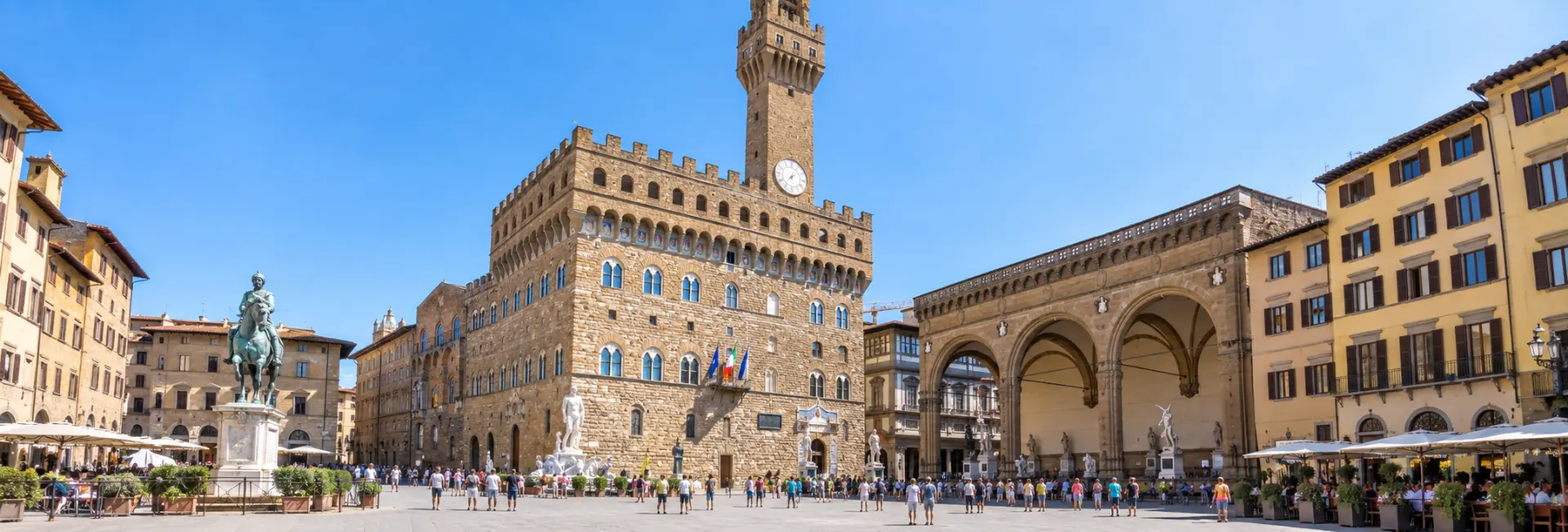
Framed by the fortress-like Palazzo Vecchio on one side and the elegant arches of the Loggia dei Lanzi on another, the square holds one of the densest collections of Renaissance sculpture anywhere in the world, all of it standing in the open, free to walk right up to. Few squares anywhere pack so much history and so much art into so small a footprint.
The square also sits at the center of Florence's UNESCO-listed historic core, recognized as a World Heritage Site in 1982 for the sheer concentration of Renaissance art and architecture packed into the city's medieval street plan. Piazza della Signoria is often the first stop visitors make on foot from the Duomo, and it tends to be the spot where Florence's reputation as an open-air museum first becomes obvious.
History
A Square Built on Rivalry
The piazza's unusual shape has its roots in 13th-century Florentine politics. In 1268, the victorious Guelph faction demolished the homes and towers of the rival Ghibelline Uberti family, who had occupied this exact spot, and left the ground deliberately unbuilt as a mark of the Ghibellines' defeat. That cleared, irregular plot became the seed of today's square, and a persistent local legend holds that the Palazzo Vecchio was later positioned slightly off-axis specifically to avoid resting on the "cursed" Ghibelline land.
Seat of the Florentine Republic
Construction of the Palazzo della Signoria, now known as the Palazzo Vecchio, began in 1299 as the seat of Florence's governing council, the Signoria, and the square in front of it quickly became the stage for the city's political life. The square itself was not properly paved until 1385, more than a century after the Ghibelline demolitions, and it continued to gain new buildings and monuments for centuries afterward, including the Loggia dei Lanzi in the 1380s and the Uffizi complex in the 1560s.
From Republic to Medici Rule
As Florence shifted from a republic to Medici control in the 16th century, the square's statues and monuments increasingly reflected that change in power. Cosimo I de' Medici added the Neptune Fountain and, later, his own bronze equestrian statue to the square, turning what had once been a symbol of republican defiance into a showcase for Medici authority. Archaeological work carried out during later repaving projects also uncovered traces of far older activity beneath the square, including Roman-era remains and even signs of prehistoric settlement, a reminder of just how long this patch of ground has been in continuous use.
Palazzo Vecchio & the Square's Layout
The Palazzo Vecchio dominates the square with its rugged, fortress-like stonework and tall crenellated bell tower, a design meant to project civic strength rather than elegance. Its position at the square's edge, rather than its center, is part of what gives Piazza della Signoria its irregular, L-shaped footprint, since the palazzo and the surrounding streets were never laid out on a single unified plan.
Facing the palazzo, the Loggia dei Lanzi forms the square's most graceful architectural feature: a set of tall, open Gothic arches built in the late 14th century, originally used for public ceremonies and later turned into an open-air sculpture gallery. Other notable buildings frame the remaining sides of the square, including the 14th-century Tribunale della Mercanzia, once used to settle disputes between Florence's trade guilds, and the 16th-century Palazzo Uguccioni opposite the Loggia. Cosimo I reportedly considered extending the Loggia dei Lanzi all the way around the square to fully enclose it, but abandoned the idea once the projected cost became clear, leaving the square with the looser, more varied mix of architecture visitors see today.
The Open-Air Sculpture Gallery
Few squares anywhere let visitors walk this close to so much major sculpture without paying an entry fee. Statues here span more than four centuries, and many were placed with a clear political message aimed at whoever controlled the city at the time, turning the square into a kind of running commentary on Florence's shifting balance of power.
- A copy of Michelangelo's David, standing where the original stood from 1504 until it was moved indoors for preservation in 1873, still marking the entrance to the Palazzo Vecchio
- Hercules and Cacus by Baccio Bandinelli, installed in 1534 as a Medici counterpoint to the republican symbolism of David
- The Neptune Fountain by Bartolomeo Ammannati, completed in the 1560s and quickly nicknamed "Il Biancone," or "Big Whitey," by unimpressed locals
- The bronze equestrian statue of Cosimo I de' Medici by Giambologna, unveiled in 1594 as one of the first large bronze equestrian monuments of its era
- Perseus with the Head of Medusa by Benvenuto Cellini, sheltered under the Loggia dei Lanzi and completed in 1554
- The Rape of the Sabine Women by Giambologna, another Loggia dei Lanzi highlight, carved from a single block of marble in the 1580s
Donatello's bronze Judith and Holofernes, depicting the biblical heroine beheading an enemy general, also stood in the square for centuries as a symbol of the triumph of the weak over tyranny, before eventually being moved indoors to the Palazzo Vecchio for conservation, with a copy now marking its old spot near the entrance.
Savonarola & the Square's Darker History
Piazza della Signoria was also the setting for one of Florence's most dramatic episodes. In 1497, the reformist friar Girolamo Savonarola, who had gained enormous influence over the city, staged a "Bonfire of the Vanities" here, burning art, books, and luxury items he considered morally corrupting. Less than a year later, in May 1498, Savonarola's own fortunes reversed, and he was hanged and burned at the stake on nearly the same spot after being condemned as a heretic.
A small round marker set into the paving near the Neptune Fountain marks the approximate site of his execution, and it remains one of the more sobering details visitors notice once they know the story behind it. The episode is often cited as one of the clearest examples of the square's dual character: a place of civic pride and artistic achievement that has also witnessed some of the city's most brutal political turns.
Ways to Experience It
The square itself is open and free to explore at any hour, and most visitors simply wander among the statues at their own pace before or after visiting the Uffizi, which sits just around the corner. Allowing 20 to 30 minutes for a slow walk through the square is usually enough to take in the main sculptures and read the plaques.
For a deeper look, tickets to the Palazzo Vecchio allow visitors to see its lavishly decorated interior, including the enormous Salone dei Cinquecento, and to climb the tower for a rooftop view over the square and the city. Guided walking tours covering the Medici family's history or Florence's Renaissance art often use the square as a starting or ending point, given how many of its monuments connect directly to that history.
The square also works well simply as a place to pause. Several cafés along its edges put out tables facing the statues, and sitting with a coffee or a drink while watching the square's steady stream of visitors is, for many people, as memorable as ticking off any single monument.
Best Time to Visit
Early morning offers the clearest views of the statues and the Palazzo Vecchio without the dense midday crowds that build up once tour groups arrive from the Duomo and Uffizi. Evening is also rewarding, when the square's cafés fill up and the buildings are lit against the night sky.
Spring and autumn bring the most comfortable temperatures for lingering in the open square, while summer afternoons can get uncomfortably hot with little shade available among the statues and paving stones.
Visitor Tips
- The square itself is free and open around the clock, though the Palazzo Vecchio and its tower keep separate, seasonally adjusted opening hours
- Book Palazzo Vecchio tickets in advance during peak season to avoid long queues at the entrance
- Watch your belongings closely, since crowded tourist squares like this one attract pickpockets
- Look for the small marker near the Neptune Fountain commemorating Savonarola's execution, easy to miss without knowing where to look
- Combine a visit with the neighboring Uffizi Gallery, since the two sit right next to each other
Nearby Attractions
Piazza della Signoria sits at the center of Florence's historic core, making it a natural hub for exploring the surrounding streets on foot.
- The Uffizi Gallery, immediately adjacent, home to one of the world's great collections of Renaissance painting
- The Ponte Vecchio, a short walk south along Via de' Guicciardini or through the Uffizi's colonnade
- The Duomo and Piazza del Duomo, a few minutes' walk north through narrow medieval streets
- The Bargello Museum, a short walk east, home to Donatello's original bronze David and other Renaissance sculpture
FAQs about visiting Piazza della Signoria
Why is Piazza della Signoria important? +
It has served as the political center of Florence since the late 13th century, first as the seat of the Florentine Republic and later under Medici rule, and it remains one of the richest open-air collections of Renaissance sculpture anywhere in the world.
Is the David in Piazza della Signoria the original? +
No, the statue standing outside the Palazzo Vecchio is a 19th-century copy. Michelangelo's original David was moved indoors to the Galleria dell'Accademia in 1873 to protect it from weather damage.
Is it free to visit Piazza della Signoria? +
Yes, the square itself is free and open to the public at all times. Only the Palazzo Vecchio and its tower charge a separate entry fee.
Why does the square have such an irregular shape? +
Its L-shaped layout dates back to 1268, when the homes of a defeated political faction were demolished and the land deliberately left unbuilt, later becoming the foundation for the square as it grew over the following centuries.
What happened to Savonarola in this square? +
The friar Girolamo Savonarola, who briefly dominated Florentine politics, was hanged and burned at the stake here in May 1498, on nearly the same spot where he had staged a public burning of books and art the year before.
How much time should I spend at Piazza della Signoria? +
Walking through and viewing the main statues takes about 20 to 30 minutes, though a Palazzo Vecchio visit adds another hour or more depending on how much of the interior and tower is included.
What is the Loggia dei Lanzi? +
It is a 14th-century open-air arcade on the square's edge that now functions as a sculpture gallery, housing works including Cellini's Perseus with the Head of Medusa and Giambologna's Rape of the Sabine Women.