Table of Contents
Overview
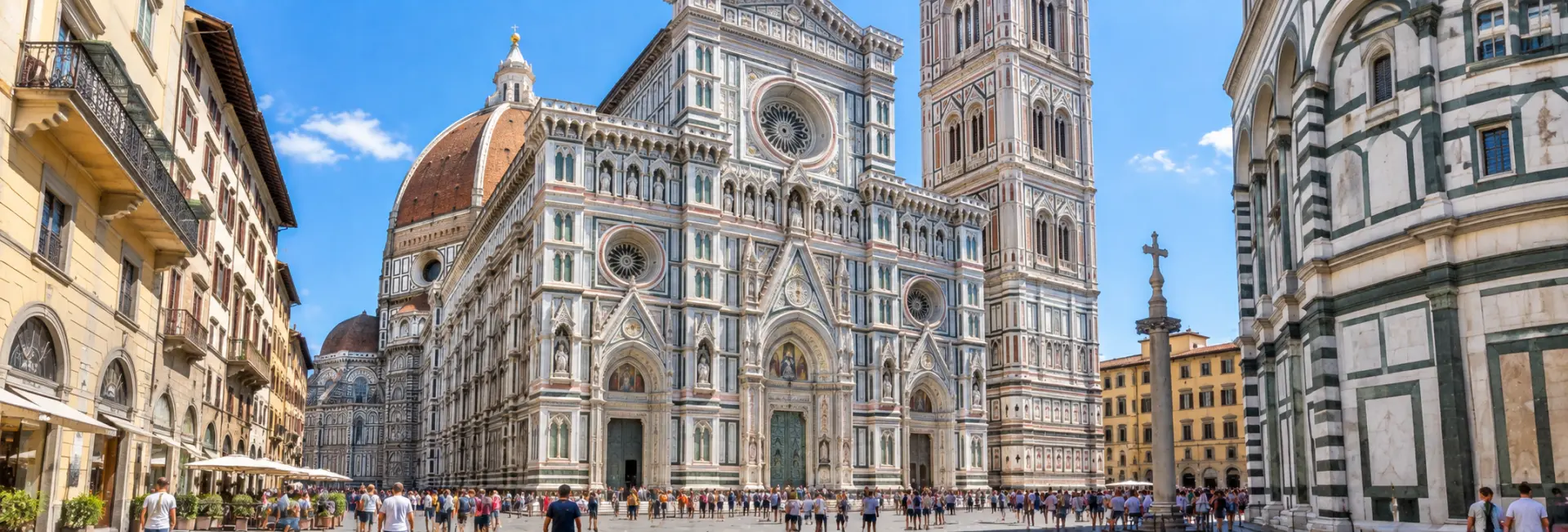
Florence Cathedral, formally the Cattedrale di Santa Maria del Fiore and known to locals simply as the Duomo, is the beating architectural heart of Florence. Its striking exterior of green, pink, and white marble panels and its immense red-tiled dome dominate the city's skyline, visible from nearly every vantage point across Florence and the surrounding hills.
Construction spanned nearly a century and a half, from 1296 to 1436, and produced not just a cathedral but an engineering landmark: Filippo Brunelleschi's dome remains the largest brick dome ever built. Together with the adjoining Baptistery and Giotto's Campanile, the cathedral forms one of the most recognizable building complexes in the world and anchors the historic center of Florence, a UNESCO World Heritage Site.
History
A Gothic Beginning
Construction began on 8 September 1296 under the architect Arnolfo di Cambio, replacing an earlier and much smaller church dedicated to Santa Reparata, whose remains can still be seen in the crypt today. Arnolfo's design called for an enormous Gothic basilica, ambitious enough that the technical means of finishing it, particularly its planned dome, did not yet exist.
Continuing the Work
After Arnolfo's death, construction slowed until 1334, when the painter and architect Giotto took over as head of the project and began work on the freestanding bell tower that still bears his name. Successive architects, including Francesco Talenti, continued expanding the nave and choir over the following decades, gradually enclosing the vast crossing that would eventually need to be capped by a dome.
Completion and Consecration
The cathedral was structurally completed in 1436 with the finishing of Brunelleschi's dome, and it was consecrated that same year by Pope Eugene IV in a ceremony for which the composer Guillaume Dufay wrote a motet whose musical structure was said to echo the proportions of the dome itself. The exterior facade, however, remained an unfinished brick shell for centuries, since Arnolfo's original decorative scheme was left incomplete after his death.
A Nineteenth-Century Facade
It was not until the 19th century that Florence addressed the cathedral's bare front. Following a design competition, architect Emilio De Fabris created the elaborate Gothic Revival facade seen today, completed in 1887, using polychrome marble panels that echo the colors of the Baptistery and Campanile nearby, over four centuries after the rest of the building was finished.
The competition that produced De Fabris's design was itself a significant cultural moment for a newly unified Italy, with Florence eager to complete a monument that had stood unfinished since the Renaissance. The chosen design deliberately drew on medieval and early Renaissance motifs already present on the Baptistery and Campanile, aiming for stylistic harmony across a complex that had, by that point, been under construction in one form or another for nearly six centuries.
Brunelleschi's Dome
When construction reached the crossing in the early 15th century, Florence faced a problem no one could solve: how to build a dome wide enough to cover the space without traditional wooden centering, since no timber long enough or strong enough was available. In 1418, the cathedral's overseers held an open competition for a solution, which was won by a Florentine goldsmith and clockmaker with no formal architectural training, Filippo Brunelleschi.
Brunelleschi's solution, built between 1420 and 1436, used an inner and outer shell connected by ribs, along with a herringbone brick-laying pattern that allowed each course to support itself as it rose, eliminating the need for scaffolding from the ground. Reportedly drawing inspiration from his study of the ancient Roman Pantheon, he combined proven classical techniques with entirely new engineering to close a span of roughly 45 meters, still the widest masonry dome of its kind ever built.
The dome's success made it an instant symbol of Renaissance ingenuity, and its silhouette, an octagonal shape crowned by a marble lantern, has defined the Florentine skyline ever since. Climbing the 463 steps between the dome's two shells remains one of the most popular ways to experience the cathedral firsthand, offering close-up views of Vasari and Zuccari's fresco of the Last Judgment before emerging onto a terrace overlooking the whole city.
Brunelleschi also had to invent much of the machinery needed to lift materials to such unprecedented heights, designing hoists and cranes specifically for the project that were themselves considered engineering marvels at the time. The techniques pioneered during construction, from the herringbone brickwork to the lifting equipment, were studied and adapted by later architects and engineers for centuries afterward, extending the dome's influence well beyond Florence itself.
Architecture & Interior
Exterior and Facade
The cathedral's exterior is faced entirely in polychrome marble, primarily white from Carrara, green from Prato, and pink from the Maremma, arranged in geometric patterns that unify the building with the neighboring Baptistery and Campanile. At 114.5 meters long and roughly 90 meters wide at the transept, it ranks among the largest churches in the world, though its interior feels notably restrained compared to the ornate exterior.
Interior Design
Inside, the cathedral's nave is comparatively plain and austere, built to Gothic proportions with tall pointed arches but largely free of the elaborate decoration found in many other major European cathedrals. This contrast between an exuberant exterior and a spare interior was intentional, reflecting Florentine tastes and the layered history of a building whose decoration evolved gradually over centuries rather than following a single unified plan.
Notable interior features include stained glass windows designed by artists such as Lorenzo Ghiberti and Paolo Uccello, along with clock faces, funerary monuments, and marble flooring that was relaid in elaborate patterns during the 16th century. Beneath the main floor, the excavated crypt of the earlier Santa Reparata church offers a rare glimpse of Florence's pre-Gothic religious architecture, layered directly under the cathedral that eventually replaced it.
- Length: approximately 153 meters
- Height: approximately 114.5 meters, including the dome and lantern
- Facade material: polychrome marble in white, green, and pink
- Interior highlight: Vasari and Zuccari's fresco of the Last Judgment, painted inside the dome
Cultural & Religious Significance
As the seat of the Archdiocese of Florence and a minor basilica of the Catholic Church, the cathedral has served as the city's principal place of worship since its consecration, hosting centuries of religious ceremonies, civic events, and moments of political drama, including the 1478 assassination attempt against the Medici family that took place during Mass inside the building.
Beyond its religious role, the cathedral has long stood as a symbol of Florentine ambition and civic pride, a building whose construction outlasted the lifetimes of the architects who began it and whose dome came to represent the broader spirit of Renaissance innovation taking hold across the city. Its continued prominence in the skyline of modern Florence keeps that symbolism intact for residents and visitors alike.
Ways to Experience It
The cathedral complex includes several distinct experiences, from a free visit to the main church interior to a range of paid, timed-entry options for its other elements.
- Enter the cathedral's main interior free of charge to see the nave, choir, and dome fresco from below
- Climb the 463 steps inside Brunelleschi's dome for close-up fresco views and a panoramic terrace over Florence
- Purchase a combined ticket covering the dome, Giotto's Campanile, the Baptistery, the crypt of Santa Reparata, and the Museo dell'Opera del Duomo
- Visit the crypt beneath the cathedral to see the excavated remains of the earlier Santa Reparata church
- Book a guided tour for deeper context on the building's architecture and centuries-long construction history
Best Time to Visit
Early morning, right at opening, is the best time to enter the cathedral interior and to begin a dome climb, since both draw long lines that build steadily through the day. The dome climb in particular is limited to timed-entry slots, and these can sell out well in advance during peak summer months, so booking ahead is worth prioritizing over spontaneity here.
Spring and autumn offer milder temperatures for the physically demanding climb up the dome's narrow stairways, while a clear day at any time of year rewards the effort with unobstructed views over the city and the Tuscan hills beyond. Evenings are best reserved for viewing the exterior and facade, when the piazza is quieter and the marble is lit dramatically after dark.
Visitor Tips
- Book dome climb tickets in advance, since access is limited to timed slots that often sell out
- Dress modestly, with shoulders and knees covered, as this is enforced for entry to the cathedral
- Wear comfortable shoes for the dome climb, which involves 463 narrow, winding stone steps with no elevator option
- Check current opening hours and ticket prices before visiting, since these vary seasonally and by attraction within the complex
- Allow at least half a day if planning to see the cathedral, dome, Baptistery, Campanile, and museum together
Nearby Attractions
- The Florence Baptistery, directly facing the cathedral, famed for its gilded bronze "Gates of Paradise"
- Giotto's Campanile, the freestanding bell tower beside the cathedral, also open to climb
- The Museo dell'Opera del Duomo, housing original sculptures and artifacts removed from the cathedral complex
- Piazza della Signoria and the Uffizi Gallery, a short walk south
- The Ponte Vecchio, Florence's historic bridge over the Arno River, roughly a 10 minute walk away
FAQs about visiting Florence Cathedral
Is it free to visit Florence Cathedral? +
Yes, entry to the main cathedral interior is free, though climbing the dome, Campanile, and visiting the Baptistery, crypt, and museum require a paid combined ticket.
How many steps are there to the top of the dome? +
The climb to the top of Brunelleschi's dome involves 463 steps, with no elevator available, following a narrow route between the dome's inner and outer shells.
Do I need to book dome tickets in advance? +
Yes, dome access is limited to timed-entry slots that frequently sell out, especially in peak season, so booking ahead is strongly recommended.
What should I wear to visit the cathedral? +
Modest dress is required, meaning shoulders and knees should be covered, as with most churches and religious sites in Italy.
How long did it take to build Florence Cathedral? +
Construction began in 1296 and was structurally completed with Brunelleschi's dome in 1436, though the facade was not finished until 1887, meaning the full complex took nearly 600 years to reach its current form.
Is Florence Cathedral part of a UNESCO World Heritage Site? +
Yes, along with the Baptistery and Giotto's Campanile, it is part of the Historic Centre of Florence, inscribed as a UNESCO World Heritage Site in 1982.
How much time should I plan for a full visit? +
Seeing the cathedral interior alone takes about 30 minutes, but visiting the dome, Baptistery, Campanile, and museum together typically requires at least half a day.
What else is nearby? +
The Baptistery, Giotto's Campanile, the Museo dell'Opera del Duomo, Piazza della Signoria, the Uffizi Gallery, and the Ponte Vecchio are all within easy walking distance.