Table of Contents
Overview
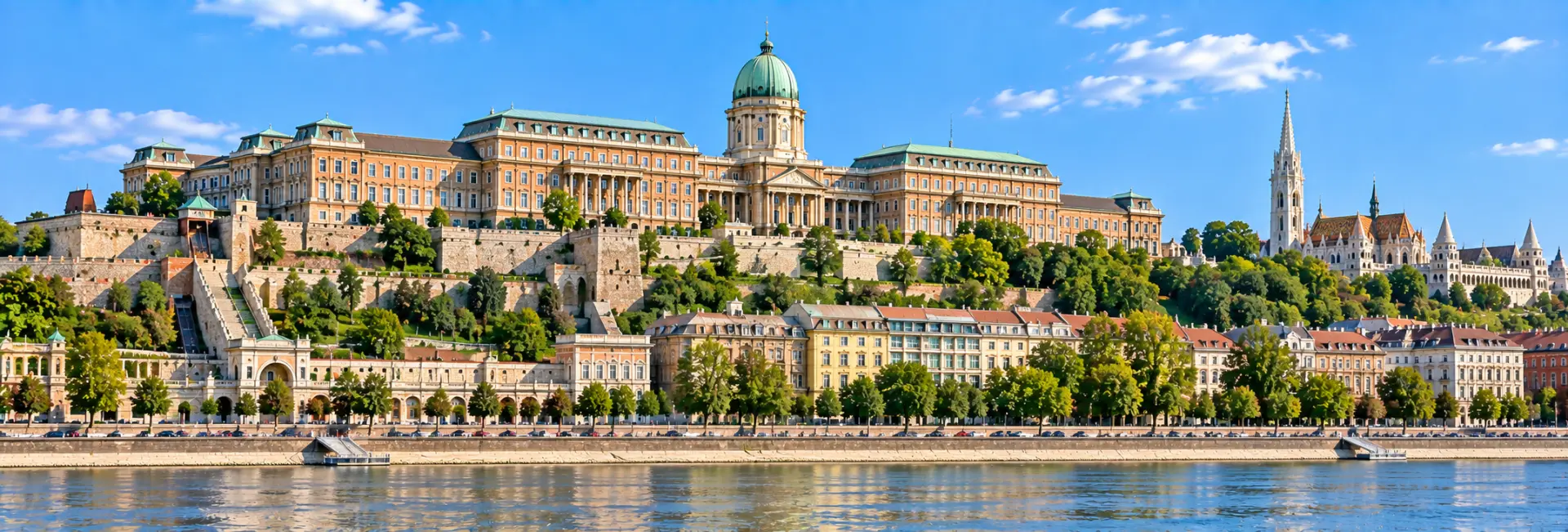
Buda Castle, also known as the Royal Palace, sits atop Castle Hill on the western bank of the Danube, roughly 48 meters above the river and visible from almost anywhere in Budapest. For more than seven centuries it has served as fortress, royal residence, and seat of power, surviving Mongol invasions, Ottoman occupation, and the devastation of the Second World War, and being rebuilt in a different style after nearly every setback.
Today the palace complex is less a single building than a small district in its own right, holding museums, courtyards, gardens, and terraces within its walls, all wrapped in sweeping views across the Danube toward the Hungarian Parliament Building and the rest of Pest. It anchors the wider Castle District, a maze of cobbled streets and historic houses that together form one of Budapest's most visited corners.
History
Medieval Origins
The site's fortifications date to the 1240s, when King Bela IV ordered Buda's hilltop fortified after Mongol raids devastated the region, including the sister settlement of Pest across the river. A royal residence followed in the 14th century, and under King Sigismund of Luxembourg in the early 1400s the palace grew into one of the largest Gothic residences in Europe, complete with a grand Knights' Hall. Its high point came under King Matthias Corvinus later that century, when the court became a celebrated center of Renaissance art and learning, drawing artists and scholars from across the continent and giving Buda a reputation, alongside Florence and Venice, as one of the great cultural capitals of the era.
Ottoman Rule and Baroque Rebuilding
Ottoman forces captured Buda in 1541 and used the palace for military purposes rather than as a residence, and the complex slowly deteriorated over nearly a century and a half of occupation. The long siege that finally drove the Ottomans out in 1686 left much of the medieval palace in ruins, and the Habsburgs who took control afterward rebuilt it on a smaller scale in the Baroque style of the 18th century, later expanding it further as a grander royal residence in the 19th century under architects including Miklos Ybl and Alajos Hauszmann.
Destruction and Modern Restoration
The palace suffered severe damage during the 1944 to 1945 Siege of Budapest at the end of the Second World War, and much of its ornate late 19th century detailing was stripped away during the plainer, communist-era reconstruction that followed. Since 2014, an ongoing state restoration effort known as the National Hauszmann Program has been rebuilding several of the palace's lost halls, domes, and surrounding buildings according to their pre-war designs, gradually returning parts of the complex to their earlier appearance while the site continues to host visitors throughout the work.
UNESCO World Heritage Status
Buda Castle and its surrounding Castle District formed Hungary's first entry on the UNESCO World Heritage list, inscribed in 1987 as part of the wider site "Budapest, including the Banks of the Danube, the Buda Castle Quarter and Andrassy Avenue." The listing recognizes the district's layered architectural history, spanning medieval, Baroque, and 19th-century styles, and its role as one of the great palace-and-riverbank ensembles of Europe, comparable in stature to historic royal quarters elsewhere on the continent.
Architecture and Notable Features
The Palace Complex
What stands today is largely the product of 19th and early 20th century rebuilding, blending Baroque and Baroque Revival design with later Art Nouveau touches, layered over medieval foundations that still survive underground in places. The palace's most photographed approach is the Lion Courtyard, named for the four stone lions guarding its gate, which opens onto the main palace building.
Matthias Fountain
Just off the main courtyard stands the Matthias Fountain, a Neo-Baroque sculpture group depicting King Matthias Corvinus on a royal hunt, often nicknamed Budapest's answer to Rome's Trevi Fountain for its theatrical, storytelling design.
Underground Buda
Beneath the hill lies a network of caves, cellars, and tunnels carved over centuries, originally used for storage and shelter and now partly open to visitors as a separate underground attraction connected to the castle's long history.
Museums and Collections
The palace buildings now house several of Hungary's leading cultural institutions rather than a royal household. The Hungarian National Gallery occupies a large part of the complex and holds the country's most comprehensive collection of Hungarian painting and sculpture, tracing artistic development from medieval altarpieces through 20th century modern works, and giving visitors a useful overview of Hungarian art history in a single set of galleries.
The Budapest History Museum, also called the Castle Museum, occupies another wing and traces the story of the city itself, including excavated Gothic and Renaissance rooms from the original medieval palace that were rediscovered and restored after WWII bomb damage exposed them. These lower-level rooms, with their vaulted stone ceilings and surviving carved details, are among the few surviving physical traces of the palace's medieval past and offer a striking contrast to the mostly rebuilt exterior above. The National Szechenyi Library, Hungary's national library, is also based within the castle grounds, holding centuries of Hungarian manuscripts, books, and maps.
Ways to Experience It
Most visitors treat Buda Castle as a place to wander rather than a single ticketed attraction, since the courtyards, terraces, and streets around it are open to the public at all hours free of charge, while the museums inside charge separate admission. A visit can be as simple as a stroll through the grounds for the views, or as involved as a full day spent moving between exhibitions, gardens, and viewpoints.
- Ride the Buda Castle Funicular from Clark Adam ter, at the Buda end of the Chain Bridge, up to Szent Gyorgy ter beside the palace, a short and scenic climb in its own right
- Walk up through the Castle Garden Bazaar, a terraced garden and arcade at the foot of the hill, for a quieter and less crowded route to the top
- Time a visit to Sandor Palace, the President's official residence next to the castle grounds, for the hourly changing of the guard ceremony
- Buy a combined or individual ticket for the Hungarian National Gallery or Budapest History Museum if the collections interest you, since courtyard access alone does not include the exhibitions
- Pay the small fee to climb into the palace dome for one of the widest panoramic views over Budapest, weather permitting
Best Time to Visit
The castle grounds are open year round, and the terraces along the western side of the hill offer some of the best sunset views in the city, looking out over the Danube toward the Hungarian Parliament Building as it lights up in the evening. Early morning is the quietest time to see the courtyards and fountains before tour groups arrive, while late afternoon tends to bring the busiest crowds, especially in summer.
Spring and autumn generally offer milder weather for the uphill walk and outdoor sightseeing than the peak heat of summer, and since much of the appeal lies in the views and architecture rather than indoor space, a clear day makes a noticeable difference to the visit.
Visitor Tips
- Wear comfortable, flat shoes, since the district is built on cobblestones and involves a real climb whether on foot, by funicular, or by bus
- Budget at least half a day if you plan to visit one of the museums inside, since the collections are large and the surrounding district rewards slow wandering
- Check which sections of the National Hauszmann restoration project are active before visiting, as scaffolding or partial closures can affect specific courtyards or buildings at different times
- Combine a castle visit with nearby Matthias Church and Fishermen's Bastion, both a short walk away within the same Castle District
- Public buses 16 and 16A run directly into the district for visitors who prefer not to use the funicular or climb on foot
Nearby Attractions
Buda Castle sits at the heart of a compact historic district, and several major sights are within easy walking distance.
- Matthias Church, a richly decorated Gothic church with a colorful tiled roof, just north of the palace grounds
- Fishermen's Bastion, a fairy-tale terrace of white turrets offering panoramic views over the Danube and Parliament
- Sandor Palace, the neoclassical presidential residence adjoining the castle, known for its hourly guard ceremony
- The Chain Bridge and its lower funicular station, connecting Castle Hill to the Pest side of the city
- Castle Garden Bazaar, a terraced 19th century garden and arcade at the base of the hill, popular for cafes and river views
FAQs about visiting Buda Castle
Is Buda Castle free to visit? +
Walking through the courtyards, gardens, and terraces of the castle grounds is free, but the museums inside, including the Hungarian National Gallery and the Budapest History Museum, charge separate admission.
How do I get up to Buda Castle? +
The Buda Castle Funicular runs from Clark Adam ter near the Chain Bridge up to the castle in a short scenic ride, and public buses 16 and 16A also reach the district; it's possible to walk up as well, though the climb is steep in places.
How much time should I set aside for a visit? +
Seeing the courtyards, fountains, and viewpoints can take an hour or two, but visiting one of the museums inside easily extends a trip to half a day or more.
Is Buda Castle still a royal residence? +
No, it hasn't functioned as a royal residence since the early 20th century; today it houses museums and cultural institutions, while the nearby Sandor Palace serves as the residence of Hungary's president.
What is the changing of the guard ceremony? +
It takes place hourly at Sandor Palace, next to the castle grounds, where a new group of guards formally relieves the previous one in a brief ceremonial ritual.
Why is part of Buda Castle under construction? +
An ongoing government restoration effort, the National Hauszmann Program, is rebuilding several halls and buildings that were destroyed in World War II or altered during the communist era, based on their earlier historical designs.
What's the best view of Buda Castle from a distance? +
The Pest side of the Danube, particularly near the Chain Bridge or the Hungarian Parliament Building, offers a classic view of the castle's silhouette on the hill, especially at sunset or once it's illuminated at night.
What else is worth seeing in the same district? +
Matthias Church and Fishermen's Bastion sit just north of the castle within easy walking distance, making it simple to combine all three into a single visit to Castle Hill.