Table of Contents
Overview
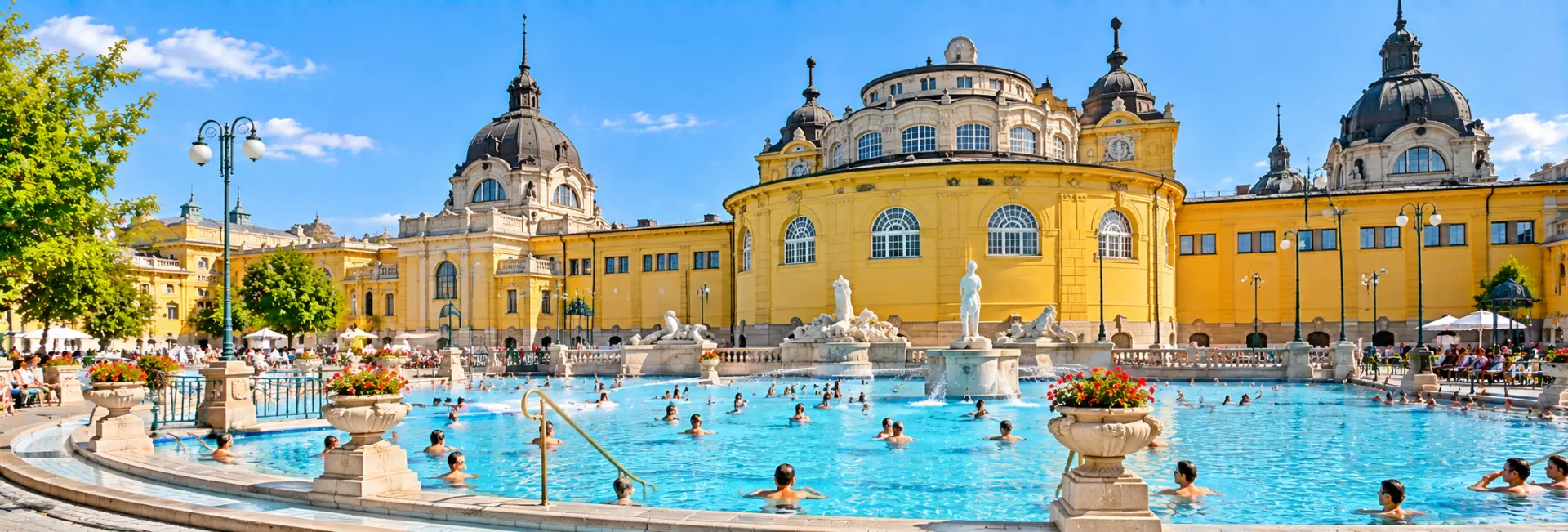
Szechenyi Thermal Bath sits inside City Park on the Pest side of Budapest, its bright yellow neo-baroque facade rising above a complex often described as the largest medicinal bath in Europe. Fed by naturally hot mineral springs drawn from deep beneath the city, it combines the feel of a grand imperial palace with the everyday ritual of soaking in warm water, a combination that has kept it central to Budapest life for more than a century.
Locals and visitors mix here in equal numbers, from elderly regulars playing chess waist-deep in the outdoor pools to first-time tourists ticking off one of the city's signature experiences. With eighteen pools spread across indoor halls and open-air courtyards, it is as much a full afternoon destination as a quick stop, and one of the clearest windows into Budapest's long relationship with its thermal water.
History
A City Built on Hot Springs
Budapest sits above one of the densest concentrations of thermal springs of any capital city, a resource first exploited on a large scale by the Romans and later expanded by the Ottomans, who built several bathhouses during their 16th and 17th century presence in the region. Szechenyi itself grew out of this much older bathing tradition, though the site's own history began later, once a deep well drilled beneath City Park in 1879 confirmed a strong, reliable thermal source. That discovery, made by engineer Vilmos Zsigmondy, proved that City Park's underground water supply was substantial enough to support a large-scale public bath rather than a modest local spring.
Construction and Opening
Architect Gyozo Czigler, a professor at Budapest's Technical University, designed the bath complex, and construction ran from 1909 to 1913. The complex opened to the public on June 16, 1913, as the first major thermal bath built on the Pest side of the Danube, named in honor of Count Istvan Szechenyi, a 19th century reformer often called "the Greatest Hungarian" for his role in modernizing the country. Within its first years the bath drew hundreds of thousands of visitors.
Expansion and Modernization
The original complex was smaller than the one visitors see today; the large outdoor pools and much of the surrounding courtyard were added in the mid-1920s, with the open-air section completed in 1927. Later renovations, including a significant modernization of the water filtration and circulation systems between 1999 and 2009, kept the aging complex functioning to modern hygiene standards while preserving its historic architecture. The bath marked its 100th anniversary in 2013 with several days of celebrations.
Architecture and Design
Szechenyi is built in a Neo-Baroque style, with touches of Neo-Renaissance detailing, designed to evoke the grandeur of an 18th century European palace rather than a simple bathhouse. Symmetrical wings, ornate domes, and a wide courtyard give the complex a formal, monumental feel, while decorative sculpture throughout the building draws on water-related mythology, from classical river gods to allegorical figures representing different uses of water through history, including drinking, healing, and irrigation.
Many of the complex's colorful ceramic tiles came from the Zsolnay factory in Pecs, the same maker responsible for much of the decorative rooftop tilework seen across Budapest. Inside, vaulted ceilings and mosaic-lined pools give the indoor halls a more intimate, almost cathedral-like atmosphere, in deliberate contrast with the open sky and busy social energy of the outdoor courtyard pools.
The Pools and Facilities
- Three large outdoor pools in the main courtyard, ranging from a cooler swimming pool to hot thermal soaking pools, all set against the bath's ornate yellow facade
- Fifteen indoor pools of varying temperatures, along with steam rooms, saunas, and smaller thermal baths tucked into side rooms
- A dedicated wellness and treatment area offering massages, mud treatments, and other spa services beyond simple bathing
- A 50-meter outdoor swimming pool, added during the 1920s expansion, used for lap swimming as well as leisure
- Chess tables built directly into one of the outdoor thermal pools, a long-running Budapest tradition and one of the complex's most photographed features
Thermal Waters and Wellness Traditions
The bath draws water from two thermal springs, one reaching around 74 degrees Celsius and the other about 77 degrees Celsius at the source, tapped from a well roughly 1,246 meters deep beneath City Park. The mineral-rich water contains sulphate, sodium, magnesium, calcium, and other compounds traditionally associated with easing joint pain, rheumatism, and certain skin and respiratory conditions, and the complex has long combined leisure bathing with more formal balneotherapy treatments.
This blend of medicine and leisure is typical of Hungarian bath culture more broadly, where thermal bathing is treated less as a novelty and more as an established, everyday form of wellness, passed down through generations of regular bathers rather than treated purely as a tourist activity.
Ways to Experience It
Most visitors buy a standard day ticket covering both the outdoor and indoor pools, with lockers or private cabins available for an additional fee. Massages, mud wraps, and other spa treatments can be booked separately for those who want a longer, more structured wellness visit rather than simply soaking.
- Bring your own swimwear, towel, and flip-flops, or rent them on site if traveling light
- Book a locker or cabin in advance during busy periods to guarantee secure storage for belongings
- Try the outdoor pools first for the classic view of the yellow facade before moving to the quieter indoor halls
- Consider booking a massage or treatment package if you want a longer, more restorative visit
- Check for the Saturday night "Sparty" pool parties if you're interested in a livelier, music-driven evening version of the baths
Best Time to Visit
Szechenyi is open year round, and visiting in winter has its own appeal, with steam rising off the hot outdoor pools against a backdrop of snow or a gray sky. Early morning tends to be the calmest time to visit, before day-trippers and tour groups arrive, while afternoons and weekends bring the largest crowds, especially in summer.
The complex is busiest during peak tourist season from June through August, so visitors who prefer a quieter soak often do better on a weekday morning or during the cooler shoulder months of spring and autumn.
Visitor Tips
- Arrive with a swim cap if you plan to use the lap pool, since some sections require one
- Pack a printed or digital reservation confirmation if you booked online, since it speeds up entry
- Keep valuables in a locked cabin rather than an open locker if you're carrying anything expensive
- Stay hydrated between soaks in the hottest pools, and take breaks rather than spending hours continuously in the hot water
- Weekday mornings offer the most relaxed experience for visitors who want to avoid crowds and long changing-room lines
Nearby Attractions
Szechenyi Thermal Bath sits inside City Park, one of Budapest's largest green spaces, surrounded by several other major attractions.
- Heroes' Square, a monumental plaza with statues of Hungary's historic leaders, a short walk from the bath's entrance
- Vajdahunyad Castle, a fantastical composite of Hungarian architectural styles set beside a small lake in City Park
- Budapest Zoo and Botanical Garden, within easy walking distance inside the same park
- Andrassy Avenue, Budapest's grand boulevard, connecting City Park to the city center via the M1 metro line
- The Museum of Fine Arts, facing Heroes' Square with an extensive collection of European art
FAQs about visiting Szechenyi Thermal Bath
How old is Szechenyi Thermal Bath? +
The complex opened in 1913, though its outdoor pools and much of the surrounding courtyard were added later, during an expansion completed in 1927.
Is Szechenyi Thermal Bath open year round? +
Yes, it operates throughout the year, including winter, when the contrast between the hot outdoor pools and cold air is part of the experience.
What should I bring for a visit? +
A swimsuit, towel, and flip-flops are essential; a swim cap is needed for the lap pool, and many visitors also bring a robe or cover-up for moving between pools.
Is Szechenyi good for families or first-time visitors? +
Yes, the complex welcomes a wide range of visitors, from families using the calmer indoor pools to first-timers exploring the main outdoor courtyard, though very young children should be supervised closely around the hottest pools.
What are the "Sparty" nights? +
They are Saturday night pool parties held in the thermal pools, combining the bath experience with DJs, lighting, and a livelier nightlife atmosphere, distinct from the calmer daytime visits.
How deep does the thermal water come from? +
The bath draws from a well roughly 1,246 meters deep beneath City Park, tapping naturally hot mineral springs that supply the pools at high temperature.
How long should I plan for a visit? +
Most visitors spend two to four hours moving between pools, though a full spa day with treatments can easily fill an entire afternoon.
What else is nearby? +
Heroes' Square, Vajdahunyad Castle, and Budapest Zoo are all within City Park itself, making it easy to combine a bath visit with other nearby sights.