Table of Contents
Overview
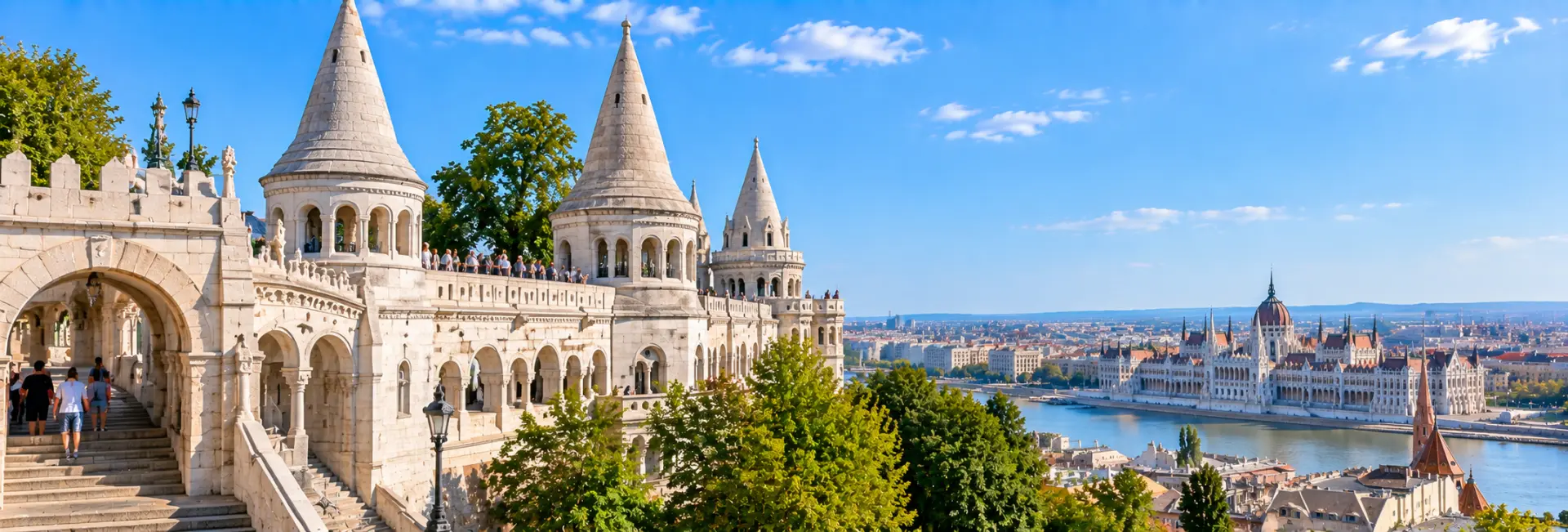
Perched on the eastern edge of Castle Hill above the Danube, Fisherman's Bastion is a terrace of white stone towers, arches, and staircases that looks like it belongs in a storybook rather than a modern city. Despite its fortress-like appearance, it was never built for defense; it exists purely to be looked at and to be looked from, offering some of the widest and most photographed views over the river and the Pest skyline.
Standing beside Matthias Church at the heart of the Buda Castle District, it draws visitors at every hour of the day, from sunrise photographers to evening strollers taking in the lit-up Hungarian Parliament Building across the water. It is compact enough to see in a short stop, yet detailed enough to reward a slower, wandering visit.
History
A Medieval Wall, Reimagined
The site's connection to fishermen goes back to the Middle Ages, when this stretch of Castle Hill's defensive walls was said to be the responsibility of the local fishermen's guild, whose community lived in the district below at the foot of the hill. A more practical theory ties the name to the fish market once held nearby, but either way, the association between this part of the wall and the city's fishing trade stuck for centuries, long after any original medieval structure had crumbled. Castle Hill itself had been fortified since the 13th century, after King Bela IV strengthened Buda's defenses in the wake of Mongol invasions, and this eastern stretch of wall above the river remained part of that broader defensive system for hundreds of years before its transformation into a decorative landmark.
Built for a Millennium
The bastion seen today has almost nothing to do with medieval defense. It was designed by Hungarian architect Frigyes Schulek, who was also responsible for restoring the neighboring Matthias Church, and built between 1895 and 1902 as a deliberately decorative structure to mark the 1,000th anniversary of the Hungarian state's founding. Schulek conceived it as a monumental viewing terrace and a piece of civic theater, not a working fortification, which is why its walls are thin, ornamental, and full of open arches rather than built to withstand a siege.
War and Restoration
Like much of Castle Hill, the bastion suffered serious damage during the fighting that swept through Budapest at the end of the Second World War. Restoration work in the years that followed, completed in the early 1950s, returned the structure to its late 19th century design, and it has remained one of the city's most carefully maintained landmarks ever since.
UNESCO World Heritage Status
Fisherman's Bastion falls within the UNESCO World Heritage Site "Budapest, including the Banks of the Danube, the Buda Castle Quarter and Andrassy Avenue," inscribed in 1987 as part of the historic Castle District that surrounds it. Its listing reflects the same recognition given to Buda Castle and the rest of the Castle Hill ensemble: a concentration of historic architecture, much of it 19th century recreation of earlier styles, that together forms one of Europe's most distinctive riverside old towns.
Architecture and Design
Seven Towers, One Idea
The bastion's most recognizable feature is its row of seven conical stone towers, each representing one of the seven Magyar tribes traditionally credited with founding Hungary in the year 895. Linked by open arcades, staircases, and a long balustraded terrace running roughly 140 meters parallel to the Danube, the complex reads less like a single building and more like a stage set assembled from turrets and archways.
Neo-Romanesque and Neo-Gothic Details
Schulek blended Neo-Romanesque arches and columns with Neo-Gothic decorative flourishes, using white limestone throughout to give the structure a pale, almost weightless look against the sky. Carved floral motifs, small statues, and stained glass details appear throughout, rewarding visitors who look closely rather than simply passing through on the way to a photo spot. The overall effect is intentionally romantic rather than historically strict, closer to how a 19th century architect imagined a medieval stronghold than to any structure that actually stood on the site centuries earlier.
What to See There
- The lower terrace, home to the grand double staircase leading up toward the towers and Matthias Church
- The upper terrace and towers, offering the widest unobstructed views across the Danube toward the Hungarian Parliament Building, St. Stephen's Basilica, and Margaret Island
- The equestrian statue of King Stephen I, Hungary's first Christian king, standing in the square in front of the bastion since 1906
- A small chapel and vaulted stone details tucked within the structure, remnants of the site's older, more functional past
- Views of neighboring Matthias Church's colorful tiled roof, best appreciated from the bastion's elevated walkways
- The on-site café and restaurant terraces, popular spots to sit with the same river view rather than just passing through
Ways to Experience It
The lower terraces and walkways around the bastion are open at all hours and free to enter, making it easy to fold a visit into a longer walk through the Castle District rather than treating it as a single ticketed stop. The upper towers and terraces, which offer the best panoramic views, require a paid ticket during the busiest daytime hours, though access to them is typically free early in the morning and again in the evening, a distinction worth planning around if budget or crowds are a concern.
- Combine a visit with neighboring Matthias Church, since both share the same small square and architect
- Stop at one of the on-site cafés for a coffee with a Danube view rather than rushing straight through
- Join a local walking tour of the Castle District if you want the history explained in person rather than self-guided
- Visit before 9am or after sunset to reach the upper towers without paying the daytime fee, and to avoid the largest tour groups
Best Time to Visit
Sunrise is a favorite time among photographers, when the terrace is nearly empty and the early light catches the white stone and the river below. Sunset and the hour just after are equally popular, since the Parliament Building and the rest of the Pest skyline light up across the water, making the bastion one of the best vantage points in the city after dark.
Midday, especially in summer, brings the heaviest crowds and the longest queues for the upper towers, so visitors who prefer a quieter experience generally do better arriving early morning or in the evening, or visiting during the shoulder seasons of spring and autumn.
Visitor Tips
- The lower walkways are free and open 24 hours, so a quick visit can happen at any time of day, including very early or very late
- Bring a small amount of cash or a card for the upper tower fee if visiting during paid daytime hours
- The terrace can get crowded and narrow in places, so hold onto cameras, phones, and bags in the busiest stretches
- Wear sturdy shoes, since the district's stairs and cobblestones make the approach less comfortable in sandals or heels
- Pair a visit with the wider Castle District, since Buda Castle and Matthias Church are both within a few minutes' walk
Nearby Attractions
Fisherman's Bastion sits at the center of Budapest's historic Castle District, within walking distance of several other major sights.
- Matthias Church, the colorfully tiled Gothic church standing directly beside the bastion
- Buda Castle and the Hungarian National Gallery, a short walk further along Castle Hill
- The Hospital in the Rock, a former secret WWII hospital and Cold War bunker built into the hill below
- Sandor Palace, the presidential residence, reachable on the same walk through the Castle District
- The Buda Castle Funicular and Chain Bridge, connecting Castle Hill down to the Danube and across to Pest
FAQs about visiting Fisherman's Bastion
Is Fisherman's Bastion free to visit? +
The lower terraces and walkways are free and open at all hours, but the upper towers charge a small fee during the daytime; entry to the towers is typically free early in the morning and after sunset.
Was Fisherman's Bastion ever actually used to defend the city? +
No, despite its fortress-like appearance, it was built purely as a decorative viewing terrace in the late 19th century and was never used for military defense.
How long does a visit take? +
A quick look around and a few photos can take as little as 20 to 30 minutes, though most visitors spend closer to an hour if they explore the towers, visit the on-site café, or pair it with nearby Matthias Church.
What is the best time to see the view? +
Sunrise and sunset are the most popular times, offering softer light, fewer crowds, and, after dark, a lit-up view of the Hungarian Parliament Building across the Danube.
How do I get to Fisherman's Bastion? +
Most visitors reach it on foot through the Castle District, via the Buda Castle Funicular, or by taking bus 16, 16A, or 116 up to Szentháromság tér, right beside the bastion.
Is Fisherman's Bastion suitable for children or visitors with mobility needs? +
Families visit comfortably, though the site involves stairs and uneven stone surfaces, so visitors with mobility concerns should expect some walking on cobblestones and steps rather than flat, paved paths.
What else is nearby? +
Matthias Church sits directly next to the bastion, with Buda Castle, Sandor Palace, and the rest of the Castle District all within an easy walk.