Table of Contents
Overview
Rising from the eastern bank of the Danube, the Hungarian Parliament Building is the single most recognizable structure in Budapest and the largest building in the country. Known in Hungarian as Orszaghaz, or "House of the Country," it has served as the seat of the National Assembly since the early 20th century and remains a working government building rather than a museum piece.
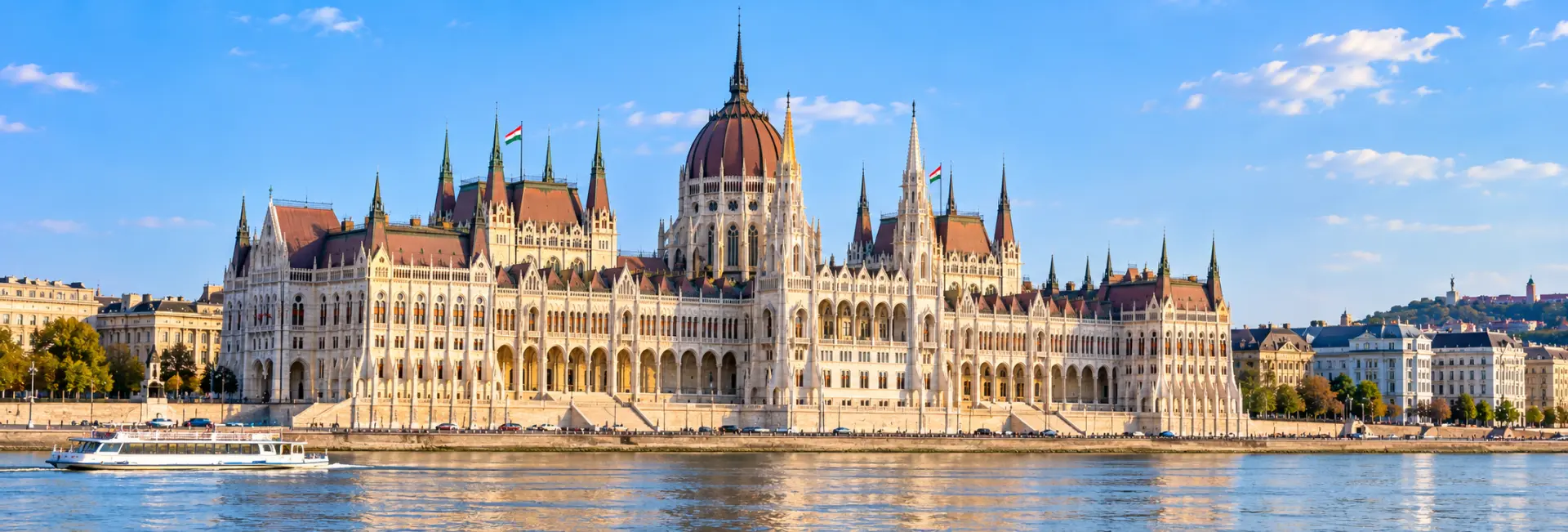
Its neo-Gothic spires, ribbed central dome, and mile-long riverside facade make it one of the most photographed parliament buildings anywhere in the world, and the sight of it lit up at night against the dark water of the Danube is one of the defining images of Central Europe. For visitors, it is both a working seat of government and a museum-grade showcase of Hungarian history, craftsmanship, and national identity.
History
A Competition for a National Symbol
By the 1880s, Hungary was a semi-autonomous partner within the Austro-Hungarian Empire, and its leaders wanted a legislative building grand enough to assert the country's own identity rather than simply echo Vienna. Budapest itself was still a young capital at the time, formed only a decade earlier from the merger of Buda, Pest, and Obuda, and a monumental new parliament on the riverfront was meant to announce that this unified city belonged among Europe's great capitals. An architectural competition drew a small field of submissions, and the winning design came from Hungarian architect Imre Steindl, whose neo-Gothic plan drew loose inspiration from London's Palace of Westminster while developing a distinct symmetrical layout and silhouette of its own.
Building a Giant
Construction began in 1885 and eventually involved roughly 100,000 workers, consuming around 40 million bricks, half a million decorative stones, and about 40 kilograms of gold leaf for interior detailing. Part of the building was formally inaugurated in 1896 to coincide with celebrations marking a thousand years since the Magyar tribes settled the Carpathian Basin, and the first parliamentary sessions were held inside a few years later, even as decorative work continued into the early 1900s. Steindl did not live to see his design fully realized; his eyesight failed during the long construction, and he died in 1902.
Surviving a Turbulent Century
The building has stood through two world wars, occupation, and political upheaval. A red star was mounted on the dome during the communist era and later removed, and the square in front of the Parliament was the site of a deadly shooting during the 1956 uprising against Soviet-backed rule, an event now marked by a memorial nearby. Inside, bullet marks from a 1912 shooting during a heated parliamentary debate are still visible today, a quieter reminder that the building has always been a stage for Hungary's political drama, not just its architecture.
UNESCO World Heritage Status
The Hungarian Parliament Building is one of the defining structures within the UNESCO World Heritage Site "Budapest, including the Banks of the Danube, the Buda Castle Quarter and Andrassy Avenue," inscribed in 1987 and later extended. UNESCO recognizes the site for preserving layered architectural history along the Danube, and the Parliament is singled out as a masterwork of 19th-century civic architecture on par with the great legislative buildings of London, Vienna, and Munich.
Beyond its UNESCO recognition, the building has held the informal title of Hungary's largest structure since its completion, and by long-standing local convention its dome height of 96 meters is matched by only one other building in the city, St. Stephen's Basilica, a deliberate rule meant to keep any single structure from overshadowing the others on the skyline.
Architecture and Design
Exterior
Stretching 268 meters along the riverbank and 123 meters wide, the building is built in the Gothic Revival style, bristling with pointed arches, turrets, and flying buttresses, while its central dome draws instead on Renaissance Revival forms, a deliberate blending of styles that gives the building a silhouette unlike any other parliament in Europe. The facade carries 88 statues of Hungarian rulers, military leaders, and historical figures, arranged with careful symmetry across both wings. Steindl's decision to pair a Gothic body with a classical dome was unusual for its time, and it remains one of the reasons the building reads as unmistakably its own thing rather than a copy of any single foreign model.
Interior
Inside, the building is organized almost as a mirror image of itself: two nearly identical assembly chambers sit on opposite sides of the central dome, one still used for sessions of the National Assembly and the other reserved for ceremonies and guided tours. Altogether the complex holds around 691 rooms, 10 courtyards, 29 staircases, and 13 elevators, connected by long corridors finished in red carpet, gilded stucco, and painted ceilings that reward slow, close-up viewing rather than a quick walk-through.
Inside the Parliament
The Dome Hall and the Holy Crown
The undisputed centerpiece of any visit is the Dome Hall, where the Holy Crown of Hungary, also known as the Crown of Saint Stephen, is displayed alongside the royal scepter, orb, and sword. According to tradition the crown was linked to Hungary's first king a thousand years ago, and today it functions as the country's most sacred national symbol rather than a simple museum object. A ceremonial Crown Guard stands watch beside it around the clock, and the guards perform a small, precise repositioning of their swords at set intervals, a detail many visitors only notice if they linger a few extra minutes.
The Grand Staircase
Leading up toward the Dome Hall, the building's Grand Staircase is lit by stained glass and topped with frescoed ceilings, giving newcomers their first real sense of the scale and craftsmanship packed into the interior. It is one of the few interior spaces that photographs almost as dramatically as the exterior facade.
Ways to Experience It
The only way to see the interior is on a guided tour, typically 45 to 60 minutes long and offered in multiple languages throughout the day. Tours cover a fixed route through the Grand Staircase, the Dome Hall with the Holy Crown, and one of the two assembly halls, led by a guide who explains the building's symbolism and history along the way. Because the building is still in active use by the National Assembly, the exact route or availability can shift at short notice around sessions or state events, so it pays to confirm details close to your visit date rather than relying on information gathered months in advance.
- Book tour tickets online in advance, since same-day availability is limited and sells out quickly in the warmer months
- Arrive at the dedicated Visitor Center entrance beside the building rather than the main political entrance
- Bring a valid passport or ID card, since it is checked against the ticket before entry
- Watch for the changing of the Crown Guard, a brief but striking ceremony near the Holy Crown display
- Consider a Danube river cruise or a walk along the opposite bank for the best full view of the facade, since the building is too large to take in properly from directly outside its own entrance
Best Time to Visit
The exterior can be admired at any hour, but the building is at its most striking around golden hour and again after dark, when floodlighting turns the stonework a warm gold and the whole facade reflects across the Danube. For a tour of the interior, mornings tend to be calmer than midday, and visiting in spring or autumn generally means shorter lines and a more relaxed pace than the peak summer crowds.
Because the building remains an active seat of government, tours can occasionally be shortened or unavailable during state functions, so it helps to keep plans flexible around major national holidays and events.
Visitor Tips
- Reserve tour tickets online well ahead of your visit, especially for summer travel or weekend dates
- Go through airport-style security before the tour, so leave oversized bags or bulky luggage at your accommodation
- Tours move as a group on a set schedule, so arrive with enough time before your slot to clear security
- For photographs of the full facade, cross to the Buda side near Batthyany ter, where the building is visible across the river without obstruction
- Dress and behave with a degree of formality in mind, since parts of the route pass close to an active legislative chamber
Nearby Attractions
Several notable sights sit within easy walking distance of the Parliament, making it simple to combine a visit with the rest of Budapest's riverside core.
- Shoes on the Danube Bank, a somber World War II memorial set directly into the riverside promenade just steps away
- Kossuth Lajos ter, the square in front of the Parliament, lined with statues of Hungarian historical figures
- The Chain Bridge, Budapest's oldest permanent Danube crossing, a short walk south along the river
- Fisherman's Bastion and Buda Castle, visible across the water and reachable by tram or a walk over the bridge
- St. Stephen's Basilica, a short walk inland, sharing the same 96-meter height as the Parliament by local tradition
FAQs about visiting the Hungarian Parliament Building
What is the Hungarian Parliament Building known for? +
It is Hungary's largest building and the seat of the National Assembly, famous for its neo-Gothic exterior, its Renaissance Revival dome, and the Holy Crown of Hungary displayed inside under permanent guard.
Do I need to book tickets in advance? +
Yes, booking online ahead of time is strongly recommended, since interior tours run on a fixed schedule with limited spots and same-day tickets can sell out quickly during busy periods.
How long does a visit take? +
A guided tour of the interior generally runs 45 to 60 minutes, though it's worth allowing extra time before and after for security screening and photographs outside.
Can I visit without a guide? +
No, the interior can only be seen as part of a scheduled guided tour; independent wandering through the building is not permitted.
What is the best time to photograph the Parliament? +
Golden hour and shortly after sunset are the most popular times, when the floodlit facade glows against the sky and reflects across the Danube, especially when viewed from the opposite riverbank.
How do I get to the Hungarian Parliament Building? +
The Kossuth Lajos ter metro station on line M2 sits right beside the building, and tram line 2 runs along the riverside with a stop at the same square.
Is the Hungarian Parliament Building suitable for children or visitors with limited mobility? +
Families are welcome on tours, though the pace and content are geared toward general adult interest; visitors with mobility needs should check current accessibility arrangements when booking, since the route involves stairs in parts of the historic building.
What else can I see nearby? +
The Shoes on the Danube Bank memorial sits just along the riverside promenade, and the Chain Bridge, Fisherman's Bastion, and St. Stephen's Basilica are all within a short walk or tram ride.