Table of Contents
Overview
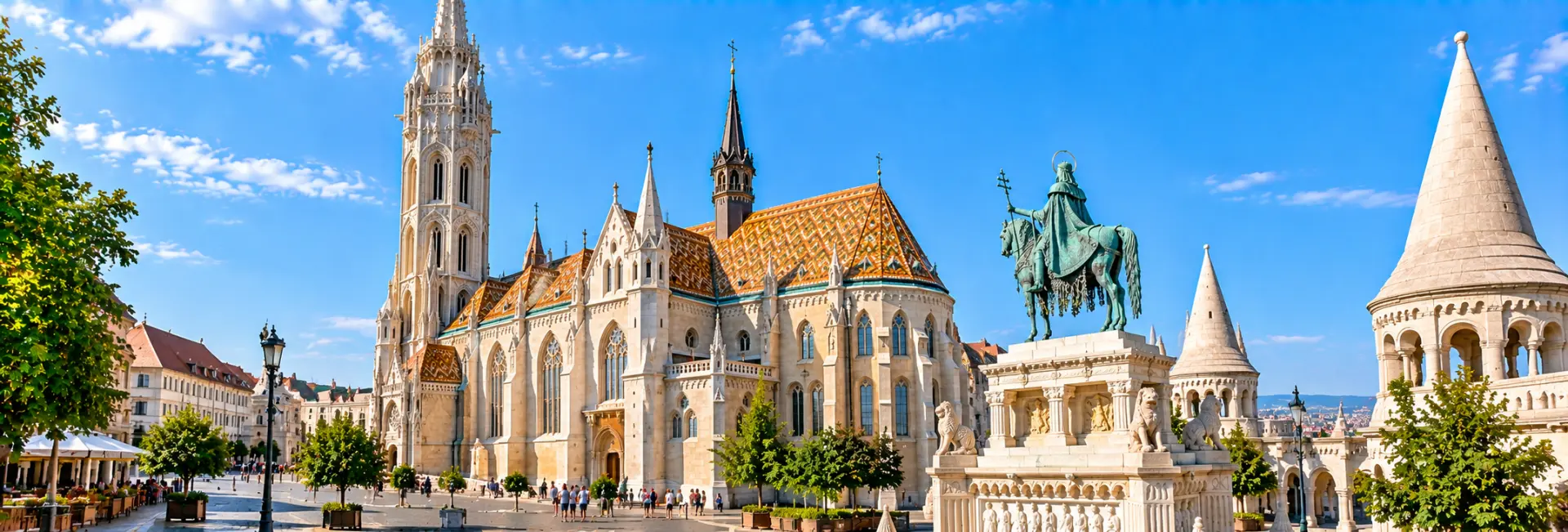
Matthias Church rises above Budapest's Castle Hill with a spire that has watched over the Danube for centuries. Officially the Church of the Assumption of the Buda Castle, it stands on Holy Trinity Square directly in front of the Fisherman's Bastion, giving visitors one of the most photographed skylines in Central Europe. Its steeply pitched roof, tiled in shimmering diamonds of Zsolnay ceramic, sets it apart from almost every other church in the region.
Though it carries the name of King Matthias Corvinus, the building is far older than his 15th-century reign and far younger in appearance than its medieval bones suggest, thanks to a sweeping 19th-century reconstruction. Twice a coronation site for Hungarian monarchs and once converted into a mosque, the church compresses nearly a thousand years of Hungarian history into a single, richly decorated interior that remains an active parish to this day.
History
Medieval Origins
Church tradition holds that a place of worship stood on this site as early as 1015, founded during the reign of Saint Stephen, Hungary's first king, though no physical trace of that structure survives. The earliest confirmed building dates to the mid-13th century, when King Béla IV ordered a new parish church built on Castle Hill after the devastating Mongol invasion of 1241–42. Construction began around 1255, and the church grew over the following two centuries into the grand hall-style Gothic building whose outline still defines the site today, including the carved Mary Gate added in the 14th century.
The King Matthias Era
The church takes its popular name from King Matthias Corvinus, who ruled from 1458 to 1490 and financed the reconstruction of its southern tower, now known as the Matthias Tower. Matthias also held two of his weddings here, and the building served as the setting for royal ceremonies throughout the late medieval period, cementing its status as one of the most important churches in the Kingdom of Hungary.
Ottoman Occupation and Decline
When Ottoman forces captured Buda in 1541, the church was converted into the city's main mosque, its frescoes whitewashed and its furnishings removed or destroyed. During the 1686 siege that finally drove the Turks from Buda, a collapsing wall is said to have exposed a hidden statue of the Virgin Mary to the praying defenders inside, an event still remembered locally as the Marian Miracle. The building suffered heavy damage in the fighting and was subsequently rebuilt in the Baroque style under Jesuit administration, a look most historians consider a poor match for the original structure.
The Schulek Restoration
The church's present appearance is largely the work of architect Frigyes Schulek, commissioned by Emperor Franz Joseph in 1873 to restore the building ahead of his own coronation. Over more than two decades, completed in 1896, Schulek stripped away later additions and rebuilt the church in a Neo-Gothic style intended to evoke its medieval origins, adding the vividly colored Zsolnay roof and reconstructing the towers largely from his own scholarly interpretation of what had been lost. He also designed the adjoining Fisherman's Bastion during the same campaign.
War Damage and Modern Restoration
Matthias Church was seriously damaged during the Siege of Budapest in the closing months of the Second World War, and repairs continued for decades afterward, with the interior not fully restored until 1968. A further large-scale conservation project in the 2000s and 2010s cleaned and stabilized Schulek's stonework and paintings, and the church remains a functioning parish of the Archdiocese of Esztergom-Budapest as well as a protected part of Budapest's UNESCO World Heritage Site, inscribed in 1987 as part of the Buda Castle Quarter.
Architecture & Design
Matthias Church is built in a late Gothic style layered with the Neo-Gothic vision Frigyes Schulek imposed during his 19th-century reconstruction. Its most recognizable feature is the roof, covered in hexagonal, diamond-patterned tiles produced by the Zsolnay factory in Pécs, whose glazed pyrogranite surface shifts color with the light and weather throughout the day. The asymmetrical silhouette pairs the tall, openwork Matthias Tower on the south side with the sturdier Béla Tower to the north, the latter retaining stonework and carving that date back to the 13th-century core of the building.
Exterior Details
Schulek filled the exterior with sculpture drawn from medieval precedent, including rows of gargoyles carved as dragons, bats, and grotesque animal forms that once channeled rainwater from the roof. The carved Mary Gate on the south side, depicting the Death and Assumption of the Virgin, survives from the 14th century and was carefully reassembled after wartime damage using its original fragments.
Interior
Inside, nearly every surface is painted in the geometric and floral patterns that Schulek's team based on fragments of medieval decoration found during restoration. The frescoes and stained glass were created by two of the era's leading Hungarian painters, Károly Lotz and Bertalan Székely, whose biblical and historical scenes cover the walls and vaulting in deep reds, blues, and gold leaf. The main altar carries a Neo-Gothic triptych, while a sandstone pulpit in a related style anchors the nave.
Cultural & Religious Significance
Matthias Church has served Hungary's spiritual and political life in equal measure. Its most celebrated role is as a coronation church: the last two kings crowned in Hungary, Franz Joseph I in 1867 and Charles IV in 1916, both received their crowns here, and composer Franz Liszt wrote his Hungarian Coronation Mass specifically for the 1867 ceremony. The building has also hosted royal weddings dating back to King Matthias himself in the 15th century.
The legend of the Marian Miracle, in which a concealed statue of the Virgin was said to have demoralized Ottoman defenders in 1686, gave the church added significance as a symbol of Christian survival through the Turkish occupation. Today it continues to function as an active Roman Catholic parish under the Archdiocese of Esztergom-Budapest, holding regular Mass alongside its role as one of Budapest's most visited landmarks, and its excellent acoustics make it a sought-after venue for organ and choral concerts.
Notable Features
- The double sarcophagus of King Béla III and his wife Anne of Antioch, moved to the Trinity Chapel in 1860 after their remains were rediscovered in the ruined cathedral of Székesfehérvár
- The Loreto Chapel beneath the south tower, home to a Baroque statue of the Madonna modeled on the original venerated in Loreto, Italy
- A collection of ecclesiastical art and treasury pieces, including replicas of the Hungarian coronation regalia, displayed in the church's gallery and crypt
- Stained glass windows and wall frescoes by Károly Lotz and Bertalan Székely, among the finest examples of Hungarian historicist religious art
- The Matthias Tower, which visitors can climb on a separate ticket for panoramic views over the Danube, Buda Castle, and the Pest skyline
- A set of seven working bells, including the historic Holy Trinity bell cast in 1723
Visiting Etiquette & Tips
As an active parish, Matthias Church expects visitors to dress and behave respectfully, particularly during Mass and other services, when tourist access may be restricted or paused. Modest clothing that covers the shoulders and knees is appropriate, and quiet, subdued conversation is expected throughout the nave.
- Entry to the church and the separate tower climb both require tickets; check the official Matthias Church website for current prices and any days when the church is closed to visitors for services or events
- Photography without flash is generally permitted in the main body of the church, but tripods and professional equipment may require prior permission
- The tower climb involves a narrow spiral staircase and is not well suited to visitors with mobility limitations or claustrophobia
- Arrive early or book tours in advance during summer, when queues for both the church and the surrounding Castle Hill sights can be long
- Combine a visit with an organ or choral concert if the schedule allows, since the acoustics are considered among the best in the city
Best Time to Visit
Early morning, shortly after opening, and the last hour before closing tend to offer the smallest crowds, since Castle Hill fills with tour groups through the middle of the day. Late afternoon light also brings out the color of the Zsolnay roof tiles particularly well, making it a favored time for photography.
Spring and early autumn offer comfortable temperatures for the walk up Castle Hill and shorter queues than the peak summer months. A winter visit around the Christmas season adds the nearby Advent market on Trinity Square, when the square in front of the church is lit and decorated, though the church itself can be busier with holiday services.
Nearby Attractions
- Fisherman's Bastion, the ornamental terrace directly beside the church, built by the same architect and offering some of the best panoramic views over the Danube and Pest
- Buda Castle and the Royal Palace, a short walk south along Castle Hill, housing the Hungarian National Gallery and Budapest History Museum
- The Holy Trinity Column, a Baroque plague monument standing in the square directly in front of the church
- The Buda Castle Funicular, connecting Castle Hill to the Chain Bridge and the banks of the Danube below
- Hospital in the Rock, a Cold War-era underground hospital and bunker museum a few minutes' walk away
FAQs about visiting Matthias Church
What is Matthias Church famous for? +
It is famous for its colorful Zsolnay-tiled roof, its role as the coronation church of Hungary's last two kings, and its position beside the Fisherman's Bastion at the heart of Buda's Castle District.
Is Matthias Church free to visit? +
No, entry requires a paid ticket, and climbing the Matthias Tower requires a separate ticket; check the official website for current prices, since these change periodically.
How much time should I spend at Matthias Church? +
Most visitors spend 30 to 60 minutes inside the church, plus additional time for the tower climb if included, and it pairs naturally with a longer walk around the rest of Castle Hill.
Can I attend Mass at Matthias Church? +
Yes, it remains an active parish church with regular Mass times, and visitors are welcome to attend services, though general sightseeing access is typically paused while a service is underway.
Is Matthias Church suitable for visitors with mobility issues? +
The main body of the church is accessible, but the Matthias Tower is reached by a narrow spiral staircase that is not suitable for wheelchair users or visitors with significant mobility limitations.
What is the best time of day to visit Matthias Church? +
Early morning or the final hour before closing usually offer the smallest crowds, and late afternoon light shows off the roof tiles particularly well.
What should I combine with a visit to Matthias Church? +
The Fisherman's Bastion, Buda Castle, and the Holy Trinity Column are all within a few minutes' walk, making Castle Hill an easy half-day itinerary on its own.