Table of Contents
Overview
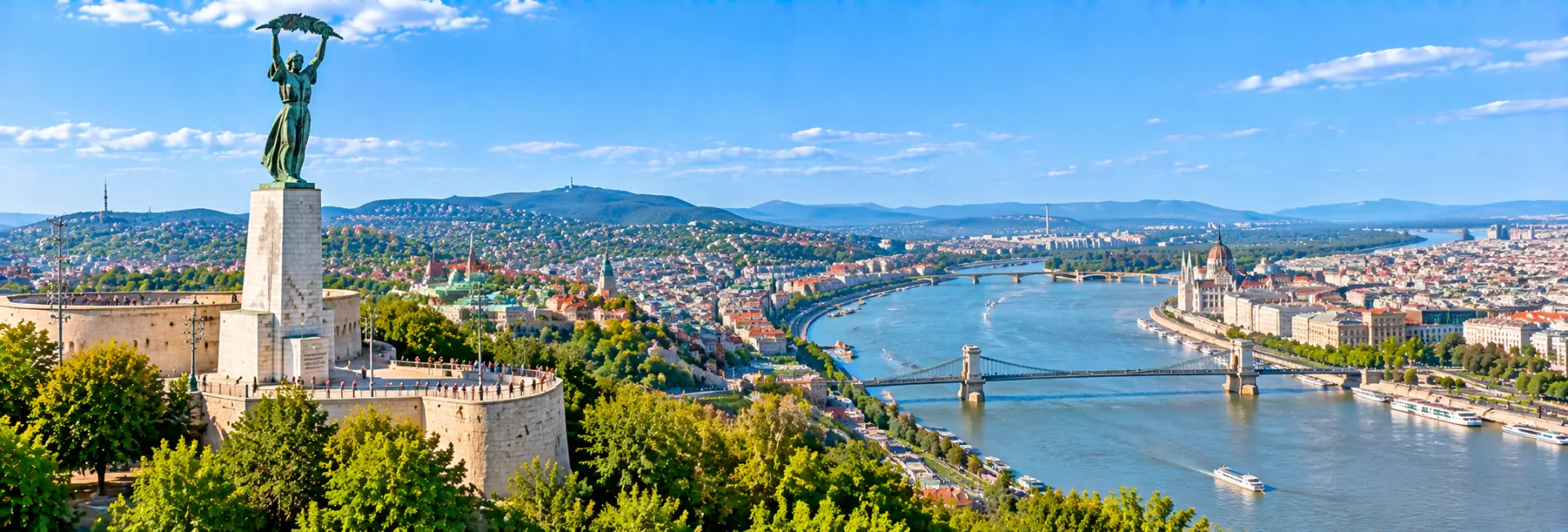
Gellért Hill rises 235 meters above sea level on the Buda side of the Danube, its dolomite bulk overlooking the river from a point roughly 140 meters above the water. It is the single best vantage point in Budapest, offering an unbroken panorama that takes in both banks of the city, its bridges, Buda Castle, and the Hungarian Parliament Building across the water.
Beyond the view, the hill layers together nearly a thousand years of history in a compact space: a martyred bishop's legend, a 19th-century fortress built to intimidate the city below, a church hidden inside a natural cave, and a monumental Liberty Statue visible from almost anywhere in Budapest. It is also, less famously, a protected nature reserve threaded with hiking trails, making it as much a green escape as a historic monument.
History & Formation
Naming and Legend
The hill takes its name from Bishop Gellért, a Venetian Benedictine monk known in Latin as Gerard of Csanád, who was invited to Hungary by King Stephen I to help convert the Magyar tribes to Christianity in the early 11th century. According to tradition, Gellért was killed in 1046 during a pagan uprising against Christian rule, sealed into a barrel and rolled down the hillside into the Danube. He was canonized in 1083, and the hill has carried his name since at least the 15th century, after earlier medieval names including Kelen-hegy and Pest-hegy.
Vineyards and Early Use
For centuries the hill's slopes supported vineyards, recorded as covering well over a hundred hectares by the late 18th century, until the vines were largely destroyed by phylloxera in the 19th century. Its strategic height over the city and the Danube also made it a natural site for fortification long before the structure seen today was built.
The Citadella
The fortress at the summit, known as the Citadella, was built by the Habsburg Empire between 1850 and 1854, immediately after the suppression of the 1848–49 Hungarian Revolution, as a deliberate show of control over a city that had just risen against Habsburg rule. Hungarians resented the fortress so intensely that it earned the nickname the "Budapest Bastille." It never saw the military use its builders intended, and in 1897 the Habsburg emperor symbolically handed it over to the city, with part of its wall demolished as a gesture of reconciliation.
Twentieth-Century Turmoil
The Citadella's defensive position was put to grim use in the 20th century: German forces used it during the 1944–45 Siege of Budapest, and Soviet forces later fired on the city from its heights during the 1956 revolution. Battle scars from this period are still visible on some buildings in the streets below. The Liberty Statue was erected at the summit in 1947 to commemorate Hungary's liberation from Nazi occupation, originally accompanied by a Soviet soldier figure that was removed after the fall of communism in the early 1990s, leaving only the central female figure and two smaller allegorical statues representing progress and the defeat of tyranny.
Following decades of decline, the Citadella underwent an extensive renovation that reopened the fortress and its surrounding park to the public in 2026, adding new public park space, a roof terrace, and direct pedestrian access between the Liberty Statue and the fortress courtyard.
Natural Features
Gellért Hill is built from Triassic-era dolomite rock, and the fault lines running along its base are responsible for the numerous hot springs that surface nearby, including the sources that feed the Gellért, Rudas, and Rácz thermal baths at the foot of the hill. The same geology, combined with the leaching action of hot mineral water over thousands of years, carved out the network of caves within the hill, the most notable being the Gellért Hill Cave that today houses the Cave Church.
Since 1987, Gellért Hill and its surrounding nature conservation area have been recognized as part of Budapest's UNESCO World Heritage listing, reflecting both its historic monuments and its ecological value. The hill supports a mix of planted and self-seeded trees, including fig trees said to date back to the era of Ottoman occupation, along with oaks, almonds, and various pines, and its slopes are managed as green parkland threaded with footpaths, meadows, and lookout terraces rather than left as untouched wilderness.
Part of the city's drinking water reserve, roughly 80 million liters, is stored inside reservoirs built into the hill, a reminder that beneath the monuments and viewpoints Gellért Hill still functions as working infrastructure for the city around it. Access to the reservoir itself is restricted, but it illustrates how thoroughly the hill's water-bearing dolomite has been put to use over the centuries, from the thermal baths at its base to the drinking water beneath its surface.
Key Areas & Landmarks
- The Citadella, the 19th-century Habsburg fortress at the summit, now reopened with a public park, exhibition space, and rooftop terrace
- The Liberty Statue, a 14-meter bronze figure holding a palm leaf atop a 26-meter pedestal, visible from across the city
- The Gellért Hill Cave, home to the Cave Church (Sziklatemplom), a Pauline monastic church built into the rock that was sealed off during the communist era and reopened in 1989
- The Statue of Saint Gellért, set above a cascading waterfall on the hill's northeastern slope near Elizabeth Bridge
- The Garden of Philosophers, a group of statues by sculptor Nándor Wagner installed on the hill's western side in 2001
- The Jubilee Park, covering much of the hill's gentler southern slopes with lawns, playgrounds, and viewpoints
Ways to Experience It
Most visitors reach the summit on foot, following one of several winding trails that climb from the Gellért Hotel and Liberty Bridge on the southeastern side, or from Elizabeth Bridge to the north; the climb takes roughly 20 to 40 minutes depending on the route and pace. Bus line 27 also runs close to the top for those who prefer not to walk the whole way, and sightseeing buses and organized tours frequently include a stop at the summit for photographs.
Inside the Citadella, a paid exhibition covers the history of the hill and the fortress, while the ramparts and park areas are free to explore. The Cave Church, near the base of the hill facing the Gellért Hotel, can be visited for a small entrance fee and offers a strikingly different experience from the open-air summit, with modest dress required inside. Hikers and joggers use the hill's network of paths year-round, and the southern slopes' lawns are popular for picnics and sledging when it snows.
Several marked viewpoints and terraces punctuate the climb, offering places to pause and take in the view before reaching the summit, and the paths themselves vary considerably in steepness, so it is worth choosing a route to match fitness level and footwear. Photographers and casual visitors alike tend to gather at the same handful of terraces near the Liberty Statue, since these offer the clearest unobstructed views over the river and both halves of the city.
Best Time to Visit
Sunset is widely considered the best time to be at the summit, when the low light catches Buda Castle, the Danube bridges, and the Parliament Building across the river; arriving 30 minutes or so before sunset helps secure a good spot before the terraces fill up. Early morning offers a quieter alternative with soft light and far fewer visitors.
Spring brings blooming almond trees partway up the hill near the large cross above the Cave Church, while summer is the busiest season for both the trails and the Citadella. Every August 20th, Hungary's national holiday, fireworks over the Danube are launched from the hill, drawing large crowds who claim viewpoints well in advance.
Autumn offers a quieter middle ground, with mild temperatures for hiking and fewer tour groups than the peak summer months, while winter occasionally brings snow to the gentler southern slopes, which locals use for sledging with children. Whatever the season, weekday mornings tend to be noticeably calmer than weekend afternoons, when both locals and visitors head to the hill in large numbers.
Visitor Tips
- Wear comfortable shoes, since the paths to the summit are steep in places and some sections use uneven stone steps
- Bring water, particularly in summer, as shade is limited on the more exposed southern slopes
- Check current opening times and any ticketing for the Citadella exhibition before visiting, since access has changed following its recent renovation
- Cover shoulders and knees if visiting the Cave Church, as it remains an active place of worship
- Budget extra time if visiting around sunset or August 20th, when the summit gets crowded and paths can be slow going
Nearby Attractions
- Gellért Baths and Hotel Gellért, the Art Nouveau thermal bath complex directly at the foot of the hill
- Rudas Baths, a historic Ottoman-era thermal bath a short walk along the river
- Liberty Bridge and Elizabeth Bridge, the two Danube crossings bookending the hill
- Buda Castle and the Castle District, a longer walk or short ride to the north along the river
- The Tabán district, the quiet residential neighborhood on the hill's northern slope
FAQs about visiting Gellért Hill
What is Gellért Hill known for? +
It is known for offering Budapest's best panoramic views, along with the Citadella fortress, the Liberty Statue, and a church built inside a natural cave.
Is Gellért Hill free to visit? +
Yes, the trails, viewpoints, and the area around the Liberty Statue are free; only the Citadella's interior exhibition and the Cave Church charge a small entrance fee.
How long does it take to walk up Gellért Hill? +
Most routes to the summit take between 20 and 40 minutes on foot, depending on the starting point and pace, though bus line 27 also reaches close to the top.
Why is it called Gellért Hill? +
It is named after Bishop Gellért, a missionary bishop who, according to tradition, was killed on the hillside during a pagan uprising in 1046 and later canonized as a saint.
What is the Cave Church at Gellért Hill? +
It is the Sziklatemplom, a Pauline monastic church built into a natural cave near the base of the hill, sealed off during the communist era and reopened to worship and visitors in 1989.
Is Gellért Hill a good spot for sunset? +
Yes, the summit is one of Budapest's most popular sunset viewpoints, with clear sightlines to Buda Castle, the Danube bridges, and the Parliament Building.
What else can I combine with a visit to Gellért Hill? +
The Gellért and Rudas thermal baths sit at the foot of the hill, and Buda Castle is within easy reach along the river for a longer day of sightseeing.