Table of Contents
Overview
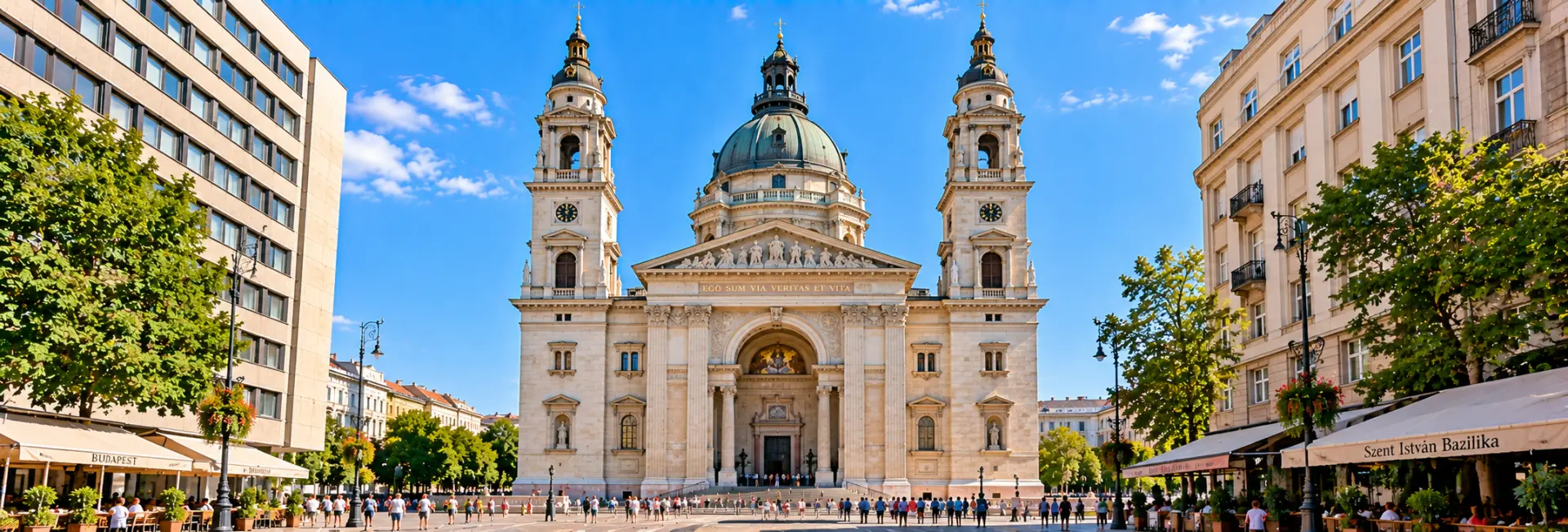
St. Stephen's Basilica is Budapest's largest church, standing in the heart of the Pest side of the city on a broad pedestrian square that shares its name. Named for Stephen I, Hungary's first Christian king, it is as much a civic landmark as a place of worship, its dome rising to exactly the same height as the Hungarian Parliament Building across town, a deliberate pairing meant to place spiritual and political authority on equal footing.
Inside, gold mosaics, dark marble, and painted domes create a hushed, richly decorated space that can hold thousands of worshippers at once, while outside the basilica anchors one of downtown Budapest's most popular squares, ringed by cafes and often filled with both locals and visitors. For many first-time visitors it is one of the first grand buildings they see in the city, and one of the most memorable.
History
A Long and Troubled Construction
Construction began in 1851 under architect Jozsef Hild, working in a restrained neoclassical style. In January 1868, with the building nearly complete, the dome and its supporting drum suddenly collapsed, the result of flawed materials and construction weaknesses made worse by a harsh winter. Workers had reportedly noticed cracks in the structure beforehand, but the full scale of the problem only became clear once the dome gave way. The entire structure had to be dismantled down to its foundations and rebuilt from scratch, a setback that added years and considerable cost to a project already years in the making.
A Change of Hands and Style
Hild died in 1867, shortly before the collapse, and the project passed to Miklos Ybl, one of the era's leading architects and later famous for Budapest's Opera House. Ybl reinforced the foundations and revised the design toward a more elaborate neo-Renaissance style, a shift visible in the basilica's finished silhouette. When Ybl himself died in 1891 with the building still unfinished, a third architect, Jozsef Kauser, completed the remaining work, finally finishing the church in 1905, fifty-four years after construction began.
War, Damage, and Restoration
The basilica suffered significant bomb damage during the Second World War, and its cellars sheltered refugees and part of Hungary's national archives during the fighting. Restoration work continued in stages through the late 20th century, gradually repairing the building's walls, towers, and decorative details to bring it back to something close to its original 1905 appearance.
Recognition and Status
Pope Pius XI granted the church the honorary title of basilica minor in 1931, formally recognizing what Budapest residents had already been calling it for decades due to its scale and prominence. In 1993, when the Archdiocese of Esztergom was reorganized as the Archdiocese of Esztergom-Budapest, the church also became a co-cathedral, sharing that role with the cathedral in Esztergom.
The basilica sits within the buffer zone of the UNESCO World Heritage Site covering Budapest's Danube riverfront and historic core, a recognition of its place within the city's broader architectural heritage even though the core listed area lies primarily along the river itself.
Architecture and Design
A Greek Cross and a Symbolic Dome
The basilica is built on a Greek cross floor plan, with four roughly equal arms meeting beneath a central dome that rises 96 meters into the sky, matching the Hungarian Parliament Building's height down to the meter. That figure was chosen deliberately to reference 896, the traditional date of the Magyar tribes' arrival in the Carpathian Basin, and for decades a building-height limit in central Budapest kept both structures as the city's tallest, giving the skyline its distinctively low, level profile.
Exterior
The neoclassical facade is fronted by a row of columns and a triangular pediment carved with religious figures, flanked by twin bell towers, one of which holds Hungary's largest bell. At 87 meters long and 55 meters wide, the building is substantial enough to hold roughly 8,500 people inside at once.
Interior
Inside, more than fifty types of marble were used across the columns, floors, and altars, alongside gilded stucco, mosaic work, and stained glass by Hungarian artist Miksa Roth. The dome's interior is painted with a monumental depiction of heaven by Karoly Lotz, the same artist responsible for frescoes inside the Hungarian Parliament Building, tying the two landmarks together stylistically as well as in height. Smaller side chapels and altars throughout the church add further layers of sculpture and painted decoration, making the interior rewarding to explore slowly rather than take in at a glance.
Inside the Basilica
The Holy Right Hand
The basilica's most significant relic is the mummified right hand of King Stephen I, known in Hungarian as the Szent Jobb, or Holy Right Hand, preserved in a jeweled reliquary within a side chapel. It is considered Hungary's most sacred religious relic, tied directly to the country's first Christian king and the founding of the Hungarian state a thousand years ago.
The Panoramic Terrace
A lift or a climb of several hundred stairs leads up to a terrace that circles the base of the dome, offering a 360-degree view over the city, including the Danube, Buda Castle, and the Hungarian Parliament Building. It is one of the highest public viewpoints in central Pest and a popular stop for visitors more interested in the skyline than the interior alone.
Ways to Experience It
Entry to the main body of the church is free, though a small donation is customary, while access to the panoramic terrace and the basilica's small treasury requires a separate paid ticket. The basilica also hosts regular organ and choral concerts, drawing on a long tradition of skilled organists and a notable pipe organ dating to 1905.
- Climb or ride the lift to the dome terrace for one of central Budapest's best panoramic views
- Check the schedule for an organ or choral concert, especially during festival periods, since many performances are open to the public
- Visit the reliquary chapel to see the Holy Right Hand, a short stop but a meaningful one for many visitors
- Join a guided tour if you want the architecture and history explained in depth rather than exploring on your own
- Combine a visit with a coffee at one of the cafes on Szent Istvan Square, ideal for basilica views without going inside
Best Time to Visit
Weekday mornings tend to be the quietest time to visit the interior, before tour groups and cruise-ship crowds build up later in the day. The dome terrace is popular at any hour with clear weather, though sunset draws the largest crowds for its light over the rooftops and the Danube beyond.
Because the basilica is an active place of worship, it periodically closes to visitors for services and ceremonies, so it helps to check opening hours in advance, particularly around Sundays and major religious holidays such as Christmas and Easter.
Visitor Tips
- Dress modestly, covering shoulders and knees, since it remains an active church rather than a museum
- Keep noise to a minimum inside, especially during services, and avoid flash photography
- Book dome terrace or treasury tickets online in advance during summer to avoid long queues at the entrance
- Check the mass and concert schedule if you specifically want to attend, or specifically want to avoid, a service during your visit
- The surrounding square is pedestrian-only, so plan to arrive on foot, by metro, or by tram rather than by car
Nearby Attractions
St. Stephen's Basilica sits in the middle of downtown Pest, within walking distance of several other major sights.
- Andrassy Avenue, Budapest's grand boulevard lined with theaters, embassies, and the Hungarian State Opera House, just a short walk away
- The Hungarian Parliament Building, roughly ten minutes on foot along the Danube
- Deak Ferenc Square, a major transit hub where all three metro lines meet
- Vorosmarty Square, home to the historic Gerbeaud cafe and, in winter, one of Budapest's main Christmas markets
- The Chain Bridge and the Danube promenade, offering views across to Buda Castle and Castle Hill
FAQs about visiting St. Stephen's Basilica
Is St. Stephen's Basilica free to visit? +
Entry to the main church is free, though a small donation is customary; the panoramic dome terrace and the treasury require a separate paid ticket.
What is the Holy Right Hand? +
It is the preserved right hand of King Stephen I, Hungary's first Christian king, kept in a jeweled reliquary inside a side chapel and considered the country's most important religious relic.
How do I get to the dome terrace? +
Visitors can reach the terrace either by climbing several hundred stairs or by taking a lift, both leading up to a walkway that circles the base of the dome with panoramic views over the city.
Why is the basilica exactly 96 meters tall? +
The height was chosen to match the Hungarian Parliament Building and to reference the year 896, when the Magyar tribes are said to have settled the Carpathian Basin, symbolizing an equal balance between church and state.
Is St. Stephen's Basilica still an active church? +
Yes, it functions as a co-cathedral of the Archdiocese of Esztergom-Budapest and holds regular masses and services, so parts of the building may close to visitors during religious ceremonies.
How long does a visit take? +
Seeing the interior alone can take 20 to 30 minutes, while adding a climb to the dome terrace or a stop at the treasury typically extends a visit to around an hour or more.
Can I attend a concert at the basilica? +
Yes, the basilica regularly hosts organ recitals and choral concerts, many of them open to the public, and schedules are worth checking in advance if music is a priority for your visit.
What else is nearby? +
Andrassy Avenue, the Hungarian Parliament Building, and Deak Ferenc Square are all within a short walk, making it easy to combine the basilica with other central Budapest landmarks.