Table of Contents
Overview
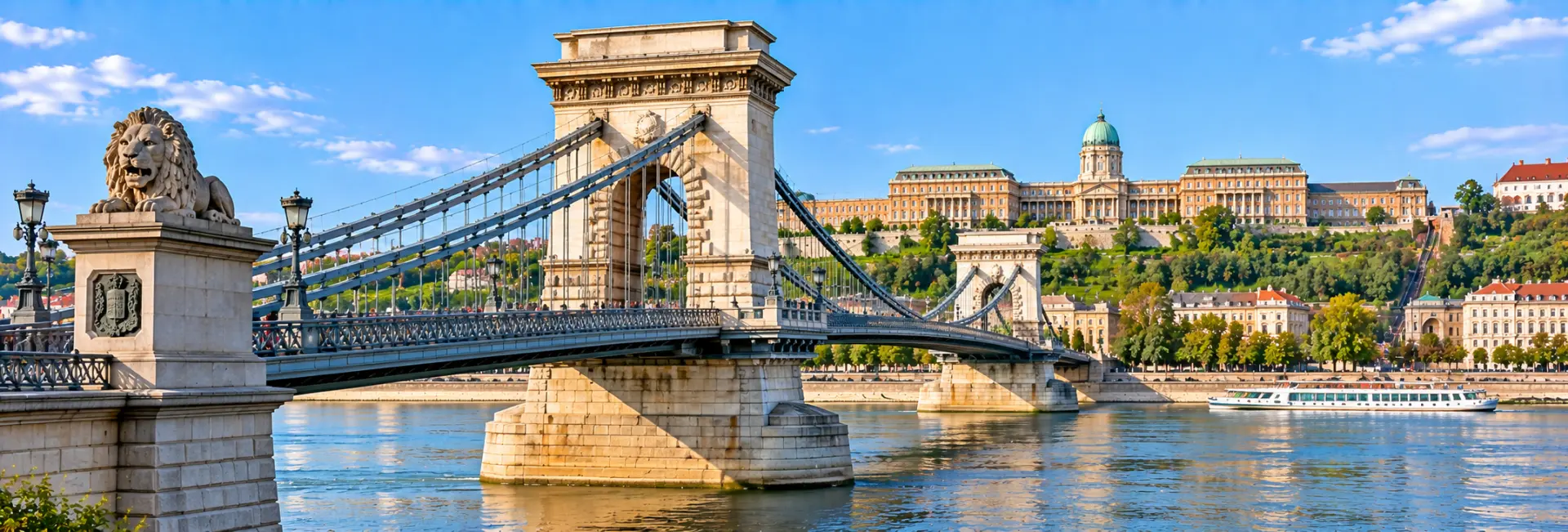
The Szechenyi Chain Bridge, almost always called simply the Chain Bridge, was the first permanent crossing to link Buda and Pest across the Danube, and it remains the most recognizable of Budapest's river bridges nearly two centuries later. Suspended between two stone towers on iron chains, with a pair of stone lions guarding each end, it connects the base of Castle Hill on the Buda side to the elegant Szechenyi Square on the Pest side, right in the heart of the city.
More than a way to cross the river, the bridge is one of Budapest's defining images, especially after dark, when its outline glows against the water and the floodlit silhouettes of Buda Castle and the Hungarian Parliament Building on either bank. Free to cross on foot at any hour, it draws a steady stream of walkers, joggers, and photographers throughout the day and night.
History
A Bridge Born from a Missed Funeral
Before the bridge existed, Buda and Pest were connected only by boats and a seasonal pontoon crossing that had to be dismantled each winter when ice floes threatened to destroy it. According to a well-known account, Hungarian statesman Count Istvan Szechenyi was delayed for several days trying to cross the frozen Danube in 1820 and missed his own father's funeral, an experience often credited with convincing him that Hungary needed a permanent bridge between its two halves.
Design and Construction
Szechenyi campaigned for years to make the bridge a reality, eventually commissioning English engineer William Tierney Clark, who had already designed suspension bridges over the Thames in England, to draw up the plans. Construction ran from 1840 to 1849 under the on-site supervision of Scottish engineer Adam Clark, unrelated to the designer despite sharing a surname, with the bridge's sections built and shipped from Britain before being assembled over the river. The bridge opened to the public on November 20, 1849, becoming the first permanent stone-and-iron crossing of the Danube in Hungary.
Symbol of a Unified City
By making year-round crossing possible for the first time, the bridge played a direct role in the 1873 merger of Buda, Pest, and Obuda into the single city of Budapest. Before its construction, the two banks had only been linked by seasonal boats and a temporary pontoon bridge, so a fixed, all-weather crossing was a genuine turning point for trade and daily life between the two halves of the future capital. The bridge also carried a quieter social significance: everyone who crossed had to pay the same toll regardless of rank, including the nobility, who had traditionally been exempt from such fees, making the bridge an early practical step toward eroding class privilege in Hungary.
Destruction and Rebuilding
The bridge survived for nearly a century before retreating German forces destroyed it on January 18, 1945, during the final stages of the Second World War, leaving only its two stone towers standing. It was rebuilt in the years that followed, closely reproducing the original design, and reopened on November 20, 1949, exactly one hundred years after its first inauguration. A further major renovation between 2021 and 2023 restored its historic appearance while reinforcing the structure for modern use.
UNESCO World Heritage Status
The Chain Bridge falls within the UNESCO World Heritage Site "Budapest, including the Banks of the Danube, the Buda Castle Quarter and Andrassy Avenue," inscribed in 1987. As one of the defining structures on the riverfront, it is a key part of the panorama that earned the listing, particularly at night, when its illuminated form is one of the most photographed views along the entire Danube corridor.
Architecture and Design
The bridge stretches 375 meters across the Danube, with a central span of 202 meters suspended from iron chains hung between two neoclassical stone towers built in the form of triumphal arches. At the time of its construction it was considered a major feat of engineering, a larger-scale version of the same suspension design William Tierney Clark had already proven on the smaller Marlow Bridge in England, and its sections were prefabricated in Britain before being shipped to Hungary for final assembly over the river.
Its original cast-iron chains and trusses were replaced with riveted steel during a strengthening project in 1914 and 1915, and the postwar reconstruction of the late 1940s closely followed the same design, reusing the surviving stone towers rather than starting from scratch. The result is a structure that looks much as it did in the 19th century, even though a significant share of its ironwork dates only to the 20th century.
Notable Features and Legends
- Four monumental stone lions, carved by sculptor Janos Marschalko and installed in 1852, guarding each end of the bridge
- A long-running urban legend claims the sculptor forgot to carve the lions' tongues and threw himself into the Danube in shame after a child pointed it out; in reality, the lions do have tongues, simply not visible from ground level
- The Kossuth coat of arms carved into the stonework at the crown of each tower arch
- A nightly illumination system that lights the bridge's chains and towers from dusk until around midnight
- The Zero Kilometre Stone, marking the point from which all road distances in Hungary are measured, standing near the bridge's Buda-side entrance at Clark Adam Square
Ways to Experience It
Walking across the bridge is free, open 24 hours a day, and requires no ticket or reservation, making it one of the easiest major Budapest sights to fit into any itinerary. Wide pedestrian sidewalks run along both sides, separated from the two lanes of vehicle traffic that still cross the bridge today.
- Walk across at sunset or after dark for the bridge's best-known illuminated view, ideally looking back from either riverbank
- Combine a crossing with the nearby Buda Castle Funicular, which starts just beside the bridge's Buda-side entrance
- Take a Danube river cruise for a view of the bridge from the water, especially popular in the evening
- Photograph the bridge from Fisherman's Bastion or the Gellert Hill viewpoint for a wider view that includes the full span and both riverbanks
Best Time to Visit
The bridge can be crossed at any hour, but the most popular time is after sunset, once the illumination switches on and the chains and towers stand out clearly against the night sky. Early morning offers a quieter walk with fewer pedestrians and less traffic noise, while midday and early evening tend to be the busiest, especially in summer when both locals and tourists are out along the riverbanks.
Visitor Tips
- Stick to the marked pedestrian sidewalks, since two lanes of vehicle traffic still cross the bridge
- Bring a camera or phone with a night mode if you're visiting specifically for the illuminated evening view
- Pair a bridge crossing with a walk along the Danube promenade on either side for more photo opportunities
- Watch your footing on the sidewalks in wet or icy weather, since the stone and metal surfaces can be slippery
- If crossing during rush hour, allow extra time, as the bridge can get crowded with both pedestrians and traffic
Nearby Attractions
Sitting at the heart of Budapest's riverfront, the Chain Bridge connects directly to several other major sights on both sides of the Danube.
- Buda Castle and the Castle Hill Funicular, reached directly from Clark Adam Square at the bridge's Buda-side entrance
- Gresham Palace and the Hungarian Academy of Sciences, standing beside the bridge's Pest-side entrance at Szechenyi Square
- The Hungarian Parliament Building, a short walk north along the Pest riverbank
- Fisherman's Bastion and Matthias Church, a walk or funicular ride up Castle Hill from the Buda side
- Vorosmarty Square and the pedestrian streets of downtown Pest, a short walk inland from the bridge's eastern end
FAQs about visiting the Chain Bridge
Is the Chain Bridge free to cross? +
Yes, pedestrians can cross for free at any hour of the day or night; only vehicles use the bridge's traffic lanes.
Why is it called the Chain Bridge? +
The name refers to its construction: the roadway is suspended from large iron chains strung between two stone towers, a design known as a chain suspension bridge.
Is it true the stone lions have no tongues? +
No, that's a popular but false legend; the lions do have tongues, they're simply carved deep in the mouth and not visible from street level below.
What happened to the original 1849 bridge? +
It was destroyed by retreating German forces in January 1945 during the Second World War, leaving only the two stone towers standing; the bridge was rebuilt and reopened in 1949.
What is the best time to see the bridge lit up? +
Shortly after sunset, once the nightly illumination switches on and stays lit until around midnight, offering the classic view seen in most photographs of Budapest.
How do I get to the Chain Bridge? +
It's centrally located and easy to reach on foot from downtown Pest, or by tram to Szechenyi Istvan ter on the Pest side or Clark Adam ter on the Buda side.
How long does it take to walk across? +
A relaxed walk across the roughly 375-meter span takes about five to ten minutes, though many visitors linger longer for photos.
What else is nearby? +
Buda Castle and the Castle Hill Funicular sit right at the Buda end, while Gresham Palace, the Hungarian Academy of Sciences, and the Hungarian Parliament Building are all within easy walking distance on the Pest side.