Table of Contents
Overview
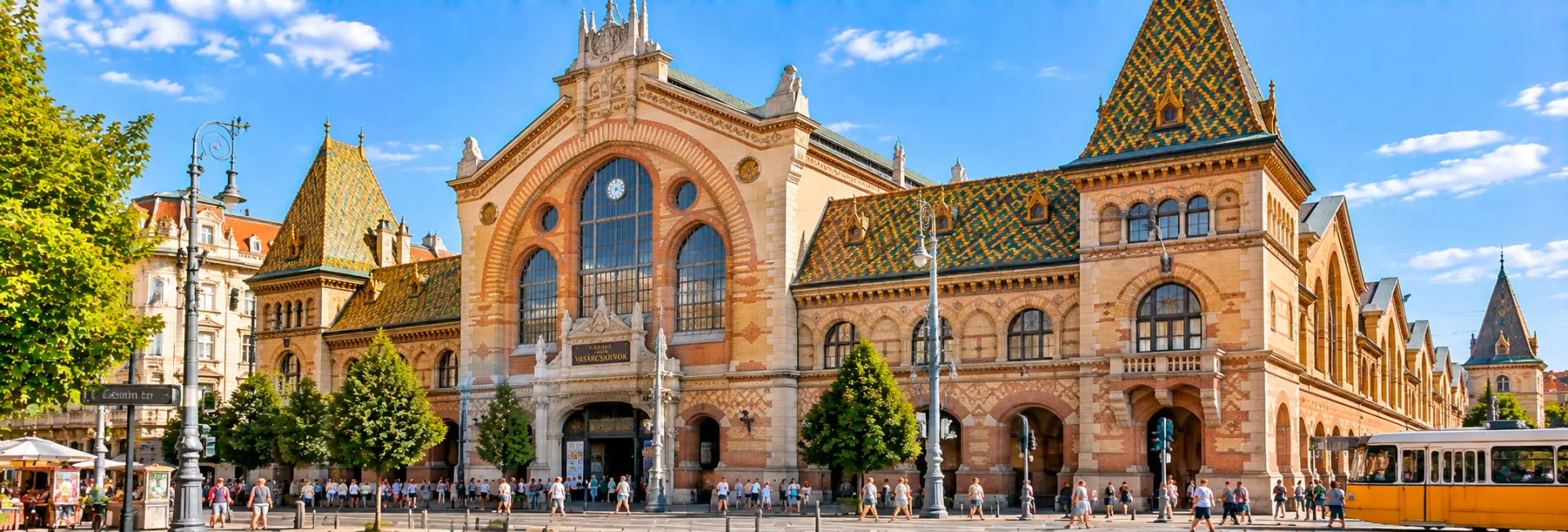
The Great Market Hall stands at Fővám tér on the Pest side of Liberty Bridge, at the foot of Váci utca, the city's best-known pedestrian shopping street. It is the oldest and largest of Budapest's covered markets, a soaring iron-framed hall roofed in colorful Zsolnay tiles that has supplied the city with fresh food for well over a century.
Part working market and part tourist attraction, the hall spreads produce, meat, and specialty stalls across three levels, from a basement of pickles and fish to an upper floor of eateries and souvenirs. Locals still shop here for everyday groceries alongside the crowds of visitors drawn by the building's architecture and its concentrated dose of Hungarian food culture.
History
Origins
The idea of building large, sanitary covered markets for Budapest took shape in the 1870s and 1880s, as the newly unified capital's rapid growth strained an outdated and poorly regulated food supply. Károly Kamermayer, Budapest's first mayor, championed the project as his largest personal investment in the city, pushing through years of committee debate over financing and location before a site was finally secured on land belonging to the state treasury in the city's 9th district.
Construction and a Fire
Architect Samu Pecz designed the hall, and construction proceeded through the mid-1890s using an iron structural frame supplied by the Ganz works, an ambitious choice that let the building achieve its long, unobstructed interior spans. In the summer of 1897, with the building only weeks from completion, a fire tore through the site and set the project back, delaying the opening that had been planned to coincide with Hungary's millennial celebrations. The hall finally opened on 15 February 1897, with the recently retired Kamermayer taking part in the ceremony as a private citizen, having overseen the project through nearly his entire mayoralty. It was one of several large market halls built across Budapest in this same period, part of a coordinated effort to bring organized, inspected food trade to every major district of the growing capital, but from the start it was designed and positioned as the flagship of the group.
War Damage and Restoration
The hall operated for decades as both a retail market and an import-export hub for Hungarian produce, with wagons once able to drive straight through a central aisle to unload goods, retailers arranged along one side and wholesalers along the other. Strict inspection rules governed what could be sold, reflecting the public health concerns that had driven the project in the first place. It suffered heavy damage during the Second World War and only received hasty repairs afterward, and by 1991 the building had deteriorated so badly that it was closed as unsafe.
A thorough restoration through the early 1990s replaced the roof's tiles with exact Zsolnay reproductions and rebuilt much of the ironwork, and the hall reopened in 1994 in close approximation of its original appearance. The building's former customs office, standing across the square, now houses part of Corvinus University, a reminder of the wider commercial district that grew up around the market in its early decades.
Architecture & Design
The Great Market Hall covers roughly 10,000 square meters and rises three stories around a long central nave lit by tall arched windows, a design typical of the great European market halls built in iron and glass during the late 19th century. Samu Pecz combined Neo-Gothic detailing, visible in the pointed arches of the main entrance, with the more overtly industrial vocabulary of exposed iron trusses and columns supporting the roof.
The building's most recognizable feature is its roof, covered in vividly glazed Zsolnay ceramic tiles from Pécs, the same manufacturer behind the tiled roofs of Matthias Church and other Hungarian landmarks of the era. Inside, a network of channels once allowed boats and barges to unload directly into storage areas beneath the hall, reflecting its original role as a working import-export facility rather than a purely retail space.
The interior is organized on three distinct levels connected by open staircases and galleries running along the sides of the nave, so that visitors on the upper floor can look directly down onto the ground-floor stalls below. This vertical layout, combined with the height of the iron roof trusses, gives the hall an airy, cathedral-like scale that is unusual among working food markets and has made it a favorite subject for architectural photography.
Recognition & Status
The 1990s restoration of the Great Market Hall earned the building the FIABCI Prix d'Excellence in 1999, an international award recognizing outstanding real estate and restoration projects. It has since been repeatedly singled out in international media as one of Europe's finest surviving market halls, prized both for its architecture and for having remained a genuinely functioning market rather than a purely ornamental relic.
The hall sits within Budapest's historic Ferencváros district, close to the Liberty Bridge crossing and within easy reach of the city's UNESCO-listed riverside district along the Danube, and it remains one of the most visited single buildings in the city.
Its continued daily use by local shoppers is itself part of what heritage bodies and architecture critics point to when praising the restoration: unlike some historic market halls elsewhere in Europe that were converted primarily into tourist venues or event spaces, the Great Market Hall has kept a working grocery function on its lower floors alongside its role as a visitor attraction.
What to See and Buy
- The ground floor, lined with stalls selling fresh produce, meat, dairy, and Hungarian staples such as paprika, salami, and Tokaji wine
- The basement level, home to the fish market and rows of vendors selling traditional pickled vegetables
- The upper gallery, filled with food stalls, souvenir shops, and traditional textiles and handicrafts
- The building's iron roof structure and Zsolnay tiling, best appreciated by looking up from the central nave
- The Neo-Gothic main entrance facing Fővám tér, with its arched clock and decorative brickwork
Beyond individual stalls, the hall as a whole functions as a kind of living museum of Hungarian food culture, with vendors who have often worked the same counters for decades and an atmosphere that shifts noticeably between the brisk, practical trading of the ground floor and the more leisurely, tourist-paced browsing upstairs.
Ways to Experience It
Most visitors simply wander the stalls at their own pace, sampling snacks such as lángos, chimney cake, or a cup of goulash from the upstairs food counters while browsing the ground-floor produce below. Guided food tours, often combined with a walk down Váci utca, are widely available and typically include tastings of salami, pastries, pickles, and Hungarian wines chosen to give a broader introduction to the country's cuisine than a solo visit might cover.
Because it remains a working market rather than a museum, the experience changes noticeably by day and hour: mornings are busiest with local shoppers and the freshest selection, while later in the day some stalls close early, particularly on Saturdays. Photographers are generally free to photograph the building and its stalls, though it is courteous to ask before photographing individual vendors closely.
Some visitors treat the market purely as a sightseeing stop, spending ten or fifteen minutes admiring the architecture before moving on, while others build an entire lunch or shopping trip around it, picking up ingredients for a picnic or cooking a Hungarian meal back at their accommodation. Both approaches work well, since the hall rewards a quick look as readily as a longer, more deliberate visit.
Language is rarely a barrier, since most vendors who deal regularly with tourists speak at least basic English and are used to explaining unfamiliar products such as different paprika grades or cured meats. Even so, learning a few basic Hungarian words for thank you and please tends to be appreciated, and can occasionally open the door to a friendlier exchange or a small taste before buying.
Best Time to Visit
Early weekday mornings, shortly after opening, offer the best combination of fresh stock and light crowds, along with the clearest photographs of the ironwork before the aisles fill up. The market is busiest in the late morning and around midday, when both tour groups and local lunch crowds converge on the upper floor's food stalls.
The hall keeps shorter hours later in the week and is closed entirely on Sundays, so a Sunday visit to Fővám tér will only take in the exterior. Saturday mornings draw the heaviest weekend crowds, since the market closes earlier that day and locals often do their weekly shopping before it shuts.
Visitor Tips
- Check current opening hours before visiting, since the hall closes earlier on Saturdays and does not open on Sundays
- Bring cash in forint for smaller stalls, since not every vendor accepts cards
- Head to the basement for pickles and fish, the ground floor for fresh produce and meat, and the upper gallery for prepared food and souvenirs
- Compare prices between a few stalls before buying paprika or salami, since quality and price can vary noticeably from vendor to vendor
- Combine the visit with a walk across nearby Liberty Bridge or along Váci utca, both within a few minutes on foot
FAQs about visiting the Great Market Hall
What is the Great Market Hall known for? +
It is known for being Budapest's oldest and largest indoor market, housed in a 19th-century iron-framed hall topped with a distinctive Zsolnay tiled roof.
Is the Great Market Hall free to visit? +
Yes, entry to the building is free; visitors only pay for the food, produce, or goods they choose to buy from individual stalls.
What should I buy at the Great Market Hall? +
Popular purchases include Hungarian paprika, salami, Tokaji wine, and pickled vegetables, along with prepared snacks like lángos and chimney cake from the upper-floor food stalls.
What are the opening hours of the Great Market Hall? +
The market generally opens early on weekday mornings and closes earlier on Saturdays, with the whole building closed on Sundays; check the official schedule before visiting, since hours can change.
How much time should I spend at the Great Market Hall? +
Most visitors spend 30 minutes to an hour browsing the stalls, though a guided food tour or a full grocery shop can easily extend the visit to two hours or more.
Is the Great Market Hall touristy or do locals still shop there? +
Both: the ground floor and basement remain genuinely popular with local shoppers for everyday groceries, while the upper gallery leans more toward tourist-oriented food and souvenirs.
What is nearby the Great Market Hall? +
Liberty Bridge and the Danube riverside are just outside, and the pedestrian shopping street Váci utca begins directly across Fővám tér.