Table of Contents
Overview
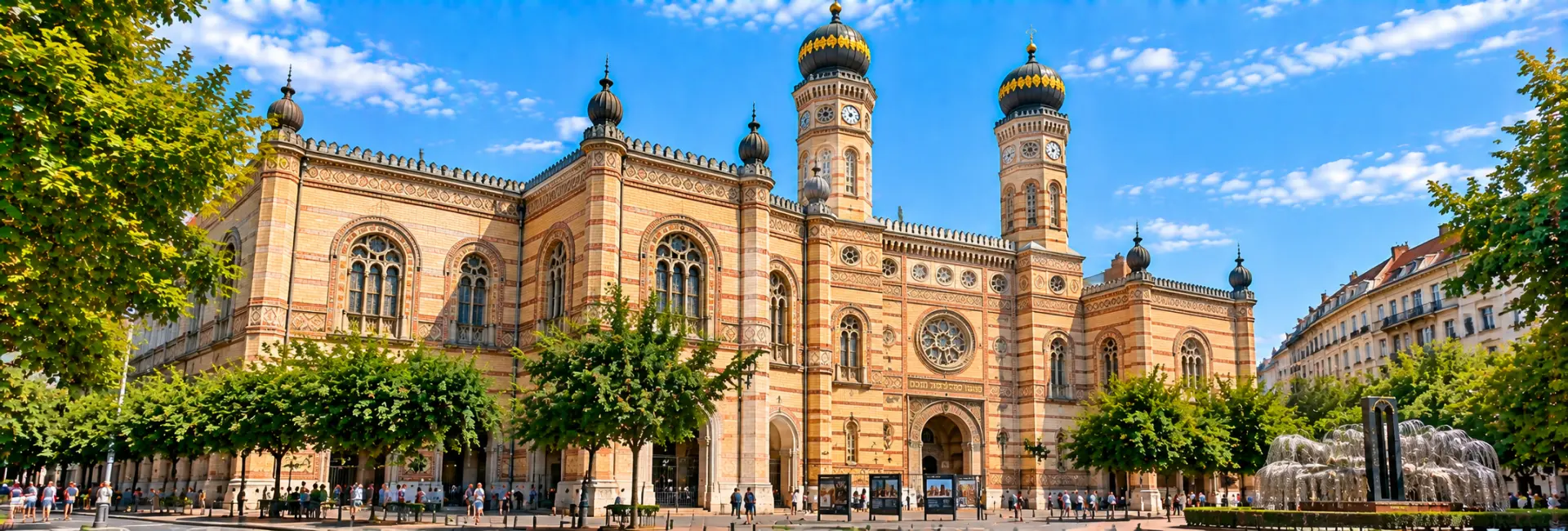
The Dohány Street Synagogue, often called the Great Synagogue, stands in the heart of Budapest's historic Jewish Quarter as the largest synagogue in Europe and the second-largest in the world, seating nearly 3,000 worshippers. Its striking twin towers and Moorish Revival facade have made it one of the most recognizable buildings in the city since its consecration in 1859.
Beyond its architecture, the synagogue complex carries the weight of Hungarian Jewish history across two centuries, from the confidence of a prosperous 19th-century community to the devastation of the Holocaust and the quiet resilience of the decades since. Alongside the main sanctuary, the site includes the Hungarian Jewish Museum, the Heroes' Temple, a memorial cemetery, and the Raoul Wallenberg Memorial Park, making a visit here as much an encounter with memory as with architecture.
History
A Community's Ambition
Construction began in 1854 and finished in 1859, commissioned by Pest's growing and increasingly prosperous Jewish community as a statement of its permanent place in Hungarian civic life. Viennese architect Ludwig Förster designed the building's exterior, while Frigyes Feszl, one of Hungary's leading architects of the period, shaped much of the interior, and Ignác Wechselmann oversaw construction as clerk of works. The synagogue was formally consecrated on 6 September 1859 and quickly became the center of Neolog Judaism, a moderate reform movement within Hungarian Jewry, drawing worshippers and visitors alike to its size and grandeur.
Early Turmoil
The building's history was not without violence even before the Second World War: in February 1939, the synagogue was bombed by members of the fascist Arrow Cross Party, foreshadowing the far greater catastrophe to come. During the war, occupying German forces used the building as a radio base and, at times, as a stable, while the surrounding streets became the boundary of the Budapest Ghetto established in late 1944.
The Ghetto and the Holocaust
Dohány Street itself marked the edge of the ghetto during the final months of Nazi occupation and the subsequent Arrow Cross regime, a period in which tens of thousands of Budapest's Jews died from violence, starvation, and disease. During the winter siege of 1944–45, the rate of death in the ghetto outpaced any ability to transport or bury the dead elsewhere, and roughly 2,000 victims were buried in mass graves in what is now the synagogue's courtyard garden. After the war, the community chose to leave the graves in place and transform the courtyard into a memorial rather than relocate the remains, a decision that still shapes how the site is experienced today.
Postwar Restoration
The synagogue suffered significant physical damage during the war and the subsequent decades of communist-era neglect, and a major international restoration effort in the 1990s, supported in part by donations from abroad, repaired the building and its grounds. This period also saw the addition of the Raoul Wallenberg Memorial Park and the Tree of Life Holocaust memorial, formally establishing the complex's dual role as both an active synagogue and a site of remembrance. The restoration was carried out with close attention to Förster and Feszl's original designs, aiming to return the building's decoration and structure as closely as possible to its 19th-century appearance while adapting it for its new role hosting large numbers of visitors alongside its worshipping congregation.
Architecture & Design
The Dohány Street Synagogue is built in the Moorish Revival style, drawing on Islamic architectural traditions from North Africa and medieval Spain, particularly the Alhambra in Granada. Ludwig Förster chose this approach deliberately, reasoning that no single architectural tradition could be identified as distinctly Jewish, and that the ornamental vocabulary of related "oriental" traditions offered a fitting alternative. The result is a building roughly 75 meters long and 27 meters wide, with twin octagonal towers rising to about 43.6 meters, each capped with an onion-shaped dome that has become a fixture of the Budapest skyline.
Exterior
The facade combines horseshoe arches, striped brickwork, and intricate geometric tilework typical of Moorish design, with a rose window and decorative brick banding drawing the eye upward toward the towers. A Hebrew inscription above the main entrance, drawn from the Book of Exodus, reads "Make me a sanctuary, and I will dwell among them."
Interior
Inside, the nave rises roughly 14 meters beneath a coffered ceiling, with galleries historically reserved for women running around three sides of the hall in a layout that borrows more from contemporary church design than from traditional synagogue architecture. The Torah ark and surrounding decoration, designed largely by Frigyes Feszl, combine gilded ornament with colorful geometric painting, and twin menorahs flank the ark on a raised platform. A large pipe organ, installed at the time of the building's completion and rebuilt in 1996, has been played over the years by visiting musicians including Franz Liszt and Camille Saint-Saëns, and its scale, with roughly 5,000 pipes, made it one of the largest instruments of its kind in Europe at the time it was built.
Cultural & Religious Significance
As the seat of Neolog Judaism, a distinctly Hungarian current of religious reform that sought to balance tradition with modern civic life, the Dohány Street Synagogue has long stood as a symbol of Jewish integration into Hungarian society. Its scale and grandeur when built reflected genuine confidence in that place within the nation, a confidence that the events of the 20th century would test severely.
Today the synagogue functions simultaneously as an active house of worship and as one of the most visited memorial sites connected to the Holocaust in Central Europe. The adjoining Hungarian Jewish Museum stands on the plot where Theodor Herzl, the founder of modern political Zionism, was born, adding another layer of historical significance to the complex. The Raoul Wallenberg Memorial Park, meanwhile, honors the Swedish diplomat and other Righteous Among the Nations, including Swiss vice-consul Carl Lutz, who worked to protect Budapest's Jews during the Nazi occupation.
The synagogue also continues to serve as a cultural venue in its own right, hosting concerts and public events that draw on its history as a performance space for major musicians as well as a place of worship, a dual identity that has persisted since the building's earliest years.
Notable Features
- The Tree of Life Holocaust Memorial, a metal weeping willow sculpture by Imre Varga whose leaves bear the names of Hungarian Jewish victims of the Holocaust
- The memorial courtyard garden, built over mass graves from the winter of 1944–45 and now a place of quiet remembrance rather than a conventional cemetery
- The Heroes' Temple, a smaller adjoining synagogue built to honor Hungarian Jewish soldiers who died in the First World War
- The Hungarian Jewish Museum and Archives, built on the birthplace of Theodor Herzl and home to religious artifacts and a dedicated Holocaust room
- The Raoul Wallenberg Memorial Park, commemorating diplomats and others recognized for saving Jewish lives during the Nazi occupation
- The synagogue's 5,000-pipe organ, among the largest in Europe at the time of its installation
Visiting Etiquette & Tips
As an active synagogue as well as a memorial site, Dohány Street expects visitors to dress modestly, with shoulders and knees covered, and men are asked to cover their heads, with a kippah typically provided at the entrance for those without one. Security checks are standard before entry, and large bags or bulky items are generally not permitted inside.
- The synagogue and museum are closed to tourist visits on Saturdays and Jewish holidays out of respect for the Sabbath and religious observance
- Admission typically covers the synagogue, the Hungarian Jewish Museum, the Heroes' Temple, and the Wallenberg Memorial Park; check the official website for current tickets and any guided tour options
- Given the site's connection to the Holocaust, visitors should be prepared for a solemn atmosphere in the memorial garden and museum sections, distinct from the more purely architectural interest of the main sanctuary
- The main areas of the complex are wheelchair accessible, though some of the older sections have narrower or uneven pathways
- Arrive early in peak summer months, since the site draws large numbers of visitors and queues can build quickly
Best Time to Visit
Weekday mornings, shortly after opening, tend to offer the smallest crowds and the most comfortable pace for taking in both the architecture and the memorial sections without feeling rushed. Since the site closes to visitors on Saturdays, planning around that closure is essential when building a Jewish Quarter itinerary.
Spring and autumn generally bring more comfortable weather for exploring the surrounding Jewish Quarter on foot before or after the visit, while summer, especially July and August, is the busiest season and benefits most from an early arrival.
Nearby Attractions
- Rumbach Street Synagogue, a smaller and distinctively different 19th-century synagogue a short walk away
- Kazinczy Street Synagogue, the center of Budapest's Orthodox Jewish community, also within easy walking distance
- Gozsdu Courtyard, a chain of connected courtyards now lined with bars and restaurants in the heart of the Jewish Quarter
- Carl Lutz Memorial Park, honoring another diplomat credited with saving Jewish lives during the Nazi occupation
- St. Stephen's Basilica and the Hungarian State Opera House, both roughly a ten-minute walk away
FAQs about visiting the Dohány Street Synagogue
What is the Dohány Street Synagogue known for? +
It is known for being the largest synagogue in Europe and the second-largest in the world, for its Moorish Revival architecture, and for the Holocaust memorials in its courtyard and adjoining park.
Is the Dohány Street Synagogue still an active place of worship? +
Yes, it remains an active center of Neolog Judaism and holds regular services, alongside its role as a museum and memorial site open to visitors.
Is the synagogue open every day? +
No, it is closed to tourist visits on Saturdays and on Jewish holidays out of respect for religious observance; check the official schedule before planning a visit.
What is buried in the synagogue's courtyard garden? +
The courtyard contains mass graves of roughly 2,000 people who died in the Budapest Ghetto during the winter of 1944–45, later transformed into a memorial garden rather than relocated.
What is the Tree of Life memorial at the synagogue? +
It is a metal weeping willow sculpture by Imre Varga, whose leaves are inscribed with the names of Hungarian Jewish victims of the Holocaust.
Is there a dress code for visiting the synagogue? +
Yes, shoulders and knees should be covered, and men are asked to cover their heads; a kippah is usually provided at the entrance for visitors who need one.
How much time should I set aside for a visit? +
Most visitors spend one to two hours covering the synagogue, the Hungarian Jewish Museum, the Heroes' Temple, and the Wallenberg Memorial Park together.