Table of Contents
Overview
Heroes' Square sits at the far end of Andrássy Avenue, marking the ceremonial entrance to Budapest's City Park. It is the largest and most monumental square in the city, built as an open-air tribute to a thousand years of Hungarian statehood, and it remains one of the first stops for almost every visitor to Budapest.
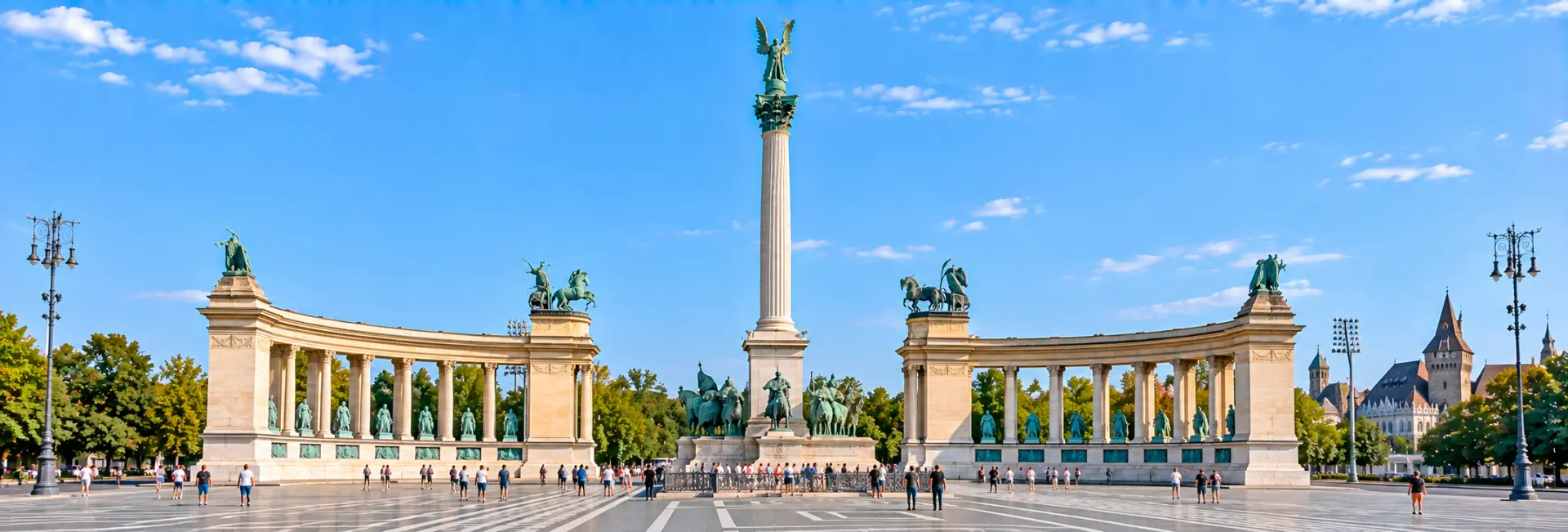
At its center stands the Millennium Monument, a towering column ringed by bronze statues of the tribal chieftains who founded the Hungarian nation and flanked by two sweeping colonnades honoring the country's most significant kings and leaders. Framed by the Museum of Fine Arts on one side and the Palace of Art on the other, the square functions as both a national memorial and a working civic space, hosting everything from state ceremonies to casual weekend strolls.
History
Origins of the Square
Before the square took its present form, the site held an ornamental fountain designed by architect Miklós Ybl, later relocated to Széchenyi Hill. In the 1890s, as Hungary prepared to mark the 1,000th anniversary of the Magyar conquest of the Carpathian Basin in 896, the government commissioned a much grander monument for the site, part of a wider wave of construction that also produced Andrássy Avenue's final form and continental Europe's first underground railway line.
Building the Millennium Monument
Architect Albert Schickedanz designed the monument in 1894, with sculptor György Zala responsible for its statues. Work was largely finished by 1900, though sculptures continued to be added for years afterward, and the ensemble was not formally completed until 1929. The square only received its current name, Heroes' Square, in 1932. Space was originally left among the colonnade statues for members of the ruling Habsburg dynasty, but these figures were removed after the First World War and the fall of the monarchy, and replaced with statues of Hungarian statesmen instead.
A Stage for Modern History
Since its completion, Heroes' Square has repeatedly become the backdrop for pivotal moments in Hungarian history. During the revolutionary upheaval of 1918–19, crowds tore down the statue of Emperor Franz Joseph from the monument, and the square was briefly refitted with communist symbols under the short-lived Hungarian Soviet Republic. Under later communist rule it was regularly used for state parades and political rallies. Its most widely remembered modern moment came in June 1989, when roughly a quarter of a million people gathered here for the ceremonial reburial of Imre Nagy, the prime minister executed after the 1956 uprising, an event that helped mark Hungary's turn toward democracy.
The square underwent a thorough restoration in 2001 that returned much of the stonework and statuary to its original appearance, following an earlier restoration of the column and central statuary in the mid-1990s. Today it is protected as a national memorial site and continues to host official commemorations, concerts, and cultural events throughout the year.
Architecture & Design
The Millennium Monument forms a broad, curved composition roughly 85 meters wide, built largely from stone and bronze in a Neoclassical style suited to its role as a national pantheon. A Corinthian column rises 36 meters from the center of the square, crowned by a bronze figure of the Archangel Gabriel holding the Holy Crown of Hungary in one hand and the apostolic double cross in the other, an image intended to symbolize both Hungarian statehood and its adoption of Christianity.
The Seven Chieftains
At the base of the column, an equestrian group depicts Árpád and the six other Magyar tribal chieftains who are traditionally credited with leading the conquest of the Carpathian Basin in the late 9th century. Their dynamic poses and detailed armor make them the most photographed element of the monument.
The Colonnades
Behind the column, two semicircular colonnades sweep outward, each lined with statues of Hungarian kings and national leaders, fourteen figures in total, running chronologically from Saint Stephen, Hungary's first Christian king, to 19th-century statesman Lajos Kossuth. Each statue stands above a relief panel illustrating a scene from that figure's life, and the colonnades are capped at each end by allegorical bronze chariot groups representing War, Peace, Work and Welfare, and Knowledge and Glory.
The left-hand colonnade traces Hungary's medieval royal line, beginning with Saint Stephen and continuing through Ladislaus I, Coloman, Andrew II, Béla IV, Charles I, and Louis I. The right-hand colonnade turns to later warrior-princes and reformers who resisted foreign rule, including John Hunyadi, Matthias Corvinus, István Bocskai, Gábor Bethlen, Imre Thököly, Ferenc II Rákóczi, and finally Lajos Kossuth. Several of the original figures, including a number of Habsburg emperors placed here at the monument's completion, were removed and replaced after Hungary broke from the Habsburg monarchy following the First World War.
Recognition & Status
Heroes' Square forms part of the UNESCO World Heritage Site inscribed in 1987 covering Budapest's Banks of the Danube, the Buda Castle Quarter, and Andrássy Avenue, with the square and avenue added to the listing as an extension in 2002. The nearby Hősök tere metro station, opened in 1896 as part of the city's original M1 line, is recognized as one of the oldest underground railway lines in continental Europe and is protected under the same designation.
In front of the monument lies the Memorial Stone of Heroes, a low stone slab surrounded by a chain barrier, dedicated to soldiers who died in Hungary's wars. It is frequently mistaken for a tomb of the unknown soldier, and an honor guard is sometimes posted here during national commemorations.
Beyond its heritage listing, the square carries symbolic weight in Hungarian civic life that outlasts any single political era. It has been reshaped by nearly every regime since its construction, from the removal of Habsburg figures after the First World War to the substitution of politically favored statues under communist rule, yet each version of the square has kept the same basic function as a national memorial where the country stages its most significant public commemorations.
What to See There
- The Millennium Monument's central column, topped by the Archangel Gabriel holding the Holy Crown of Hungary
- The equestrian statues of the Seven Chieftains of the Magyars at the column's base
- The two colonnades of fourteen statues, spanning kings from Saint Stephen to reform-era leader Lajos Kossuth
- The allegorical chariot sculptures representing War, Peace, Work and Welfare, and Knowledge and Glory at the ends of the colonnades
- The Memorial Stone of Heroes, a war memorial often mistaken for a tomb of the unknown soldier
- The Museum of Fine Arts and the Palace of Art (Műcsarnok), the two grand exhibition buildings flanking the square
Ways to Experience It
Most visitors simply walk the square freely, since it is an open public space with no entry fee and no fixed opening hours, taking in the monument's scale and detail at their own pace before continuing into City Park behind it. Guided walking tours along Andrássy Avenue commonly end or begin here, using the square to introduce Hungary's national history before continuing toward the Danube or into the park.
The Museum of Fine Arts and the Palace of Art, standing on either side of the square, both charge separate admission and can be combined with a visit to the square itself, making it easy to turn a quick photo stop into a half-day of sightseeing. City Park directly behind the square holds Vajdahunyad Castle, the Széchenyi Thermal Bath, and the Budapest Zoo, all reachable on foot within a few minutes.
The square also functions as a public gathering space and occasional concert venue, and it hosts national commemorations on holidays such as March 15th and August 20th, when an honor guard and official ceremony are sometimes held beside the Memorial Stone of Heroes. Visitors who happen to be in Budapest around these dates can see the square used much as it has been for over a century, as a stage for public memory as well as a monument.
Best Time to Visit
Heroes' Square is open around the clock and free to enter, so timing mainly comes down to crowds and light. Early morning offers the emptiest square and the softest light for photographing the monument, while sunset casts a warm glow across the colonnades that many visitors consider the most striking time of day.
The square is busiest in the middle of the day during the summer high season, when tour groups arrive in large numbers, and around national holidays such as August 20th and March 15th, when official commemorations are held here. Evenings are generally quieter and pleasantly cool, and the monument is illuminated after dark.
Visitor Tips
- Take the M1 metro line, Continental Europe's oldest underground railway, directly to the Hősök tere station beneath the square
- Set aside time to walk into City Park afterward, since Vajdahunyad Castle and the Széchenyi Thermal Bath are both a short walk from the square
- Visit the Museum of Fine Arts or the Palace of Art if the collections interest you, since both require a separate ticket from the square itself
- Bring water and sun protection in summer, as the square is almost entirely open with little shade
- Be respectful around the Memorial Stone of Heroes, particularly if an honor guard is present during a national commemoration
- Pair the visit with a walk down Andrássy Avenue, since many guided tours use the square as a natural starting or ending point for exploring the wider UNESCO-listed avenue
FAQs about visiting Heroes' Square
What is Heroes' Square famous for? +
It is famous for the Millennium Monument, a column topped by the Archangel Gabriel and surrounded by statues of the Seven Chieftains of the Magyars and fourteen Hungarian kings and national leaders, built to mark 1,000 years of Hungarian statehood.
Is Heroes' Square free to visit? +
Yes, the square itself is free and open at all times; only the Museum of Fine Arts and the Palace of Art on either side charge separate admission.
How do I get to Heroes' Square? +
The easiest route is the M1 metro line to the Hősök tere station, which sits directly beneath the square and is itself part of continental Europe's oldest underground railway.
How much time should I spend at Heroes' Square? +
Most visitors spend 20 to 40 minutes taking in the monument and statues, though the square pairs naturally with a longer visit to City Park or one of the flanking museums.
Is Heroes' Square part of a UNESCO World Heritage Site? +
Yes, it is included in the UNESCO listing covering Budapest's Banks of the Danube, Buda Castle Quarter, and Andrássy Avenue, added as an extension to the site in 2002.
What is the stone slab in front of the monument? +
It is the Memorial Stone of Heroes, a war memorial dedicated to fallen soldiers, often mistaken for a tomb of the unknown soldier.
What else is nearby Heroes' Square? +
City Park lies directly behind the square, home to Vajdahunyad Castle, the Széchenyi Thermal Bath, and the Budapest Zoo, all within a short walk.