Table of Contents
Overview
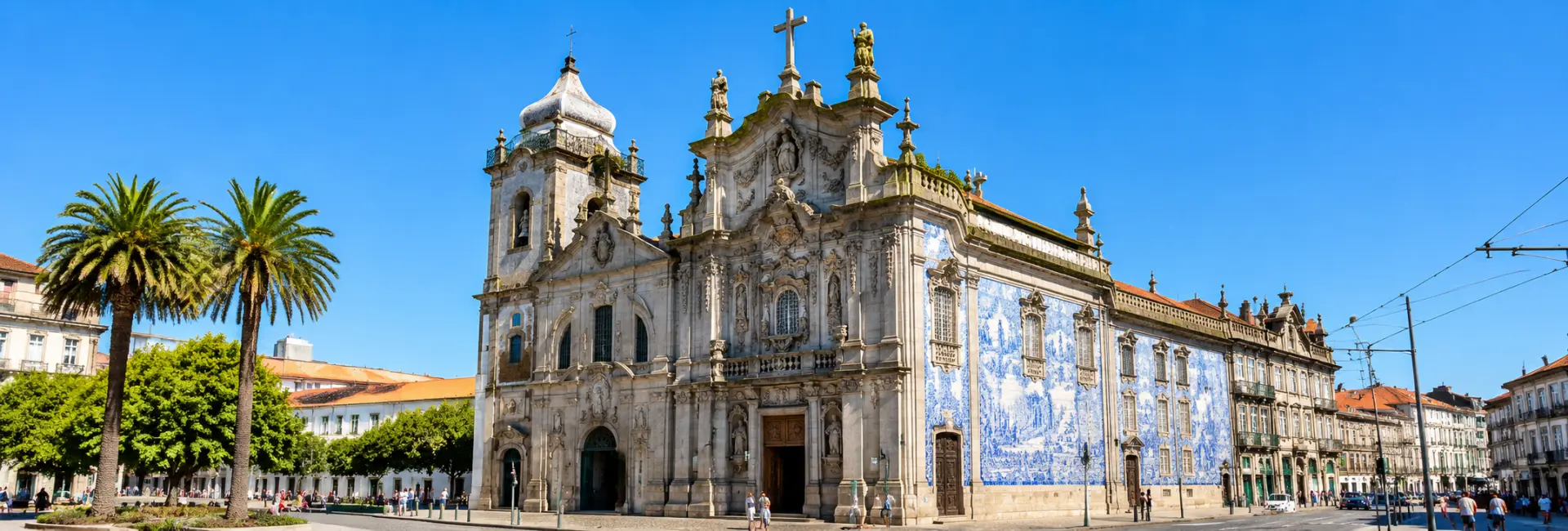
Carmo Church sits at the top of Rua do Carmo in central Porto, and it rarely goes unnoticed. From the street, it looks like one enormous building, but it is actually two separate churches standing shoulder to shoulder, with a curious sliver of a house squeezed between them. What stops most visitors mid-stride, though, is the side wall: a vast panel of blue-and-white ceramic tiles that ranks among the most photographed surfaces in the city.
Built in the late 1700s for a lay Carmelite brotherhood, the church combines a restrained granite exterior with a richly gilded interior, and it remains an active place of worship as well as a stop on nearly every walking tour of Porto's historic core.
Its location only adds to the appeal: the church stands on Praça de Gomes Teixeira, one of the busiest crossroads in Porto's Baixa district, within easy reach of the University of Porto's former rectory building, Clérigos Tower, and the café culture that surrounds them. For many visitors it is a five-minute stop that turns into half an hour once the tile wall and the hidden house between the two churches come into view.
History
Origins and Funding
Carmo Church, formally the Church of the Venerable Third Order of Our Lady of Mount Carmel, was raised for the Third Order of Our Lady of Mount Carmel, a lay religious brotherhood affiliated with the Carmelites but distinct from the monastic order next door. Its construction was largely underwritten by Joaquina Felizarda Guedes da Maia, a local benefactor who wanted to encourage devotion to Our Lady of Mount Carmel among the people of Porto.
Construction
Work ran from 1756 to 1768 under the direction of architect José de Figueiredo Seixas, who trained under Nicolau Nasoni, the Italian architect whose Baroque style shaped much of 18th-century Porto. The new church was deliberately built right up against the older Carmelitas convent church next door, which had already stood on the site since the 1600s as part of an enclosed convent for Carmelite friars. A narrow structure was inserted between the two buildings so that the cloistered religious community connected to the older convent and the members of the new Third Order brotherhood would have no direct physical contact, a separation taken seriously enough to shape the final footprint of both buildings.
Later Recognition
Carmo Church and its neighbour, the Church of the Carmelites, were jointly classified as a Portuguese National Monument on 3 May 2013, recognising them as a single, tightly linked architectural ensemble rather than two independent buildings.
Architecture & Design
Exterior
The main façade faces Praça de Gomes Teixeira and is built in late Baroque and Rococo style, with a rectangular stone portal flanked by carved statues of the prophets Elijah and Elisha, both figures central to Carmelite tradition and both sculpted in Italy before being shipped to Porto. Compared to the tile-covered flank around the corner, this front elevation is comparatively sober, relying on carved stonework rather than colour for its effect.
Interior
Inside, a single nave is lined with seven gilded altarpieces carved by the sculptor Francisco Pereira Campanha, combining Baroque exuberance with the lighter, more curved Rococo forms popular in the mid-1700s. Gilded woodwork, a decorated ceiling, and a scattering of devotional oil paintings complete an interior that feels considerably richer than the granite exterior suggests.
The layout is simple by design: a single, unbroken nave rather than a divided basilica plan, which keeps the gilded altarpieces and ceiling decoration as the clear visual focus for anyone walking in from the plain stone portal outside. That contrast between a restrained shell and an ornate interior is typical of Third Order churches built for lay brotherhoods across northern Portugal in this period.
Cultural & Religious Significance
Carmo Church remains tied to the Carmelite devotion that shaped its founding, and the statues of Elijah and Elisha on its façade are a direct nod to the order's traditional roots on Mount Carmel. Alongside its religious role, the building has become a civic symbol of Porto itself: its tiled wall appears on postcards, guidebook covers, and social media feeds far beyond Portugal, making it one of the clearest visual shorthand images for the city's historic centre.
The church sits within the area of Porto's historic centre inscribed as a UNESCO World Heritage Site in 1996, reinforcing its place among the buildings that define the city's protected old town. Its joint National Monument classification with the neighbouring Carmelitas church, granted in 2013, formally recognises the pair as a single heritage ensemble rather than two unrelated buildings that happen to sit side by side.
Ways to Experience It
Most visitors start on the far side of Rua do Carmo, where there's enough distance to take in the full tile mural in one view, before crossing to see the carved main portal on Praça de Gomes Teixeira. A basic visit to the church interior is free of charge.
- Standard visit: the nave, altars, and main façade, at no cost
- Paid touristic circuit: typically includes the Casa Escondida, catacombs beneath the church, and connecting halls
- Guided walking tours: many Porto old-town tours pause here alongside Clérigos Tower and Livraria Lello
- Historic Tram 22: stops nearby at "Carmo," linking the church to other heritage sites on its route
Because opening hours, ticket prices, and what's included in the paid circuit can change, it's worth checking current details with the church or a local visitor centre on the day of your visit. Many visitors combine the stop with the neighbouring Carmelitas church, since both sit on the same small square and are easy to see back to back within the same short walk.
Best Time to Visit
Early morning or late afternoon light works best for photographing the tile mural, since the glazed surface reflects strong midday sun and can wash out detail in photos. An overcast day, somewhat counterintuitively, often produces the richest, most even colour on the tiles.
Visiting on a weekday morning, shortly after opening, tends to mean fewer tour groups clustered around the façade and inside the narrow stairways leading to the upper sections of the paid circuit. Weekends and Portuguese public holidays draw noticeably larger crowds, given the church's central location between Clérigos Tower and Praça de Gomes Teixeira.
Seasonally, spring and autumn offer a comfortable balance of mild weather and manageable crowd levels compared with the peak of summer, when Porto's historic centre is at its busiest and the narrow pavement in front of the tile wall can feel crowded with people trying to get the same photograph.
Visitor Tips
- Bring small cash: some elements of the paid visitor circuit have historically been cash-only
- Cross the street for photos: standing directly beneath the tile wall makes it impossible to capture in one frame
- Expect narrow stairs: the route to the Casa Escondida and catacombs involves tight, low passages not well suited to mobility aids or larger bags
- Respect service times: as an active church, sightseeing pauses during Mass and other services
- Combine with a short stop: the interior and tile wall can be appreciated in under an hour, making it easy to fit alongside other Baixa-district sights
Nearby Attractions
Carmo Church sits in one of the most walkable pockets of central Porto, within a few minutes of several other major landmarks.
- Clérigos Tower and Church, a short walk away and one of the city's best viewpoints
- Livraria Lello, the ornate bookshop just around the corner
- Praça de Gomes Teixeira and its Fonte dos Leões fountain, directly in front of the church
- Cordoaria Garden, a green space bordering the former University of Porto rectory building
- Aliados Avenue and metro station, a short walk toward the city's civic centre
FAQs about visiting Carmo Church
What is Carmo Church known for? +
It's best known for the enormous blue-and-white azulejo tile mural covering its side wall, added in 1912, and for the tiny "hidden house" squeezed between it and the neighbouring Carmelitas church.
Is Carmo Church free to visit? +
Entry to the main church interior is free. Seeing extras such as the Casa Escondida and the catacombs usually requires a separate paid ticket for the touristic circuit.
How much time do I need to visit? +
Most visitors spend 20 to 45 minutes here, longer if they add the paid circuit through the hidden house and catacombs.
Are Carmo Church and Carmelitas Church the same building? +
No. They're two separate churches that appear to form one façade from the outside, divided internally by the narrow Casa Escondida, and they were jointly listed as a National Monument in 2013.
What's the best time of day to photograph the tiles? +
Early morning or late afternoon light is gentlest on the glazed tiles; harsh midday sun tends to create glare and hard shadows across the mural.
Is Carmo Church accessible for visitors with mobility needs? +
The main nave is reasonably accessible, but the passages leading to the Casa Escondida and catacombs on the paid circuit involve narrow stairways that aren't well suited to wheelchairs or limited mobility.
What else is nearby worth visiting? +
Clérigos Tower, Livraria Lello, and Praça de Gomes Teixeira are all within a few minutes' walk, making this an easy stop to combine with a broader visit to Porto's historic centre.