Table of Contents
Overview
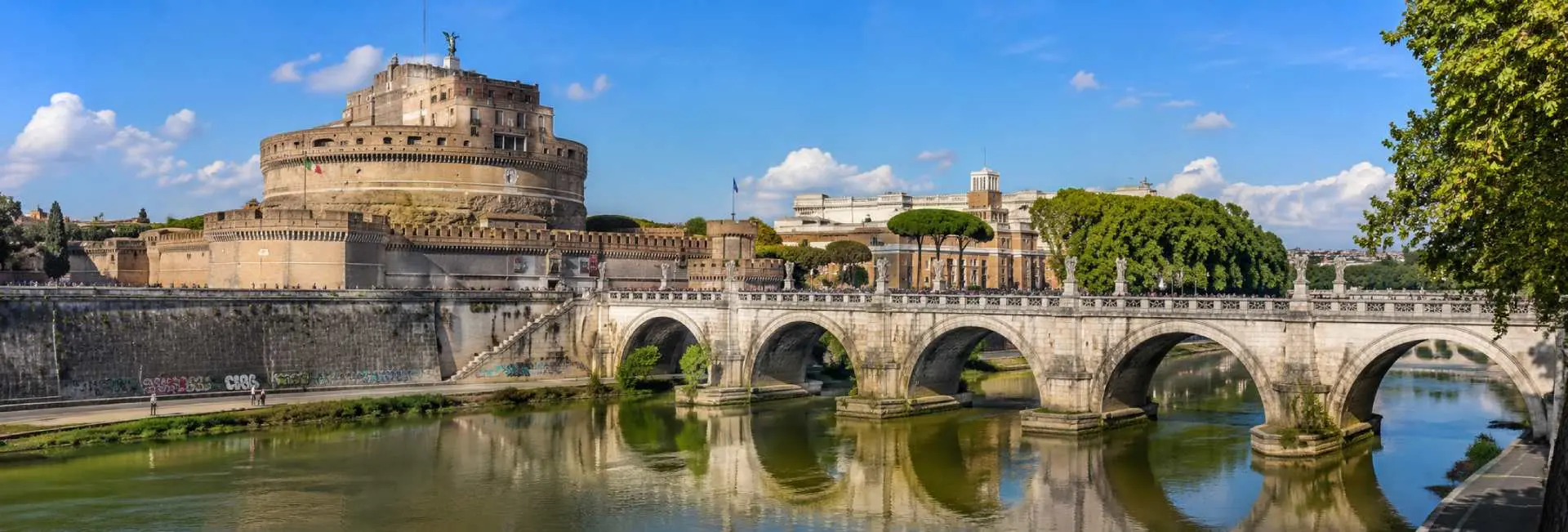
Castel Sant'Angelo is a massive cylindrical fortress on the banks of the Tiber River in Rome, originally built as a mausoleum for the Roman Emperor Hadrian. Over nearly two thousand years it has served as an imperial tomb, a military stronghold, a papal residence, a prison, and today a museum that traces the entire arc of that history in one building.
Few monuments in Rome pack in so many identities. Visitors climb the same spiral ramp that once carried imperial funeral urns, pass through frescoed Renaissance papal apartments, and emerge on a rooftop terrace with one of the best 360-degree views in the city.
History
Origins as Hadrian's Mausoleum
Emperor Hadrian commissioned the building around 135 AD as a monumental tomb for himself and his family, and it was completed in 139 AD by his successor, Antoninus Pius, a year after Hadrian's death. The structure held the remains of Hadrian and several emperors who followed, including Marcus Aurelius, Septimius Severus, and Caracalla, the last emperor interred there in 217 AD.
From Tomb to Fortress
By the early 5th century the mausoleum had lost its original purpose. In 401 AD, Emperor Honorius folded the structure into Rome's Aurelian Walls, converting it into a military fortress and destroying much of its original funerary decoration in the process. It changed hands repeatedly through the medieval period, at times controlled by powerful Roman families such as the Orsini.
A Refuge for Popes
The building's current name traces to 590 AD, when Pope Gregory I is said to have seen a vision of the Archangel Michael sheathing his sword above the fortress, taken as a sign that a devastating plague was ending. From the 13th and 14th centuries onward, popes fortified and expanded the site, and Pope Nicholas III added the Passetto di Borgo, a fortified elevated corridor linking the castle directly to the Vatican for use as an emergency escape route during sieges.
Prison and Museum
Alongside its role as a papal stronghold, the castle also functioned as a prison for centuries, holding notable figures such as the sculptor Benvenuto Cellini. Its military role ended in 1901, and it has operated as a public museum ever since.
Architecture & Design
The core of Castel Sant'Angelo is a massive cylindrical drum built on a square base, originally faced in travertine and topped with an earth mound planted with trees and crowned by a bronze statue group, in the style of Roman imperial mausolea. As the building was converted into a fortress over the centuries, defensive bastions, ramparts, and thick perimeter walls were added around the original Roman core.
Inside, an ancient spiral ramp carved into the masonry still leads visitors upward through the monument, much as it once carried funeral processions. Higher up, Renaissance-era popes added richly decorated apartments, including frescoed reception rooms, in sharp contrast to the austere Roman stonework below.
Key Areas
- The Ancient Ramp and Funerary Chambers – The original spiral passage and burial chamber from the building's days as Hadrian's mausoleum.
- The Courtyards – Renaissance-era open courtyards, including areas once used for storing ammunition and supplies.
- The Papal Apartments – Lavishly decorated rooms added by popes for use as a residence and refuge, including the Sala Paolina.
- The Prison Cells – Lower-level rooms once used to hold prisoners.
- The Angel Terrace – The open rooftop platform at the very top of the fortress, beneath the bronze statue of the Archangel Michael.
Notable Landmarks & Features
The Angel Statue
The bronze statue of the Archangel Michael sheathing his sword, which gives the castle its name, currently standing is the work of Flemish sculptor Peter Anton von Verschaffelt, cast in 1753. It replaced earlier versions in wood and marble that were damaged over the centuries, including one destroyed by lightning.
The Sala Paolina
One of the most elaborate rooms in the papal apartments, decorated with frescoes commissioned in the 16th century, showcasing the building's transformation from military fortress to refined papal residence.
The Passetto di Borgo
An 800-meter elevated fortified corridor connecting the Vatican to the castle, historically used by popes to flee to safety during attacks on Rome. It is only accessible on select guided tours.
Cultural Significance & Legends
Castel Sant'Angelo's transformation from pagan imperial tomb to a monument named for a Christian archangel captures a broader shift in Rome's own identity across the centuries. The plague-ending vision attributed to Pope Gregory I turned the fortress into a site of religious significance that endures in its name and iconography to this day.
The castle has also long captured artistic and popular imagination, appearing in works ranging from Puccini's opera Tosca, in which the heroine leaps from its ramparts, to modern thriller fiction set in Rome.
Ways to Experience It
- Self-guided museum visit – Explore the funerary chambers, papal apartments, and terrace at your own pace with an audio guide.
- Guided tours – Led tours that dive deeper into the building's layered history, some including access to the Passetto di Borgo corridor.
- Terrace-focused visits – Timed for sunset, to combine the museum with golden-hour views over the Tiber and St. Peter's dome.
- Combined passes – Tickets bundled with other major Rome sites such as the Vatican Museums and Colosseum.
Best Time to Visit
Early morning, shortly after opening, and late afternoon are the quietest times to visit, with markedly smaller crowds than the midday period between roughly 11 a.m. and 2 p.m., when tour groups tend to arrive. Weekdays are generally calmer than weekends.
For photography and atmosphere, the rooftop terrace is especially striking about an hour before sunset, when the Tiber and the dome of St. Peter's Basilica are bathed in golden light.
Visitor Tips
- Book tickets online in advance, particularly during peak season from April to October, since same-day entry slots are limited.
- Plan for 1.5 to 2 hours to see the funerary chambers, papal rooms, and terrace without rushing.
- The site is closed on Mondays as well as January 1, May 1, and December 25.
- Accessibility is partial: an elevator serves some levels, but parts of the historic route have uneven floors and narrow stairways.
- Avoid the first Sunday of the month if crowds bother you, as free-entry days draw long queues.
Nearby Attractions
- Ponte Sant'Angelo – The pedestrian bridge in front of the castle, lined with Bernini-designed angel statues.
- St. Peter's Basilica and Vatican City – About a 10-minute walk away, historically linked to the castle by the Passetto di Borgo.
- Vatican Museums – A short walk from the castle, often paired on the same day.
- Piazza Navona – A lively baroque square a short walk across the river, good for a meal after visiting.
Common Questions about Castel Sant'Angelo
What was Castel Sant'Angelo originally built for? +
It was built as a mausoleum for the Roman Emperor Hadrian and his family, completed in 139 AD, before later becoming a military fortress and papal stronghold.
Where does the name Castel Sant'Angelo come from? +
It comes from a vision of the Archangel Michael reportedly seen by Pope Gregory I in 590 AD above the fortress, marking the end of a plague in Rome.
How much time should I plan for a visit? +
Most visitors spend around 1.5 to 2 hours exploring the funerary chambers, papal apartments, and rooftop terrace.
Do I need to book tickets in advance? +
Booking ahead is strongly recommended, especially from April to October, since same-day entry slots are limited and queues can be long.
Is Castel Sant'Angelo accessible for visitors with mobility needs? +
Access is partial - an elevator serves some levels, but several historic areas have uneven floors, narrow passageways, and stairs typical of a 2nd-century monument.
What is the best time of day to visit? +
Early morning or late afternoon are quietest, and the rooftop terrace is especially beautiful about an hour before sunset.
What can I see from the rooftop terrace? +
A 360-degree view of Rome, including St. Peter's Basilica, the Pantheon, and the Tiber, beneath the bronze statue of the Archangel Michael.
What is the Passetto di Borgo? +
An 800-meter elevated corridor connecting the castle to the Vatican, historically used by popes as an escape route, accessible today only on select guided tours.
Is Castel Sant'Angelo suitable for kids? +
Yes, most families find it engaging, though the open terrace and stairways call for close supervision of young children.
What else is nearby that I can combine with a visit? +
St. Peter's Basilica, the Vatican Museums, and Ponte Sant'Angelo with its Bernini angel statues are all within a short walk.