Table of Contents
Overview
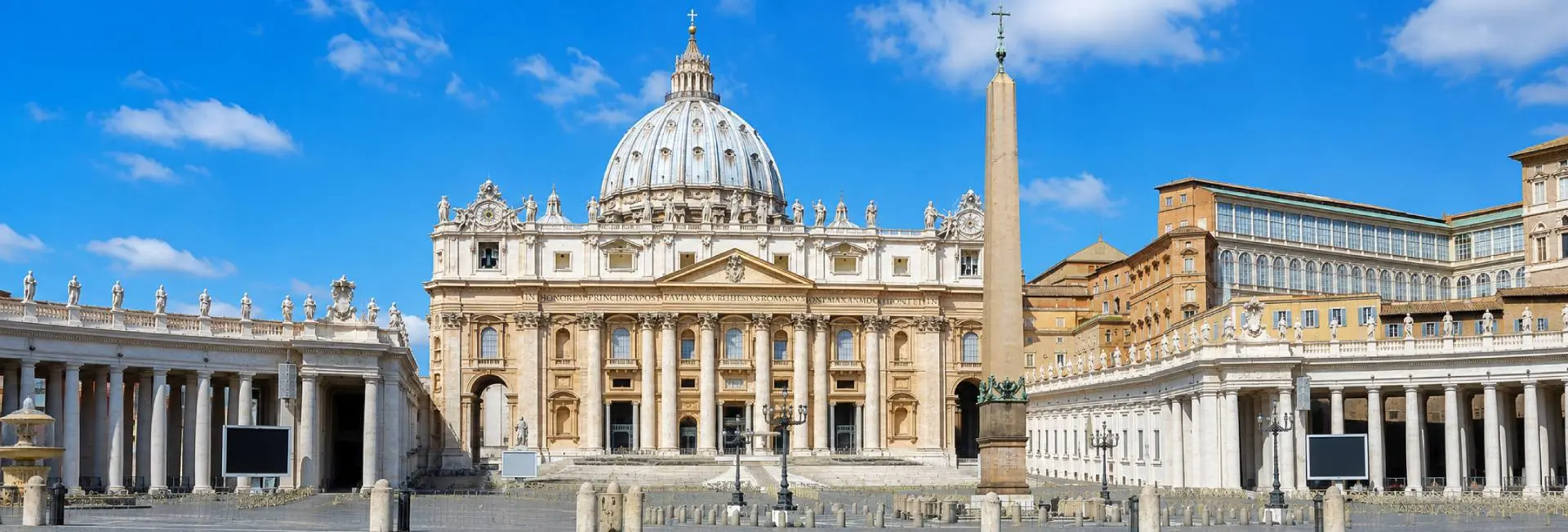
St. Peter's Basilica is the largest and most important church in the Catholic world, standing at the heart of Vatican City within Rome. Built over the traditional burial site of Saint Peter, the leader of Jesus's apostles and the first pope, it has served for centuries as the spiritual center of Catholicism and the setting for papal ceremonies, canonizations, and the Christmas and Easter Masses broadcast to millions of viewers worldwide.
Beyond its religious role, the basilica is one of the defining works of Renaissance and Baroque architecture, shaped by a succession of history's greatest artists including Donato Bramante, Michelangelo, and Gian Lorenzo Bernini. Its dome dominates the Roman skyline, and its interior houses masterpieces such as Michelangelo's Pietà, making it as much a destination for art and architecture lovers as for the faithful.
Each year, millions of visitors pass through its doors, drawn not only by devotion but by the sheer scale of the building itself - a structure so vast that its own floor markers show where other famous cathedrals around the world would end if placed inside it.
History
The Original Basilica
The first church on this site was commissioned by the Roman emperor Constantine in the early 4th century, built directly over what was believed to be the burial place of Saint Peter, near the location of his martyrdom. Constantine's basilica took several decades to complete and stood for over a thousand years, becoming one of the most important pilgrimage churches in Christendom before gradually falling into disrepair as its foundations weakened.
Rebuilding Begins
By the 15th century, the aging structure was in such poor condition that Pope Nicholas V first proposed rebuilding it. It was Pope Julius II, however, who committed fully to the project, laying the first stone of an entirely new basilica in 1506 with the ambition of surpassing anything built before it, including the ancient monuments of Rome itself.
A Century of Construction
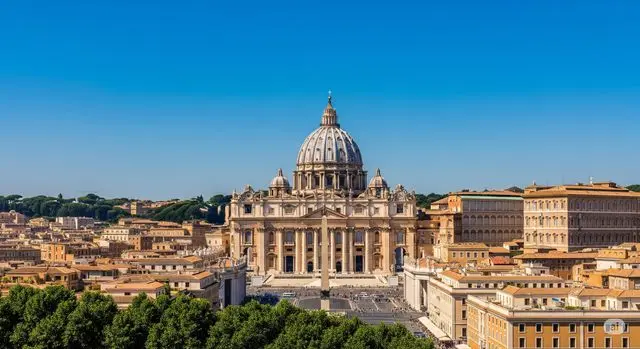
Over the next 120 years, a succession of architects shaped the building, including Donato Bramante, Raphael, Antonio da Sangallo the Younger, and Michelangelo, who took over the project late in life and designed the basilica's iconic dome. Carlo Maderno later extended the nave and designed the facade, while Gian Lorenzo Bernini added the sweeping colonnaded square in front of the church decades after construction had finished. The basilica was formally consecrated in 1626, marking the end of a project that had spanned the working lives of several generations of artists.
A Living Monument
Since its consecration, the basilica has remained in continuous use as the ceremonial center of the Catholic Church, hosting papal elections' public announcements, canonization Masses, and the funerals of popes. Restoration and conservation work has continued for centuries, preserving both its structure and the artworks housed within it.
Recognition & Status
St. Peter's Basilica holds the rank of Papal Major Basilica, one of only four churches in the world with this designation, and it is the largest Christian church by interior area. As part of Vatican City, it has been recognized as a UNESCO World Heritage Site since 1984, a designation that reflects its outstanding cultural, artistic, and religious significance to humanity as a whole, not just to the Catholic faith.
Its scale alone sets it apart: the basilica covers an interior area of over 15,000 square meters, with a dome rising more than 130 meters above the ground, making it one of the tallest and most recognizable domed structures ever built. Dozens of popes are buried within its walls, alongside notable historical and royal figures, reinforcing its role as both a place of worship and a repository of centuries of history.
Architecture & Design
A Renaissance Masterwork
The basilica blends the ideas of several master architects into a single coherent design, executed primarily in the style of the High Renaissance with later Baroque additions. Bramante originally envisioned a centrally planned church in the shape of a Greek cross, an idea later reshaped into the elongated Latin cross layout seen today, better suited to grand processions and large congregations gathering for papal Mass.
The Dome
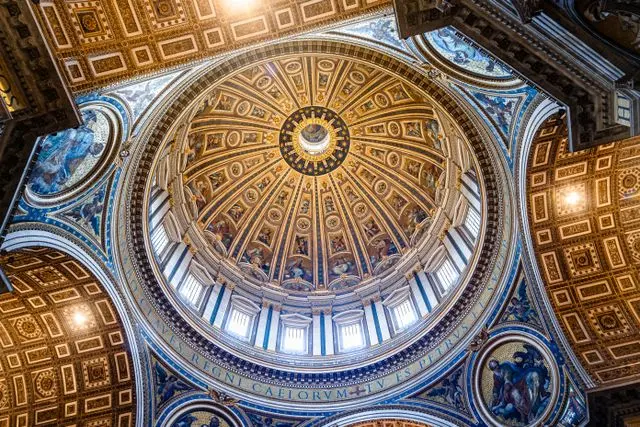
Michelangelo's dome, completed after his death by Giacomo della Porta, remains one of the most celebrated engineering achievements of its era. Rising roughly 136 meters above the ground, it was directly inspired by the dome of Florence Cathedral and by ancient Roman engineering, and it continues to define the Roman skyline more than four centuries after its completion.
The Facade and Piazza
Carlo Maderno's facade, completed in the early 17th century, stretches across the front of the church and is lined with statues of Christ, John the Baptist, and eleven of the apostles. In front of it, Bernini's elliptical piazza is framed by two sweeping colonnades of over 280 travertine columns, arranged in four rows and designed to symbolically embrace visitors as they approach, described by Bernini himself as the welcoming arms of the church.
Interior Scale and Materials
Inside, the basilica showcases an extraordinary range of materials, from richly colored marble sourced across the Mediterranean to gilded bronze and elaborate mosaic work covering the ceilings and domes of side chapels. The scale of every element, from doorways to statues, was deliberately exaggerated to maintain visual proportion within such an immense interior space.
Key Areas
St. Peter's Square
The vast piazza in front of the basilica serves as the gathering point for papal audiences and blessings, capable of holding hundreds of thousands of people during major events. An Egyptian obelisk, originally brought to Rome in antiquity, stands at its center and was relocated to its current position in the late 16th century in a complex engineering feat for its time.
The Nave and Interior
Inside, the basilica's main nave stretches over 200 meters, lined with statues, marble floors, and gilded ceilings. Bronze markers set into the floor show the comparative lengths of other major churches around the world, from Milan Cathedral to St. Paul's in London, illustrating just how vast the space truly is compared to other landmark cathedrals.
The Vatican Grottoes
Beneath the main floor lie the Vatican Grottoes, a lower level containing the tombs of numerous popes across different centuries, along with several historical monuments relocated from the earlier basilica. The grottoes offer a quieter, more intimate contrast to the grandeur of the main church above.
Notable Landmarks & Art
The basilica's interior functions almost as a museum in its own right, filled with sculpture, mosaics, and monumental art assembled over centuries by some of the most celebrated names in art history.
Michelangelo's Pietà depicts the Virgin Mary holding the body of Christ and is displayed near the entrance behind protective glass, one of the artist's most emotionally resonant works and the only piece he ever signed.
Bernini's bronze Baldachin rises nearly 30 meters over the papal altar, its twisted columns and gilded detailing marking the ceremonial heart of the basilica directly above the traditional site of Saint Peter's tomb.
The bronze Cathedra of St. Peter, also by Bernini, enshrines an ancient chair traditionally associated with the apostle, framed by soaring bronze rays and a stained-glass depiction of the Holy Spirit.
The bronze statue of St. Peter, attributed to Arnolfo di Cambio, has had its right foot worn smooth by centuries of pilgrims touching or kissing it as a gesture of devotion.
Throughout the basilica, many of what appear to be paintings are in fact elaborate mosaic reproductions, a technique used to replace fragile original canvases with more durable copies able to withstand the humidity of the church interior over centuries.
Climbing the Dome
Visitors can climb to the top of Michelangelo's dome for one of the best panoramic views of Rome, taking in St. Peter's Square, the Vatican Gardens, and the rooftops of the city stretching toward the horizon. The ascent involves several hundred steps in total, part of which winds through the narrow, curved inner space between the dome's two shells, a design detail few visitors expect before making the climb.
An elevator can shorten part of the journey by covering the initial stretch, though a significant number of stairs remain unavoidable, particularly in the steep and narrow final section near the lantern at the very top. The climb is not recommended for visitors with mobility issues, heart conditions, or claustrophobia, but for those able to make it, the view is widely considered one of the best in Rome.
The Vatican Necropolis & Grottoes
Deep beneath the basilica lies the Vatican Necropolis, an ancient Roman burial ground predating the original Constantinian basilica, containing the area traditionally identified as the tomb of Saint Peter himself. Access to the necropolis is limited and requires a separate, advance reservation known as the Scavi Tour, conducted in small groups due to the confined underground space.
The necropolis offers a markedly different experience from the rest of the basilica: a quiet, archaeological journey through pagan and early Christian tombs, layered directly beneath centuries of later construction. It is considered one of the most historically significant excavation sites in Rome, though it remains far less visited than the basilica above it simply because of the booking requirements involved.
Best Time to Visit
Early morning is generally the quietest time to visit, before tour groups arrive and lines lengthen at the security checkpoint. Late afternoon can also be less crowded, particularly outside of peak tourist season, offering softer light for photography inside the basilica.
Spring and autumn tend to offer milder weather alongside comparatively lighter crowds than the height of summer, making them popular seasons for visitors trying to balance comfort with fewer lines. Summer months bring the highest volume of visitors and the longest waits, especially around midday, when both heat and crowd size peak together.
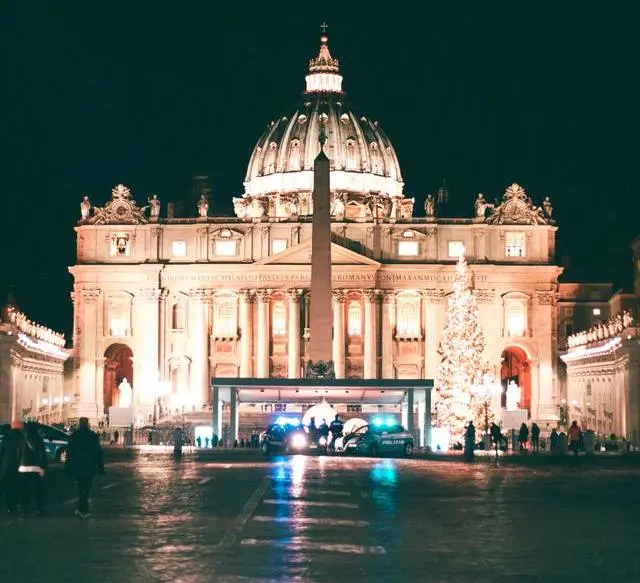
Major religious holidays such as Easter and Christmas draw enormous crowds and often involve special access arrangements or temporary closures around papal ceremonies. Wednesdays typically see St. Peter's Square filled for the Pope's general audience, which can affect basilica access and surrounding foot traffic for much of the morning.
Visitor Tips
Entry to the basilica itself is free, though a strict dress code and airport-style security screening apply to every visitor regardless of nationality or religion. Shoulders and knees should be covered, and bags are checked before entry, so planning accordingly can save significant time in line.
Dress modestly. Shorts, sleeveless tops, and short skirts are not permitted inside, and visitors who arrive dressed inappropriately are typically turned away at the door rather than allowed to cover up on the spot.
Arrive early or book ahead. Lines for security can stretch well beyond an hour during peak season, and a skip-the-line reservation can meaningfully shorten the wait, especially in summer.
Book dome access separately. The dome climb has its own ticket counter and entrance, distinct from the main basilica queue, and tickets can often be purchased in advance online.
Keep visits respectful. The basilica remains an active place of worship, and quiet, respectful behavior is expected throughout, particularly during Mass or other religious services.
Photography is generally permitted inside the basilica, though flash photography and tripods are typically restricted to protect both the artwork and the experience of other visitors.
Nearby Attractions
St. Peter's Basilica sits within easy reach of several other major Vatican and Roman landmarks, making it easy to combine into a fuller day of sightseeing.
The Vatican Museums and Sistine Chapel are a short walk from the basilica and house one of the world's greatest art collections, culminating in Michelangelo's ceiling frescoes.
Castel Sant'Angelo, a fortress along the Tiber River, was once connected to the Vatican by a secret escape passage used by popes during times of siege.
The Ponte Sant'Angelo bridge, lined with sculpted angels designed in part by Bernini's workshop, leads directly toward the castle and offers scenic views back toward the basilica's dome.
Beyond the river, the historic center of Rome is within walking distance, connecting a Vatican visit easily with the city's other major ancient and Renaissance sites.
FAQs about St. Peter's Basilica
Is St. Peter's Basilica free to visit? +
Yes, entry to the basilica is free of charge, though visitors pass through a security check similar to airport screening before entering.
How long does it take to visit St. Peter's Basilica? +
Most visitors spend around one to two hours inside the basilica itself, with additional time needed for the dome climb, the Vatican Grottoes, or a reserved visit to the underground necropolis.
Do I need to book tickets in advance? +
Basic entry doesn't require a ticket, but lines can be long, so many visitors book a skip-the-line time slot; climbing the dome requires a separate ticket, and visiting the Vatican Necropolis requires an advance reservation made well ahead of your trip.
Is there a dress code? +
Yes, shoulders and knees must be covered for both men and women, sleeveless tops, shorts, and short skirts are not permitted, and hats are generally required to be removed once inside.
Can I climb the dome, and is it difficult? +
Yes, dome access is open to visitors for an additional fee and involves several hundred steps, including a narrow winding staircase near the top, so it isn't recommended for those with mobility issues, heart conditions, or claustrophobia.
Is St. Peter's Basilica accessible for visitors with disabilities? +
The main basilica floor is wheelchair accessible, though the dome climb is not accessible due to its narrow stairways, and alternate arrangements should be checked in advance for other underground areas.
What's the best time of day to avoid crowds? +
Early morning, shortly after opening, tends to be the quietest period, before tour groups and midday crowds build up, with late afternoon as a secondary option outside peak season.
What shouldn't I miss inside? +
Michelangelo's Pietà near the entrance, Bernini's bronze Baldachin over the main altar, the bronze Cathedra of St. Peter, and, for those able to make the climb, the view from the top of the dome are the highlights most visitors prioritize.
What is the Vatican Necropolis, and how is it different from the basilica? +
It's an ancient underground burial ground beneath the basilica, accessible only through a separate advance reservation known as the Scavi Tour, offering a quieter, archaeological look at the site's earliest history.
Does the Pope's Wednesday audience affect a basilica visit? +
It can, since St. Peter's Square is often filled for the event and access routes around it may be busier or temporarily restricted during the morning hours.