Table of Contents
Overview
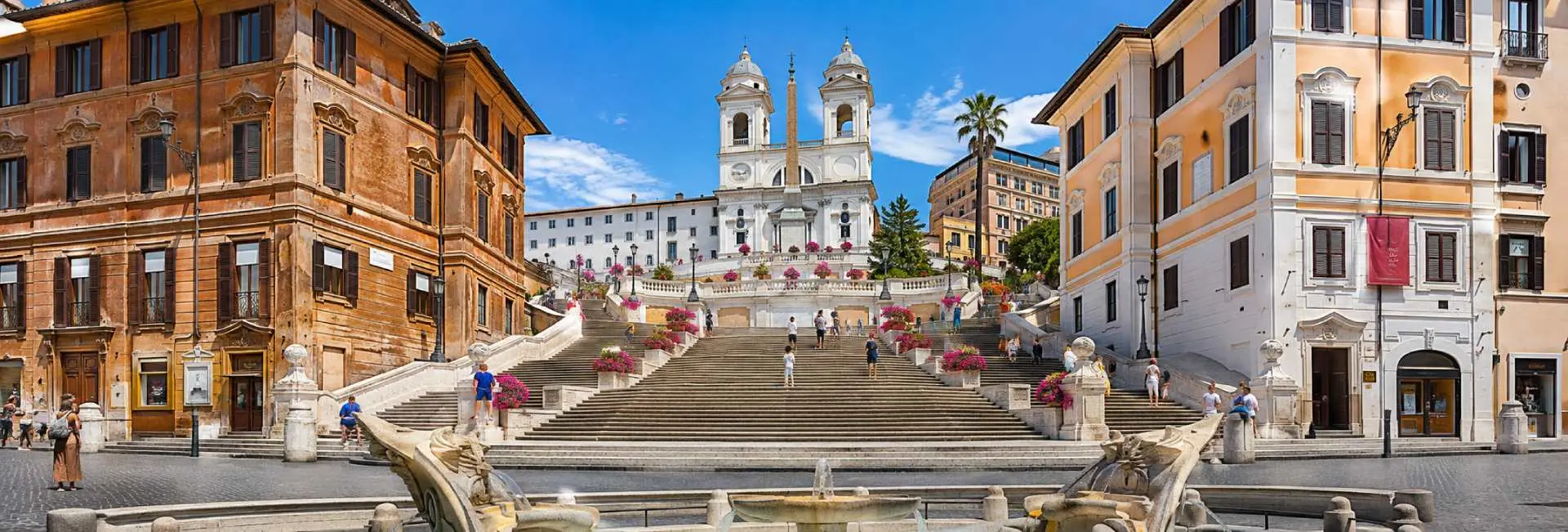
The Spanish Steps, known in Italian as the Scalinata di Trinità dei Monti, form one of Rome's most recognizable public spaces. The monumental staircase climbs from the bustling Piazza di Spagna up to the twin-towered church of Trinità dei Monti, tying together two very different parts of the city in one sweeping baroque gesture.
Built in the 1720s, the steps have long served as a meeting point, a stage for people-watching, and a favorite backdrop for photographers and filmmakers. Today they remain a centerpiece of any first visit to Rome, even though sitting on them is now officially prohibited.
History
Origins and the Push for a Grand Staircase
For centuries, the steep slope between the French church of Trinità dei Monti and the piazza below was a rough dirt path, difficult to climb and prone to erosion. Various proposals for a formal staircase circulated through the 1600s, but disputes between French and Spanish interests, who each controlled land at either end, repeatedly stalled progress.
Funding and Construction
Momentum finally came from an unexpected source: the French diplomat Étienne Gueffier left a bequest specifically to fund a stairway connecting the church to the square. Design competitions followed, and the commission ultimately went to architect Francesco de Sanctis, working with input attributed to Alessandro Specchi. Construction ran from 1723 to 1725, resulting in the travertine staircase seen today.
The Name
The stairs take their popular English name from the Piazza di Spagna at their base, itself named for the nearby Spanish Embassy to the Holy See. Locals, however, generally refer to the site by its Italian name, tied to the church at the top rather than the square below.
Architecture & Design
The staircase is built almost entirely from travertine, the same warm limestone used throughout much of historic Rome, and comprises 135 steps arranged in an irregular, asymmetrical pattern of terraces, curves, and landings rather than a single straight run.
This deliberate irregularity was part of de Sanctis's design: the steps widen, narrow, split, and rejoin as they ascend, creating a sense of movement and theatrical rhythm characteristic of Roman baroque architecture. The layout also cleverly manages the site's uneven terrain and difference in elevation between the piazza and the church terrace above.
- 135 travertine steps rising across a series of terraces
- Asymmetrical, curving layout typical of Roman baroque design
- An Egyptian-style obelisk, the Sallustiano obelisk, standing before the church at the top
- Twin bell towers of Trinità dei Monti framing the view from below
Key Areas
Piazza di Spagna
The square at the base of the steps is anchored by the Fontana della Barcaccia, a boat-shaped fountain generally attributed to Pietro Bernini, father of the more famous Gian Lorenzo Bernini. The fountain's low profile was reportedly designed to work with the area's notoriously weak water pressure.
The Staircase Itself
The middle stretch of steps offers wide landings that historically served as informal gathering spots, while the terraced sections provide changing views back over the piazza and the rooftops of central Rome.
Trinità dei Monti
At the top, the French Gothic-influenced church of Trinità dei Monti presides over the staircase with its distinctive twin towers. The terrace in front of the church offers one of the better panoramic views over central Rome, taking in domes and rooftops toward St. Peter's Basilica.
Cultural Significance
Few staircases in the world carry as much cultural weight. The Spanish Steps have appeared in countless films, most famously in the 1953 romance "Roman Holiday," and have long attracted writers, artists, and poets to the surrounding neighborhood.
The English poet John Keats died in a small apartment at the foot of the steps in 1821, a building now preserved as the Keats-Shelley House museum. The area's mix of literary history, fashion, and everyday Roman life has made it a symbolic crossroads of the city for nearly three centuries.
Ways to Experience It
- Walk the full staircase from Piazza di Spagna to the church terrace for changing views along the way
- Visit the Keats-Shelley House at the base to see where the poet spent his final months
- Join a guided walking tour that pairs the steps with nearby landmarks like the Trevi Fountain and Pantheon
- Browse the surrounding streets, including Via dei Condotti, one of Rome's premier fashion shopping strips
- Photograph the view from the top terrace, especially useful for capturing the piazza and skyline together
Best Time to Visit
Late April through May is the most rewarding time to see the steps, when terracotta pots of azaleas are arranged across the terraces, a tradition that dates back decades and draws crowds specifically for the display.
Early morning, shortly after sunrise, is the best window for a quieter visit and clearer photographs, since the piazza and steps fill quickly once shops open and tour groups arrive. Evenings can also be pleasant, with softer light and a more relaxed atmosphere as the day's crowds thin out.
Visitor Tips
- Sitting or lying on the steps is banned; fines range from roughly €250 up to €400 for damaging or dirtying the stone
- Eating and drinking on the steps is also prohibited, in line with the same rules
- The site is free to visit and open at all times, with no ticket required
- The climb involves 135 steps with no elevator, so visitors with mobility concerns should plan accordingly
- The nearest metro stop, Spagna, sits just steps from the piazza and is the easiest way to arrive
- Pickpockets are active in the crowded piazza, so keep valuables secure
Nearby Attractions
- Trevi Fountain – roughly a 10 to 15 minute walk through the surrounding streets
- Via dei Condotti – Rome's high-fashion shopping street, running directly off the piazza
- Villa Borghese – a large park reachable on foot from the top of the steps, home to the Borghese Gallery
- Pantheon – a scenic walk south through Rome's historic center
- Keats-Shelley House – located directly at the base of the steps
FAQs about The Spanish Steps
What are the Spanish Steps and why are they famous? +
They are an 18th-century baroque staircase of 135 travertine steps connecting Piazza di Spagna to the church of Trinità dei Monti, famous for their architecture, film appearances, and springtime azalea displays.
Can you still sit on the Spanish Steps? +
No, sitting or lying on the steps has been banned since 2019, with fines starting around €250 and rising to €400 for damage or littering.
Is it free to visit the Spanish Steps? +
Yes, there is no entrance fee or ticket required at any time.
What is the best time to visit the Spanish Steps? +
Late April through May is ideal for the azalea displays, while early morning offers the quietest visit and best light for photos year-round.
How long does it take to see the Spanish Steps? +
Most visitors spend 20 to 30 minutes walking the steps and the surrounding piazza, longer if combining it with the Keats-Shelley House or nearby shopping.
How do you get to the Spanish Steps? +
The Spagna metro station on Line A sits right at the base of the steps, making it the simplest way to arrive.
Are the Spanish Steps accessible for visitors with mobility issues? +
The staircase has no elevator or ramp, so visitors with mobility limitations may find it challenging; the surrounding piazza and shops remain accessible without climbing.
What is nearby the Spanish Steps worth combining with a visit? +
The Trevi Fountain, Via dei Condotti's shopping district, and Villa Borghese park are all within easy walking distance and pair well with a visit.