Table of Contents
Overview
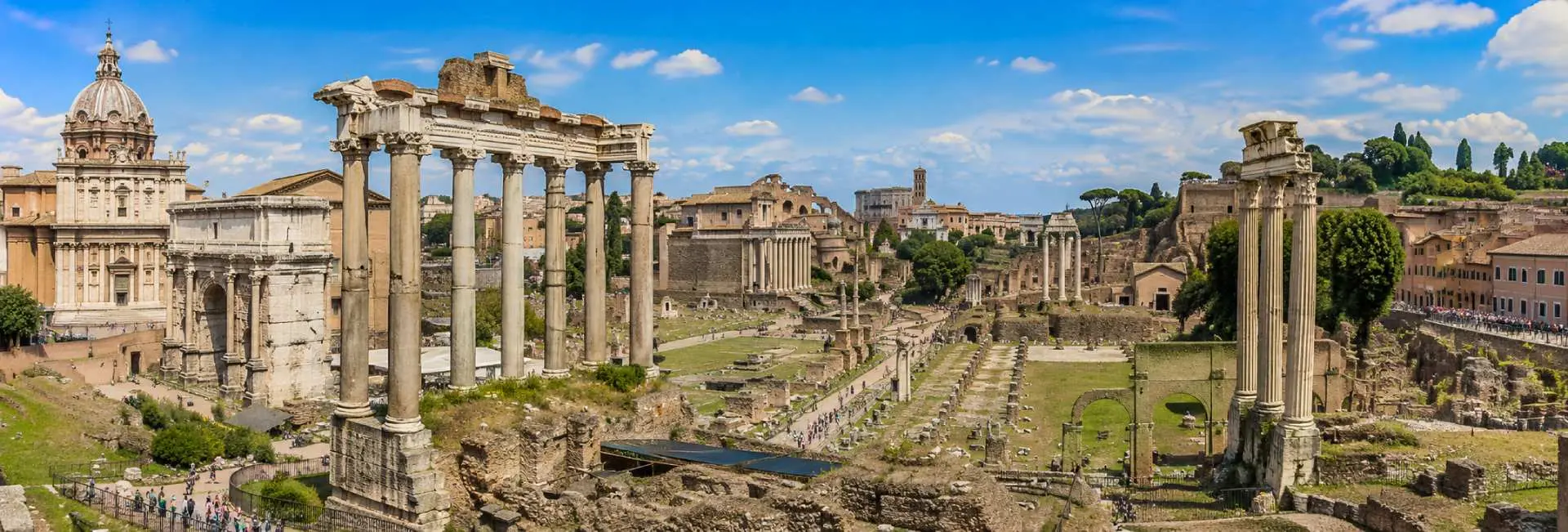
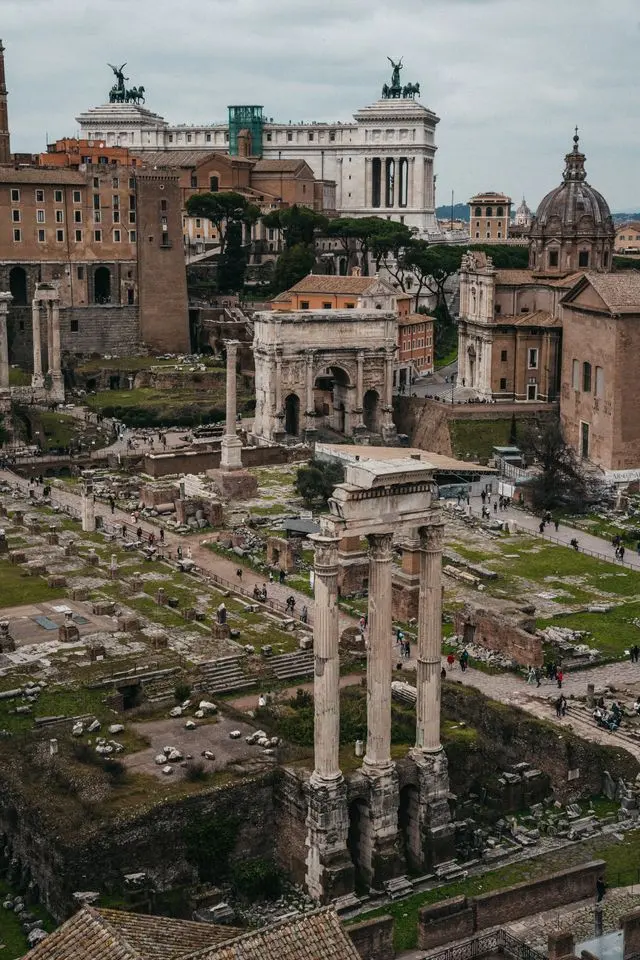
The Roman Forum, or Foro Romano, is the sprawling archaeological park that once served as the political, religious, and commercial core of ancient Rome. Sitting in the valley between the Capitoline and Palatine Hills, it grew over roughly a thousand years from a simple marketplace into a dense cluster of temples, law courts, and monuments that reflected the power of an empire.
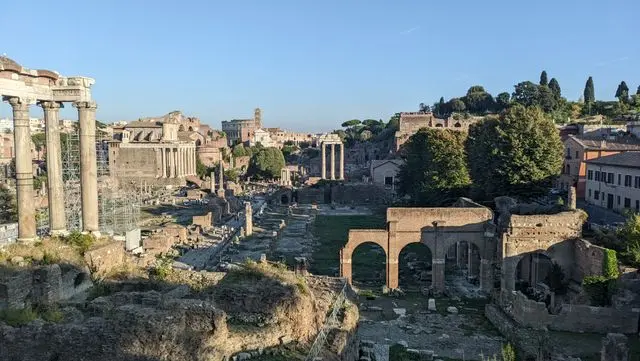
Today the Forum is a field of columns, foundations, and partially reconstructed buildings, but it remains one of the most evocative archaeological sites in the world. Walking its main road, the Via Sacra, visitors pass the same ground where senators debated, emperors were honored, and crowds gathered to hear the news of the day.
History
Origins
The valley that became the Forum started as marshy, low-lying ground between early hilltop settlements. According to Roman legend, the area was the site of a battle between the Romans and the neighboring Sabines in the 8th century BCE, and Roman tradition dates the founding of the city itself to 753 BCE. Engineers drained the marsh with channels that would later evolve into the Cloaca Maxima, one of the world's earliest large-scale sewer systems, making the site usable as a public gathering space.
Republic and Empire
From around the 7th century BCE onward, the drained valley developed into the civic heart of Rome, hosting elections, public speeches, criminal trials, and religious rites. As the Republic grew, permanent structures replaced simple market stalls: the Basilica Aemilia was raised in 179 BCE to house judicial business, and Julius Caesar later added the Basilica Julia and the Curia Julia, the new home of the Senate. Under the emperors that followed, the Forum became increasingly monumental, filling with temples dedicated to deified rulers, triumphal arches celebrating military conquests, and statues honoring military and political figures.
Decline and Rediscovery
A major fire in 283 CE forced substantial rebuilding, and the Forum continued to serve ceremonial functions even as Rome's political center of gravity shifted elsewhere in later centuries. After the fall of the Western Roman Empire, the site gradually fell into disuse, was stripped of stone and marble by later builders, and was eventually buried under centuries of silt and pasture, earning the nickname "Campo Vaccino," or cow field. Systematic excavation began in the 18th century and continued through the 19th and 20th centuries, gradually uncovering the ruins visitors see today.
UNESCO Status & Recognition
The Roman Forum is protected as part of the "Historic Centre of Rome, the Properties of the Holy See in that City Enjoying Extraterritorial Rights and San Paolo Fuori le Mura," a UNESCO World Heritage Site inscribed in 1980. The designation recognizes the Forum alongside the Colosseum, the Palatine Hill, and the historic core of Rome as an irreplaceable record of over two thousand years of urban development, art, and architecture.
- Inscribed as part of Rome's historic center in 1980
- Managed jointly with the adjoining Palatine Hill and Colosseum Archaeological Park
- Recognized for its role in shaping Western concepts of law, governance, and public architecture
Architecture & Design
The Forum was never built to a single master plan; instead, it accumulated structures over centuries as different rulers and magistrates left their mark. The result is a layered mix of building styles and materials, including tufa, travertine, marble, and brick-faced concrete, reflecting the engineering advances of each era.
Temples and Sacred Buildings
Religious structures anchored the site, from the archaic shrines of the earliest Roman kings to grand imperial temples dedicated to deified emperors and their families. Columns and podium fragments are often all that remain, but they still hint at the scale and decoration these buildings once carried.
Civic and Commercial Structures
Basilicas functioned as combined law courts and covered meeting halls, sheltering business and legal activity from Rome's weather. Long colonnaded porticoes lined much of the Forum, providing shade and defining its public spaces, while triumphal arches punctuated the Via Sacra to commemorate military victories.
Notable Landmarks
Arch of Titus
Standing at the eastern entrance near the Colosseum, this triumphal arch was completed under Emperor Domitian to commemorate the Roman victory over Jerusalem. Its carved reliefs, depicting spoils taken from the Temple in Jerusalem, are among the best-preserved narrative sculptures to survive from ancient Rome.
Temple of Saturn
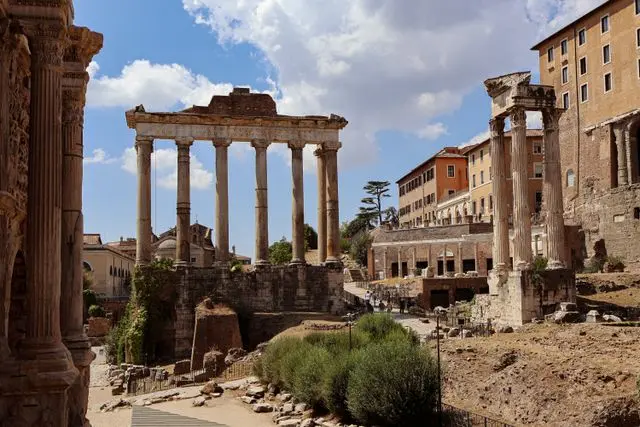
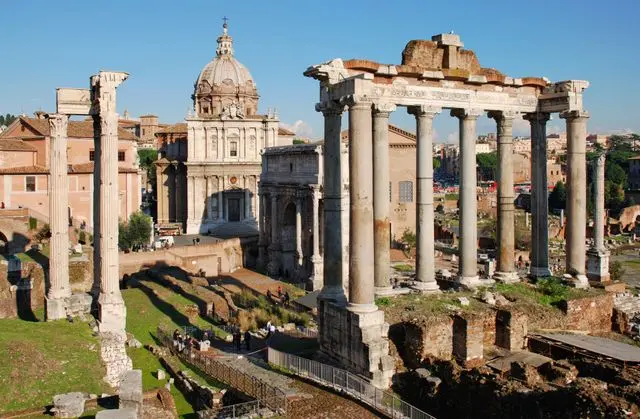
Eight towering columns mark the remains of one of the Forum's oldest and most important temples, originally dedicated in the early 5th century BCE and rebuilt in its current form after a later fire. The temple doubled as the state treasury, storing Rome's public funds and archives.
Curia Julia
This brick building, remarkably intact by Forum standards, was the meeting house of the Roman Senate, begun under Julius Caesar and completed under Augustus. Its plain exterior and surviving interior floor give visitors a rare sense of an actual Roman government building rather than a scattered ruin.
Temple of Vesta and House of the Vestal Virgins
The circular Temple of Vesta housed Rome's sacred, perpetually burning flame, tended by the Vestal Virgins, priestesses bound by vows of chastity. Next door, the ruins of their residence, arranged around a long reflecting pool lined with statues, form one of the most atmospheric corners of the site.
Arch of Septimius Severus
This large marble arch was raised in 203 CE to celebrate the emperor's military campaigns against the Parthian Empire. Its detailed relief panels illustrate battle scenes and remain some of the sharpest surviving carvings in the Forum.
Basilica of Maxentius
Completed in the early 4th century CE, this was the largest building in the Forum and one of the largest in Rome, used as a courthouse and public meeting hall. Its massive surviving vaults later influenced the design of Renaissance architects, including the dome of St. Peter's Basilica.
Cultural Significance
For centuries, the Forum was where Roman public life actually happened, not just a backdrop to it. Major political speeches, including funeral orations for assassinated leaders, were delivered from its speaking platform, the Rostra, while religious processions and festivals moved along the Via Sacra, the Forum's principal road.
The Forum's legacy extends well beyond antiquity. Its basilicas influenced the floor plans of early Christian churches, its legal and political institutions shaped later Western concepts of civic governance, and its ruins became a touchstone for Renaissance and Enlightenment artists and architects studying classical form.
Ways to Experience It
- Self-guided walking route along the Via Sacra, following the main path past the major landmarks
- Audio guides, available for rent near the entrance, providing context that on-site signage often lacks
- Guided small-group or private tours, which can include access to areas not always open to independent visitors
- Combined visits with the adjoining Palatine Hill and the nearby Colosseum, typically covered by the same ticket
- Elevated viewpoints from the Palatine Hill and Capitoline terraces, offering panoramic views over the entire site
Best Time to Visit
Early morning, right at opening, and the last couple of hours before closing tend to be the quietest times, with softer light that's also better for photography. Midday can bring heavy crowds and, in summer, intense heat, since the site has very little shade.
Spring and autumn offer the most comfortable temperatures for the amount of walking involved. Visiting in winter means smaller crowds, though hours are shorter and the site closes on December 25 and January 1.
Visitor Tips
- Wear sturdy, comfortable shoes; the ancient paving is uneven and there's significant walking involved
- Bring water and sun protection, since shade is limited across most of the site
- Allow 2 to 3 hours to see the main landmarks without rushing
- Enter near the Arch of Titus, at the end of Via dei Fori Imperiali, or via the Palatine Hill entrance to avoid the busiest queue
- Check current opening hours, ticket options, and any combined-entry requirements with the Colosseum and Palatine Hill before your visit, as these can change
Nearby Attractions
- The Colosseum, roughly a five-minute walk away and often included on the same ticket
- Palatine Hill, adjoining the Forum and offering the best overview of the site
- Capitoline Hill and Capitoline Museums, overlooking the Forum from the northwest
- Trajan's Market and the Imperial Fora, a short walk along Via dei Fori Imperiali
- The Circus Maximus, a short walk south of the Palatine Hill
FAQs about The Roman Forum
What is the Roman Forum? +
It's the ruined civic center of ancient Rome, a valley of temples, government buildings, and monuments that served as the political, religious, and commercial hub of the city for centuries.
Is the Roman Forum a UNESCO World Heritage Site? +
Yes, it's part of the "Historic Centre of Rome" UNESCO World Heritage Site, inscribed in 1980 along with the Colosseum and the rest of Rome's ancient core.
How much time should I plan for a visit? +
Most visitors spend around 2 to 3 hours seeing the main landmarks, though history enthusiasts with an audio guide or tour may want longer.
Do I need a separate ticket for the Roman Forum? +
Entry is almost always sold as a combined ticket covering the Roman Forum, Palatine Hill, and Colosseum; check current pricing and booking options with the official ticketing source before you go, since these details can change.
What are the must-see landmarks? +
Highlights include the Arch of Titus, the Temple of Saturn, the Curia Julia, the Temple of Vesta and House of the Vestal Virgins, the Arch of Septimius Severus, and the Basilica of Maxentius.
Is the Roman Forum suitable for kids or visitors with limited mobility? +
Kids often enjoy the open ruins and imagining ancient life there, but the ground is uneven ancient paving with gravel paths and few railings, which can be difficult for strollers, wheelchairs, or visitors with mobility issues; it's worth checking accessible route options in advance.
How close is the Roman Forum to the Colosseum? +
They're very close, about a five-minute walk apart, and are commonly visited together in the same trip.
What mistakes do visitors commonly make? +
Underestimating the walking and lack of shade, skipping an audio guide or map (making it hard to identify which ruin is which), and visiting at midday when it's most crowded and hottest are the most common issues.