Table of Contents
Overview
The Archbasilica of Saint John Lateran is the cathedral of Rome and the official seat of the Pope as Bishop of Rome, making it - not St. Peter's Basilica - the highest-ranking church in the Catholic world. Consecrated in 324 AD under Emperor Constantine, it holds the title of the oldest public church in the Western world and is affectionately known as the "Mother and Head of All Churches in Rome and the World."
Beyond the basilica itself, the site forms a wider complex that includes a medieval cloister, an ancient baptistery, and the famous Scala Sancta (Holy Stairs), giving visitors a layered look at nearly seventeen centuries of Christian history in one place.
History
Constantinian Origins
The land on which the basilica stands once belonged to the Roman Laterani family before passing to the imperial household. After the Edict of Milan legalized Christianity in 313 AD, Emperor Constantine donated the site to the Bishop of Rome, and construction of the basilica began soon after, with formal consecration around 324 AD.
For centuries the adjoining Lateran Palace served as the residence of the popes, functioning as the administrative heart of the early Church before the papacy's eventual move to Avignon in the 14th century.
Destruction and Rebuilding
The basilica suffered repeatedly over the centuries: it was sacked during the Visigothic invasion led by Alaric in 410 AD and again during the Vandal raid of 455 AD, and it was badly damaged by an earthquake in 896. Devastating fires in the 14th century further required extensive rebuilding, funded in part by popes such as Clement V, John XXII, and Urban V.
Renaissance and Baroque Transformation
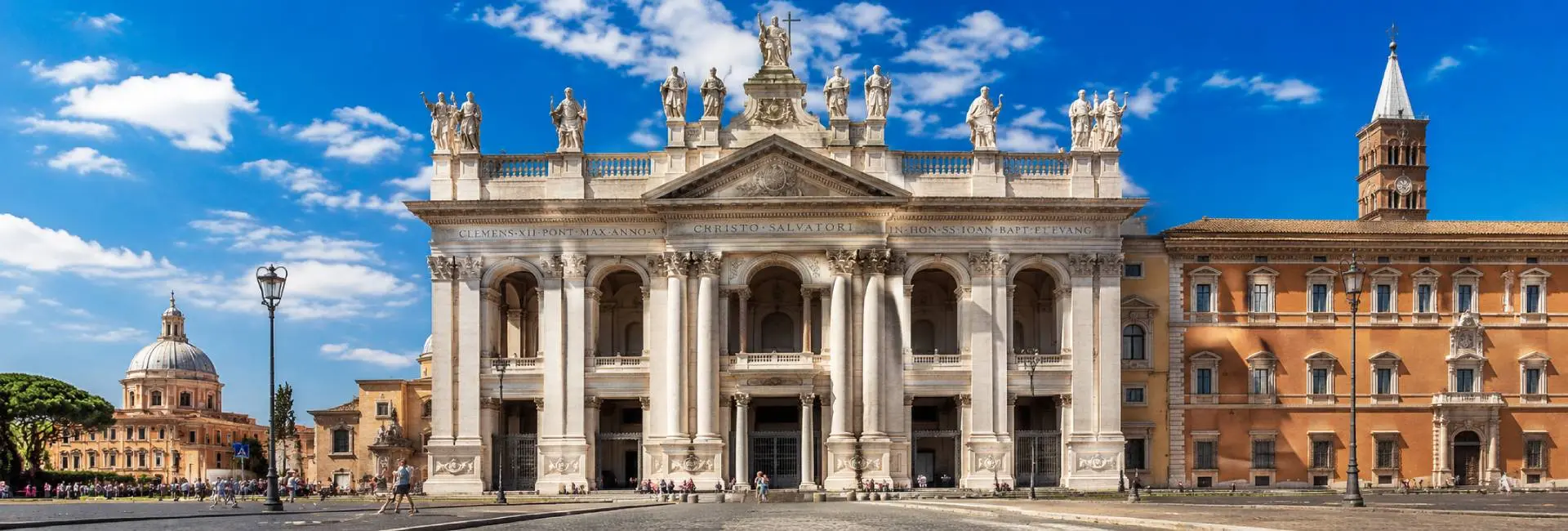
Major renewal came in the late 16th century under Pope Sixtus V, who rebuilt the Lateran Palace and had the ancient Egyptian obelisk in the piazza re-erected in 1588. In the 17th century, architect Francesco Borromini reshaped the basilica's interior for Pope Innocent X, and the iconic Baroque façade seen today was completed in 1735 by Alessandro Galilei, the winner of a competition held under Pope Clement XII.
Recognition & Status
- Serves as the cathedral of the Diocese of Rome and the official ecclesiastical seat of the Pope.
- Holds the unique title of "archbasilica," ranking above all other churches in the Catholic world, including St. Peter's Basilica.
- Granted extraterritorial status under the Lateran Treaty of 1929, giving it a special legal relationship with the Italian state.
- Inscribed as part of the UNESCO World Heritage Site "Historic Centre of Rome, the Properties of the Holy See in that City Enjoying Extraterritorial Rights and San Paolo Fuori le Mura" since 1980.
- Hosted five ecumenical Church councils over its history, including the influential Fourth Lateran Council of 1215.
Architecture & Façade
The Baroque and Neoclassical façade, completed in 1735, is topped by fifteen colossal travertine statues, including a central figure of Christ the Redeemer flanked by John the Baptist, John the Evangelist, and Doctors of the Church. Its design was deliberately conceived to echo the grandeur of St. Peter's Basilica across the city.
Inside, the nave is lined with twelve monumental statues of the apostles, each holding the symbol of their martyrdom. Commissioned in the early 18th century, the statues were paid for individually by different European princes, with the pope himself funding the statue of St. Peter, resulting in a kind of friendly competition among the era's leading sculptors.
The basilica measures roughly 140 meters long and 73 meters wide, and its interior still incorporates ancient columns and structural elements from the original Constantinian church beneath Borromini's 17th-century remodeling.
Key Areas of the Complex
The Cloister
Tucked beside the basilica, the 13th-century cloister is one of Rome's finest surviving examples of Cosmatesque craftsmanship. Its pairs of twisted, inlaid marble columns were created by the Vassalletto workshop and enclose a quiet garden that feels far removed from the busy piazza outside.
The Lateran Baptistery
Standing separately from the main church, the octagonal Lateran Baptistery was founded in the 5th century under Pope Sixtus III and is among the oldest baptisteries in Christendom. Its interior preserves early Christian and later decorative mosaics.
Scala Sancta and Sancta Sanctorum
Across the square from the basilica stand the Scala Sancta, or Holy Stairs, a flight of 28 marble steps venerated by tradition as the steps Christ climbed during his trial before Pontius Pilate. Pilgrims commonly ascend them on their knees. At the top sits the Sancta Sanctorum, the popes' former private chapel and one of the most sacred rooms in the Lateran complex.
The Piazza and Obelisk
The square in front of the basilica holds the Lateran Obelisk, an ancient Egyptian granite obelisk and the tallest surviving obelisk in Rome, re-erected on the site in 1588.
Notable Landmarks & Artworks
- The bronze central doors, originally taken from the ancient Roman Senate building (the Curia) in the Forum and installed in the basilica in the 17th century.
- The Gothic papal altar and ciborium, believed by tradition to house relics associated with Saints Peter and Paul, and used only by the Pope.
- The apse mosaic, a late-19th-century reconstruction of the medieval original by Jacopo Torriti and Jacopo da Camerino, depicting Christ, the dove of the Holy Spirit, and attendant saints.
- A fragment of a fresco attributed to Giotto, depicting Pope Boniface VIII proclaiming the Jubilee of 1300, found along the nave.
- Six papal tombs housed within the basilica, including those of Innocent III and Martin V.
Cultural & Religious Significance
As the cathedral of Rome, the basilica carries a rank in Catholic tradition even above St. Peter's, since it is tied specifically to the Pope's role as Bishop of Rome rather than to the Vatican. This is reflected in its full title, which describes it as "Mother and Head of All Churches in Rome and in the World."
The Scala Sancta remains one of the most visited pilgrimage sites within the complex, drawing the faithful who climb the steps as an act of devotion tied to the Passion of Christ. The basilica's dedication is commemorated annually on November 9th, a feast celebrated across the global Catholic Church.
Ways to Experience It
- Self-guided visit: Free entry to the main basilica lets visitors explore the nave, apostle statues, and papal altar at their own pace.
- Combined ticket: An all-inclusive pass covers the cloister, baptistery, Museum of the Lateran Treasury, and the Scala Sancta with Sancta Sanctorum, often bundled with a two-hour audio guide.
- Guided tours: Local guides and audio-guide rentals are available on-site for those who want deeper historical context on the artworks and architecture.
- Pilgrimage visit: Many visitors climb the Scala Sancta on their knees as a traditional act of devotion, a experience distinct from a standard sightseeing visit.
Best Time to Visit
Spring (April–May) and fall (September–October) offer mild weather and are generally considered the most pleasant times to explore both the basilica and its outdoor areas, such as the piazza and obelisk.
Arriving early in the morning or later in the afternoon helps avoid the heavier crowds that build up around midday, especially since the basilica sits along a popular pilgrimage and tour route.
Visitor Tips
- Dress modestly: shoulders and knees must be covered for entry, and hats should be removed.
- Entry to the main basilica is free; only the cloister, treasury museum, and Scala Sancta/Sancta Sanctorum carry separate small fees.
- The nearest metro stop is San Giovanni on Line A, an easy walk to the piazza.
- Ramps are available at the entrances for wheelchair access.
- Check official hours before visiting, since the basilica, cloister, and baptistery each keep slightly different opening times.
Nearby Attractions
The Lateran complex sits within easy reach of several other major Roman sites. The Colosseum and the Basilica of San Clemente are a short trip away, while the Baths of Caracalla and the Arch of Constantine can also be combined into the same day of sightseeing in the southeastern part of the historic center.
FAQs about Archbasilica of Saint John Lateran
What is the Archbasilica of St. John Lateran? +
It is Rome's official cathedral and the seat of the Pope as Bishop of Rome, making it the highest-ranking church in the Catholic world, even above St. Peter's Basilica.
Is it more important than St. Peter's Basilica? +
In ecclesiastical rank, yes - St. John Lateran is Rome's cathedral, while St. Peter's is the principal church of the Vatican; the Lateran's role as the Pope's own cathedral gives it precedence.
Is entry free? +
Entry to the main basilica is free. Small fees apply only for the cloister, the Museum of the Lateran Treasury, and the Scala Sancta with the Sancta Sanctorum.
How much time should I plan for a visit? +
Around 45 minutes to an hour covers the basilica itself; visitors who also want to see the cloister, baptistery, and Scala Sancta should allow closer to two hours.
When is the best time to visit? +
Spring and fall bring the most comfortable weather, and early morning or late afternoon visits generally mean smaller crowds.
What are the Scala Sancta and Sancta Sanctorum? +
The Scala Sancta are 28 marble steps traditionally believed to be from Pontius Pilate's praetorium in Jerusalem, often climbed on the knees as an act of devotion; the Sancta Sanctorum at the top was the popes' private chapel and holds important relics.
How do I get there? +
The San Giovanni stop on Metro Line A is the most direct option, with several bus lines also stopping near the piazza.
Is it suitable for visitors with mobility needs or children? +
Ramps are available at the main entrances for wheelchair access, and the open piazza and spacious nave make it manageable for families, though the Scala Sancta pilgrimage is a more demanding, optional experience.
What's nearby to combine with a visit? +
The Colosseum, Basilica of San Clemente, Baths of Caracalla, and Arch of Constantine are all within easy reach for the same day.
What's a common mistake visitors make? +
Arriving without shoulders or knees covered is the most common issue, since the dress code is strictly enforced and can mean being turned away at the door.